









Was this page helpful?

| Opening hours: |
|
||
|---|---|---|---|
| Public website: | www.neuschwanstein.de |
| Power Grid: |
230 V, 50 Hz Plug: Type C , Type F
Type C:
  Read about power adapters |
|---|---|
| Currency: |
Euro (EUR) £1 ≈ €1.19 |
| Cashless info: |
Rating 4/5
Cards are widely accepted, especially in urban areas, but small establishments may prefer cash. Be prepared for occasional cash-only situations.
Save with a travel credit card |
| eSIM providers: |
Best value: Saily Flexibility: Airalo Read our in-depth comparison |
| Tipping: | Tipping is common in restaurants, typically 5-10%. For taxis, it is customary to round up to the nearest euro. Tipping in cash is more common than adding it to card payments. |
|---|---|
| Public drinking: | Public drinking is allowed in most parts of Germany, especially in beer gardens and public events, but some local regulations may restrict it in specific areas. |
| Public smoking: | Smoking is prohibited indoors in public places such as restaurants, trains, and buses. Designated smoking areas are available outside many buildings. |
| Oktoberfest (September) |
Huge crowds in Munich. Expect high hotel rates and crowded transport. |
|---|---|
| Christmas (December) |
Christmas markets are popular, expect crowded cities and higher prices. |
| Labour Day (May) |
Many shops are closed, and there are celebrations throughout the country. |
| Emergency contact: | Police: 110, Emergency Number: 112 (Fire, Ambulance) |
|---|---|
| Taxi apps: | Uber, Free Now, myTaxi |
| Other: | Germany is well-equipped for tourists, with good public transport and high-quality facilities. However, be prepared for language barriers in some rural areas. |
The best times to travel section shows how the months compare for a visit, so you can find the time of year that fits what you want to do.
Background colours of the months:
The colour shows the typical temperature: yellow (hot), green (mild) and blue (cold). How strong the colour is shows the travel season: full colour means high season, soft colour means shoulder season and soft-striped means off season.
Weather symbols:
Each month has one symbol showing what the weather is typically like, such as hot and sunny, freezing or a rainy or snowy season. Use them to quickly spot months that match the weather you want, or to avoid the ones that don't.
Crowdedness:
The people icon shows how busy the place usually is. The more people, the more crowded it gets.
Additional notes:
The grey info boxes point out special things worth knowing, like recurring weather issues or seasonal events.
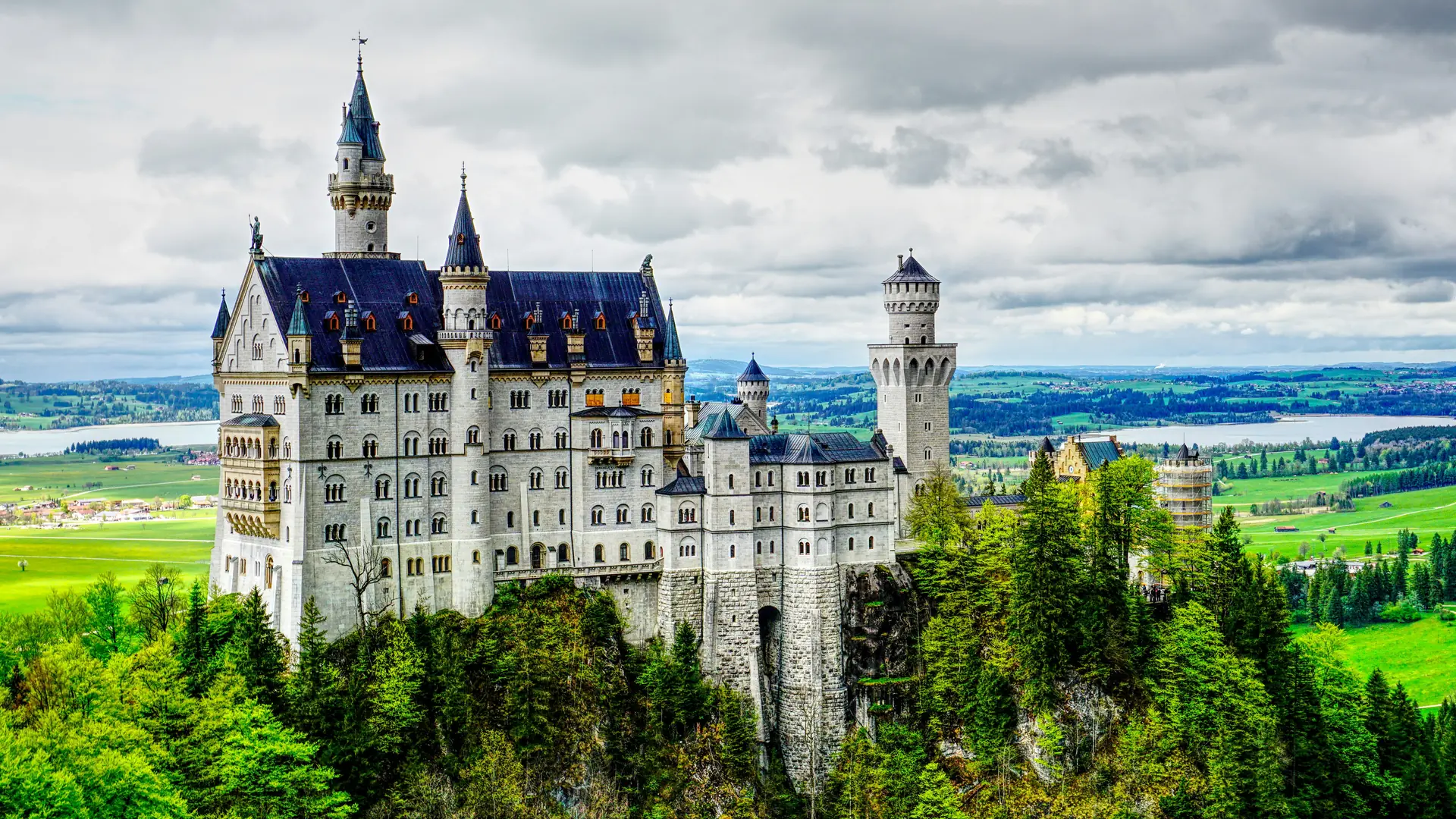
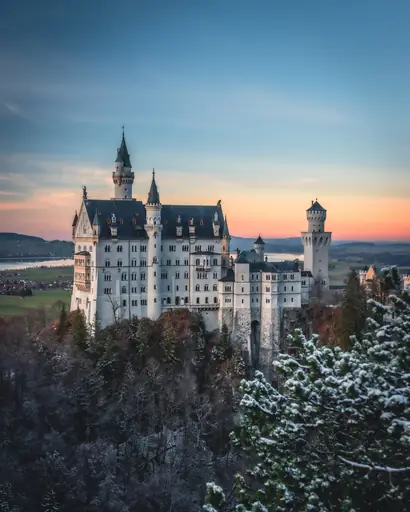
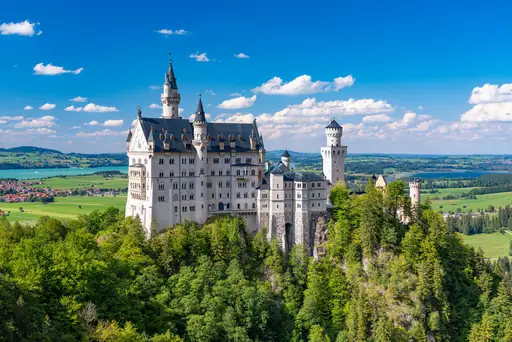
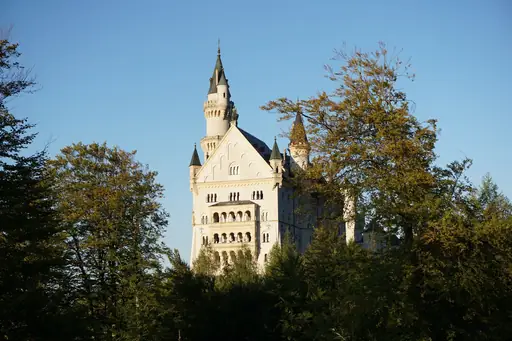
Neuschwanstein Castle was the project of Ludwig II (1845 to 1886), the king of Bavaria, who began construction in 1868. It was never finished. The king had it designed in medieval styles but fitted with the technology of its day. It's often called the most famous historicist building in the world. Ludwig died in 1886 and the castle opened to visitors soon after.
The guided tour covers the finished rooms, among them the Throne Hall, the Singers' Hall and the king's bedroom. Murals in many rooms show scenes from medieval legends and from Richard Wagner's operas, which Ludwig admired. The rooms also had modern fittings for the time, such as running water and a hot-air heating system.
Many visitors walk to the Marienbrücke, a bridge over the Pöllat gorge near the castle, for the view of the castle from the side. The shuttle bus stops there and the bridge is usually crowded. The official site advises checking each day which viewpoints are open, since closures can happen with weather or maintenance work.
Rooms can only be seen on a guided tour with limited capacity. The tour lasts about 30 minutes. Your ticket shows a tour number, so be in the castle courtyard on time to find your group on the monitor by the turnstiles. The tour includes about 350 steps, with a lift for visitors with reduced mobility. The castle is open daily from 09:00 – 18:00 from late March to mid-October and 10:00 – 16:00 the rest of the year. It's closed on Christmas Eve, Christmas Day, New Year's Eve and New Year's Day. Allow extra time before your tour, because the walk up and the wait for the shuttle bus can be long in peak season.
The usual route is by train to Füssen and then a bus to Hohenschwangau, the village below the castle. Regional trains run from Munich Central Station to Füssen. From there bus 73 or 78 takes about 15 minutes to the Hohenschwangau/castles stop. Füssen station is about 5 km from the village. By car, the A7 exit at Füssen is about 7 km away and Munich Airport (MUC) is about 155 km from Hohenschwangau. Private cars can't drive up to the castle, so you park in the paid car parks P1 to P4 in the valley. From the Ticket Centre the walk to the castle takes about 40 minutes uphill. A shuttle bus from the P4 car park takes about 15 minutes and costs €3.50 (£2.95) each way or €5 (£4.21) return. It stops at the Marienbrücke, which leaves a steep walk of about 15 minutes down to the entrance. Horse carriages cost €8 (£6.74) uphill and take about 20 minutes. They stop below the castle and leave about 15 minutes of uphill walking.
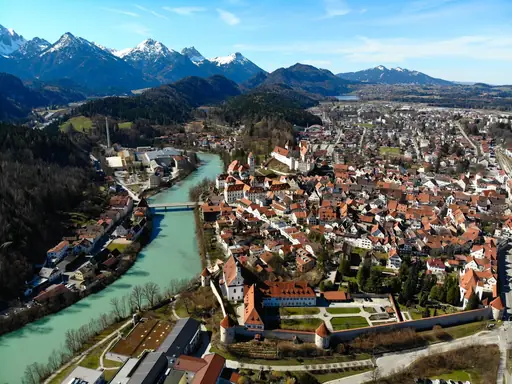
The closest places to stay are Hohenschwangau (the village at the foot of the castle) and neighbouring Schwangau, which have hotels, guesthouses and holiday apartments. Füssen is a small town about 5 km away with a medieval old town and a train station. It usually has more choice at lower prices than the villages next to the castle. Without a car, both Hohenschwangau and Füssen work well, since buses 73 and 78 link Füssen station with the castles stop. Munich is a long day trip away, but staying nearby lets you be at the Ticket Centre when it opens at 08:00 and skip an early train. Rooms in Hohenschwangau fill up in summer, so book ahead for those months.
Food at Neuschwanstein Castle is limited. A café and bistro on the castle's second floor are open for refreshments after the guided tour, on the same floor as a free multivision show about King Ludwig II and his castles. The Schlossrestaurant Neuschwanstein is just outside the castle gates.
Hohenschwangau village below the castle has more restaurants and inns, so a full meal is easiest to find there before or after the climb. Menus in the village lean towards Bavarian and Allgäu cooking such as Käsespätzle, egg noodles with melted cheese and fried onions or roast pork with dumplings. Large bags aren't allowed inside the castle, so eat and drink before you go up if you're carrying a bulky pack.
Log in to add this place to a travel list and get a summary of all recommended items for your whole trip.
We calculate the average costs when travelling to destinations and compare those with the living costs at your home. With this you can get an estimate of how expensive or cheap the destination is for you.
To customise this, you can set up which location and price level are used for the calculations in your account settings.
The exchange rate price factor shows how expensive or cheap a currency currently is compared to its historical average. It's a quick way to see if a country is currently more or less affordable due to exchange rate changes.
