








Was this page helpful?

| Power Grid: |
230 V, 50 Hz Plug: Type C , Type F
Type C:
  Read about power adapters |
|---|---|
| Currency: |
Euro (EUR) £1 ≈ €1.19 |
| Cashless info: |
Rating 5/5
Cashless payment is widely accepted in Spain, particularly in urban areas and tourist destinations. Credit and debit cards are commonly used, and mobile payment options are available in many establishments.
Save with a travel credit card |
| eSIM providers: |
Best value: Saily Flexibility: Airalo Read our in-depth comparison |
| Tipping: | Tipping is not mandatory in Spain but appreciated for good service. In restaurants, rounding up the bill or leaving 5-10% is customary. Taxi drivers and hotel staff may also be tipped, though it is less common. |
|---|---|
| Public drinking: | Public drinking is restricted in some regions, particularly in tourist-heavy cities. Local laws may vary. |
| Public smoking: | Smoking is banned indoors in public places but allowed in designated outdoor areas. |
| La Tomatina (August) |
A famous tomato-throwing festival, expect large crowds in Buñol. |
|---|---|
| Semana Santa (March/April) |
Religious parades and events make this a busy time in major cities. |
| Christmas (December) |
Markets and festive celebrations, with tourist areas becoming busier. |
| Emergency contact: | Emergency Number: 112 (Police, Fire, Ambulance) |
|---|---|
| Taxi apps: | Cabify, Bolt, Uber |
| Other: | Spain is known for its diverse culture, stunning architecture, and vibrant festivals. Public transport is reliable and efficient, making it easy to explore. |
The best times to travel section shows how the months compare for a visit, so you can find the time of year that fits what you want to do.
Background colours of the months:
The colour shows the typical temperature: yellow (hot), green (mild) and blue (cold). How strong the colour is shows the travel season: full colour means high season, soft colour means shoulder season and soft-striped means off season.
Weather symbols:
Each month has one symbol showing what the weather is typically like, such as hot and sunny, freezing or a rainy or snowy season. Use them to quickly spot months that match the weather you want, or to avoid the ones that don't.
Crowdedness:
The people icon shows how busy the place usually is. The more people, the more crowded it gets.
Additional notes:
The grey info boxes point out special things worth knowing, like recurring weather issues or seasonal events.
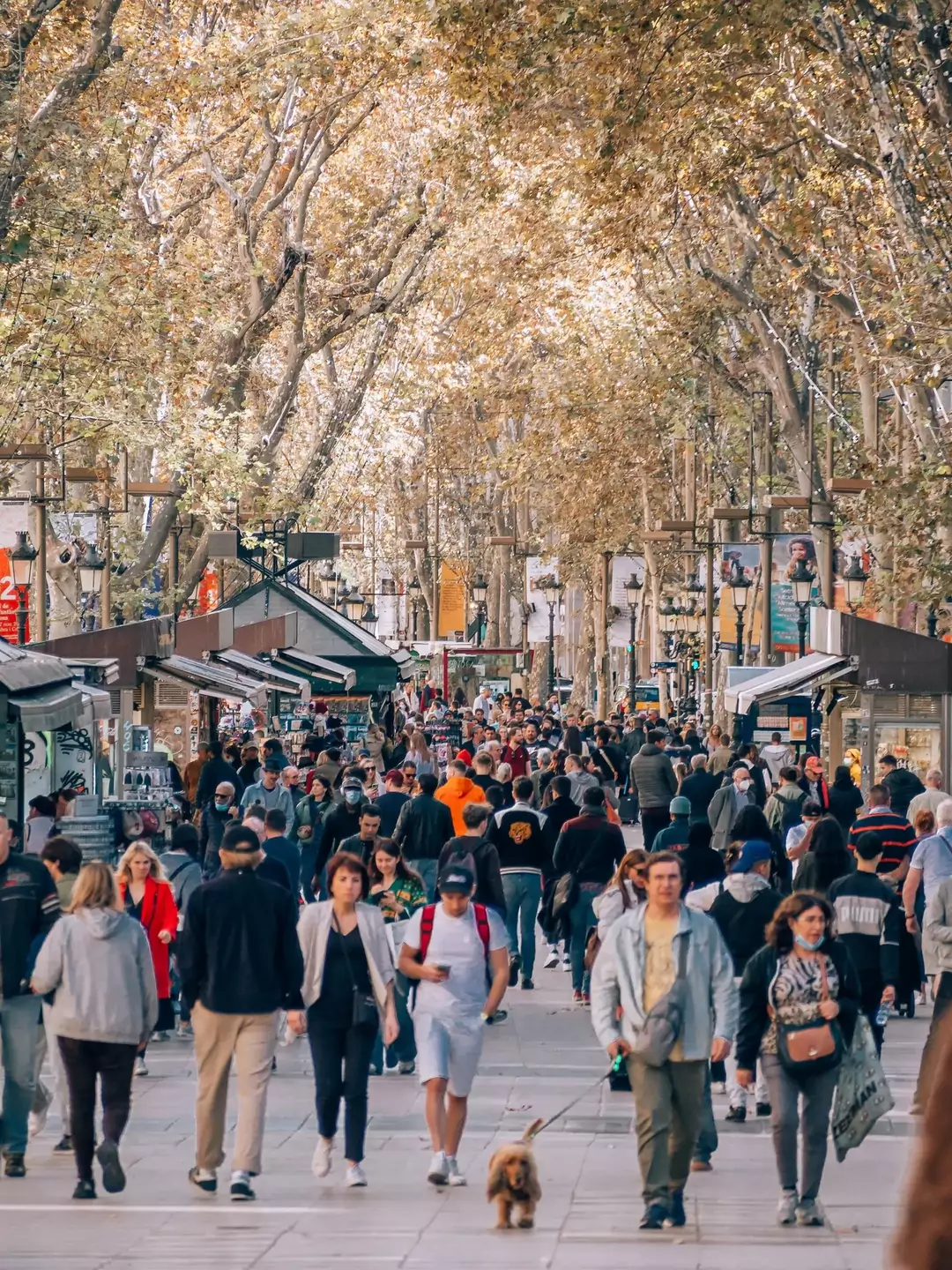
La Rambla stretches from Plaça de Catalunya to the Christopher Columbus Monument at Port Vell, serving as a lively artery filled with street artists, flower stalls and bustling markets. Its historic roots as a dry riverbed turned promenade have made it a rich tapestry of Barcelona's social and cultural evolution.
The boulevard is home to stunning landmarks such as the Boqueria Market, a paradise for food lovers and the Gran Teatre del Liceu opera house. Nearby, you can enjoy quiet moments in the adjacent Parc de la Ciutadella or explore the maritime views at the harbor.
However, as a major tourist hotspot, La Rambla can become extremely crowded, especially during peak seasons and festivals. Visitors should stay alert to pickpockets and be cautious of inflated prices in nearby eateries and shops. Despite this, its vibrant atmosphere remains one of Barcelona's most iconic experiences.
Whether seeking cultural sights, relaxation or people-watching, La Rambla offers a dynamic, if sometimes bustling, portrait of life in Barcelona.
La Rambla is centrally located in Barcelona and easily accessible by metro (lines L3 and L1), buses and trams. Visitors arriving via Barcelona‑El Prat Airport can use airport shuttles, taxis or public transport to reach the city center, followed by a short walk to La Rambla.
Barcelona offers a wide range of accommodations around La Rambla, from luxury hotels in the Gothic Quarter to budget hostels, enabling easy access to the city's main attractions.
Log in to add this place to a travel list and get a summary of all recommended items for your whole trip.
We calculate the average costs when travelling to destinations and compare those with the living costs at your home. With this you can get an estimate of how expensive or cheap the destination is for you.
To customise this, you can set up which location and price level are used for the calculations in your account settings.
The exchange rate price factor shows how expensive or cheap a currency currently is compared to its historical average. It's a quick way to see if a country is currently more or less affordable due to exchange rate changes.
