






Was this page helpful?

| Opening hours: |
|
||
|---|---|---|---|
| Public website: | www.ryoanji.jp |
| Power Grid: |
100 V, 50 Hz Plug: Type A
Type A:
 Read about power adapters |
|---|---|
| Currency: |
Japanese Yen (JPY) £1 ≈ JP¥210 |
| Cashless info: |
Rating 4/5
Cashless payments are becoming more common, especially in cities, with some shops still preferring cash. Be prepared for occasional cash-only situations in rural areas.
Save with a travel credit card |
| eSIM providers: |
Best value: Saily Flexibility: Airalo Read our in-depth comparison |
| Tipping: | Tipping is not customary in Japan and can be considered rude. Excellent service is the norm, and tipping is unnecessary in most places. |
|---|---|
| Public drinking: | Public drinking is legal and commonly accepted, particularly during festivals and events. |
| Public smoking: | Smoking is prohibited in indoor public places but allowed in designated outdoor areas. Some restaurants may have smoking sections. |
| New Year (January) |
One of the most important holidays, expect crowded temples and high prices. Plan ahead. |
|---|---|
| Golden Week (April-May) |
The busiest travel time, expect high demand for accommodation and transport. |
| Obon (August) |
A time to honour ancestors, many businesses close, and transport can be crowded. |
| Emergency contact: | Emergency Number: 110 (Police), 119 (Fire & Ambulance) |
|---|---|
| Taxi apps: | Uber, JapanTaxi, DiDi |
| Other: | Japan is a country of respect, so understanding local customs and etiquette is important. Public transport is efficient, but can be crowded during peak hours. |
The best times to travel section shows how the months compare for a visit, so you can find the time of year that fits what you want to do.
Background colours of the months:
The colour shows the typical temperature: yellow (hot), green (mild) and blue (cold). How strong the colour is shows the travel season: full colour means high season, soft colour means shoulder season and soft-striped means off season.
Weather symbols:
Each month has one symbol showing what the weather is typically like, such as hot and sunny, freezing or a rainy or snowy season. Use them to quickly spot months that match the weather you want, or to avoid the ones that don't.
Crowdedness:
The people icon shows how busy the place usually is. The more people, the more crowded it gets.
Additional notes:
The grey info boxes point out special things worth knowing, like recurring weather issues or seasonal events.
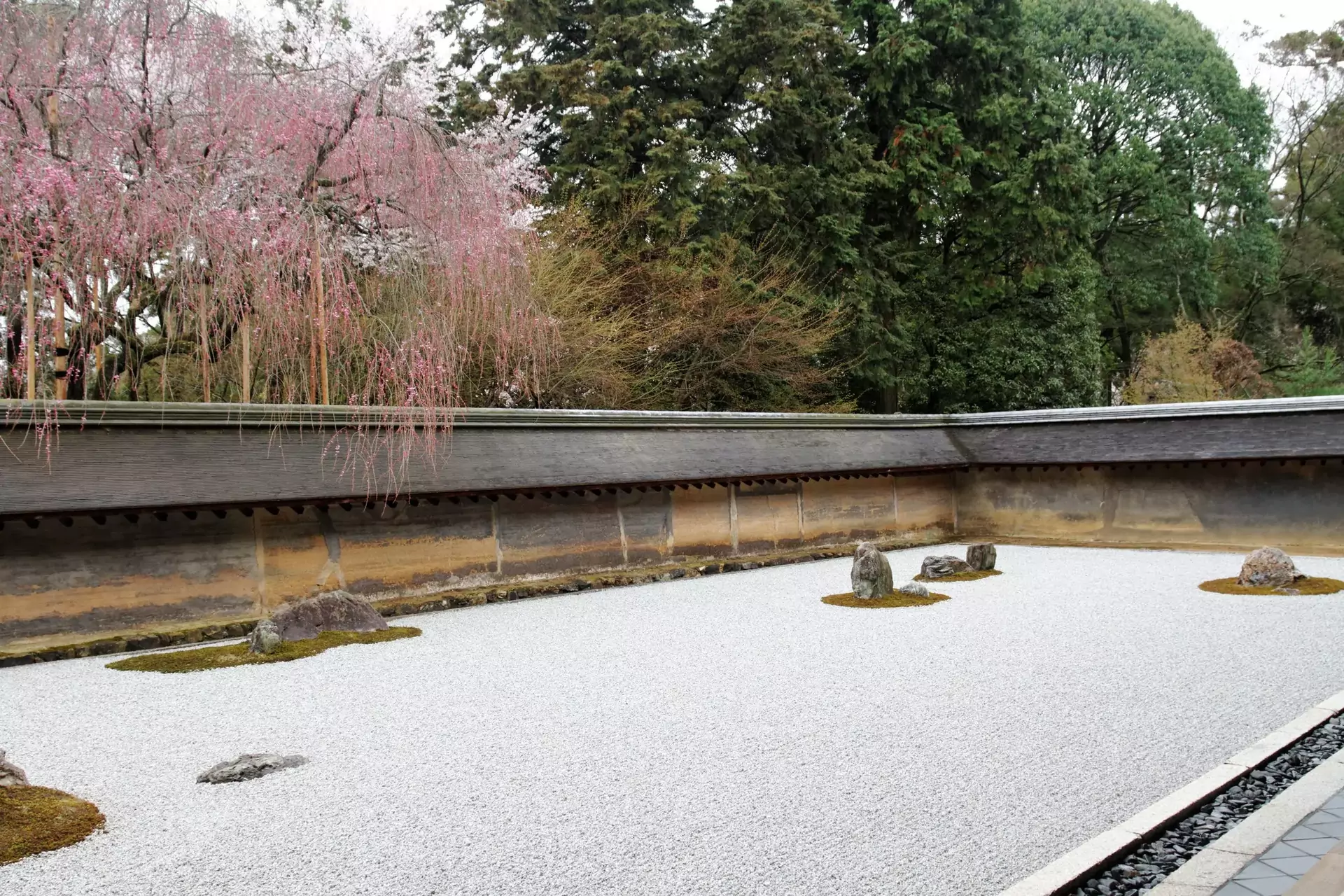
Ryoan-ji is famous for its dry rock garden, a rectangle of raked white gravel with fifteen stones arranged in small groups. The garden covers about 250 m² and has no trees or water. The stones are placed so that at least one stays hidden from any single spot, which many people link to the idea that you can never take in the whole from one viewpoint. No one is sure who made it. Its meaning has been debated for centuries. Some read the gravel as a sea with islands, others as a tiger carrying her cubs across a river.
The site began as a villa of the Tokudaiji family. In 1450 Hosokawa Katsumoto, a deputy of the shogun, gave it to the priest Giten Genso, who turned it into a Zen temple. Today it belongs to the Rinzai school and is part of the UNESCO listing Historic Monuments of Ancient Kyoto. Visitors enter through the main buildings and can sit on the wooden veranda facing the garden. The veranda fills up quickly at peak hours.
Behind the abbot's quarters is a round stone water basin called a tsukubai, shaped like an old coin. Its four characters combine with the square hole in the centre to form a phrase about having just what you need. Beyond the main garden a path leads around a large pond and past a tea house, which makes a nice contrast with the stark rock garden. There's also a restaurant on the grounds serving Kyoto-style tofu.
Most visitors spend 45 minutes to an hour. Entry costs about JP¥600 (£2.84). Hours are usually 08:00 – 17:00 from March to November and a little shorter in winter. Going when the gates open or shortly before closing gives the best chance of a quiet seat on the veranda. Cherry blossoms and autumn leaves bring crowds. Shoes come off at the entrance, so wear socks you don't mind showing.
Buses and the Keifuku tram are the usual ways to reach Ryoan-ji. Kyoto City Bus 59 runs from Sanjo Keihan Station and stops at Ryoan-ji-mae, directly in front of the temple. Several other city buses serve the area, so check the route from your hotel. The Keifuku Kitano Line, known as the Randen, stops at Ryoan-ji Station. From there it's a walk of about 10 minutes north to the gate. The tram links with Arashiyama and with the Kitano area, which makes it a handy way to combine sights. From Kyoto Station a bus or a taxi is the easiest way, taking around 30 to 40 minutes depending on traffic. Kansai Airport (KIX) is reached by JR Haruka express to Kyoto Station in about 80 minutes, then by bus or taxi. By car, parking is limited, so public transport is easier.
Ryoan-ji is in a quiet residential part of northwest Kyoto with few hotels nearby, so most visitors stay elsewhere and come for the morning. Kyoto Station has the widest range of hotels and the best rail links, while Shijo and Kawaramachi are close to restaurants and shopping. Arashiyama and the Kitano area have a smaller choice of guesthouses and ryokan, but both are linked to the temple by the Randen tram. If you want to arrive when the gates open, a hotel in the Kinkaku-ji or Kitano area shortens the trip. Rooms across Kyoto fill up during cherry blossom season in late March and early April and during autumn leaves in November, so book early at those times.


Food at Ryoan-ji is simple and tied to the temple. A restaurant on the grounds serves Kyoto-style tofu, including yudofu, tofu simmered in hot broth, which suits the Zen setting. It can fill up at midday in busy seasons.
The streets around the temple are residential, with a few cafes and small restaurants and fewer choices than in central Kyoto. Many visitors eat in the Kitano area or go back toward the Kawaramachi district and Kyoto Station, where food options are far wider.
Tofu-based dishes suit vegetarians. Fish stock is common in Kyoto cooking, so ask when you order. Convenience stores near the tram station sell drinks and snacks.
Log in to add this place to a travel list and get a summary of all recommended items for your whole trip.
We calculate the average costs when travelling to destinations and compare those with the living costs at your home. With this you can get an estimate of how expensive or cheap the destination is for you.
To customise this, you can set up which location and price level are used for the calculations in your account settings.
The exchange rate price factor shows how expensive or cheap a currency currently is compared to its historical average. It's a quick way to see if a country is currently more or less affordable due to exchange rate changes.
