









Was this page helpful?

| Opening hours: |
|
||
|---|---|---|---|
| Public website: | www.shokoku-ji.jp |
| Power Grid: |
100 V, 50 Hz Plug: Type A
Type A:
 Read about power adapters |
|---|---|
| Currency: |
Japanese Yen (JPY) £1 ≈ JP¥210 |
| Cashless info: |
Rating 4/5
Cashless payments are becoming more common, especially in cities, with some shops still preferring cash. Be prepared for occasional cash-only situations in rural areas.
Save with a travel credit card |
| eSIM providers: |
Best value: Saily Flexibility: Airalo Read our in-depth comparison |
| Tipping: | Tipping is not customary in Japan and can be considered rude. Excellent service is the norm, and tipping is unnecessary in most places. |
|---|---|
| Public drinking: | Public drinking is legal and commonly accepted, particularly during festivals and events. |
| Public smoking: | Smoking is prohibited in indoor public places but allowed in designated outdoor areas. Some restaurants may have smoking sections. |
| New Year (January) |
One of the most important holidays, expect crowded temples and high prices. Plan ahead. |
|---|---|
| Golden Week (April-May) |
The busiest travel time, expect high demand for accommodation and transport. |
| Obon (August) |
A time to honour ancestors, many businesses close, and transport can be crowded. |
| Emergency contact: | Emergency Number: 110 (Police), 119 (Fire & Ambulance) |
|---|---|
| Taxi apps: | Uber, JapanTaxi, DiDi |
| Other: | Japan is a country of respect, so understanding local customs and etiquette is important. Public transport is efficient, but can be crowded during peak hours. |
The best times to travel section shows how the months compare for a visit, so you can find the time of year that fits what you want to do.
Background colours of the months:
The colour shows the typical temperature: yellow (hot), green (mild) and blue (cold). How strong the colour is shows the travel season: full colour means high season, soft colour means shoulder season and soft-striped means off season.
Weather symbols:
Each month has one symbol showing what the weather is typically like, such as hot and sunny, freezing or a rainy or snowy season. Use them to quickly spot months that match the weather you want, or to avoid the ones that don't.
Crowdedness:
The people icon shows how busy the place usually is. The more people, the more crowded it gets.
Additional notes:
The grey info boxes point out special things worth knowing, like recurring weather issues or seasonal events.
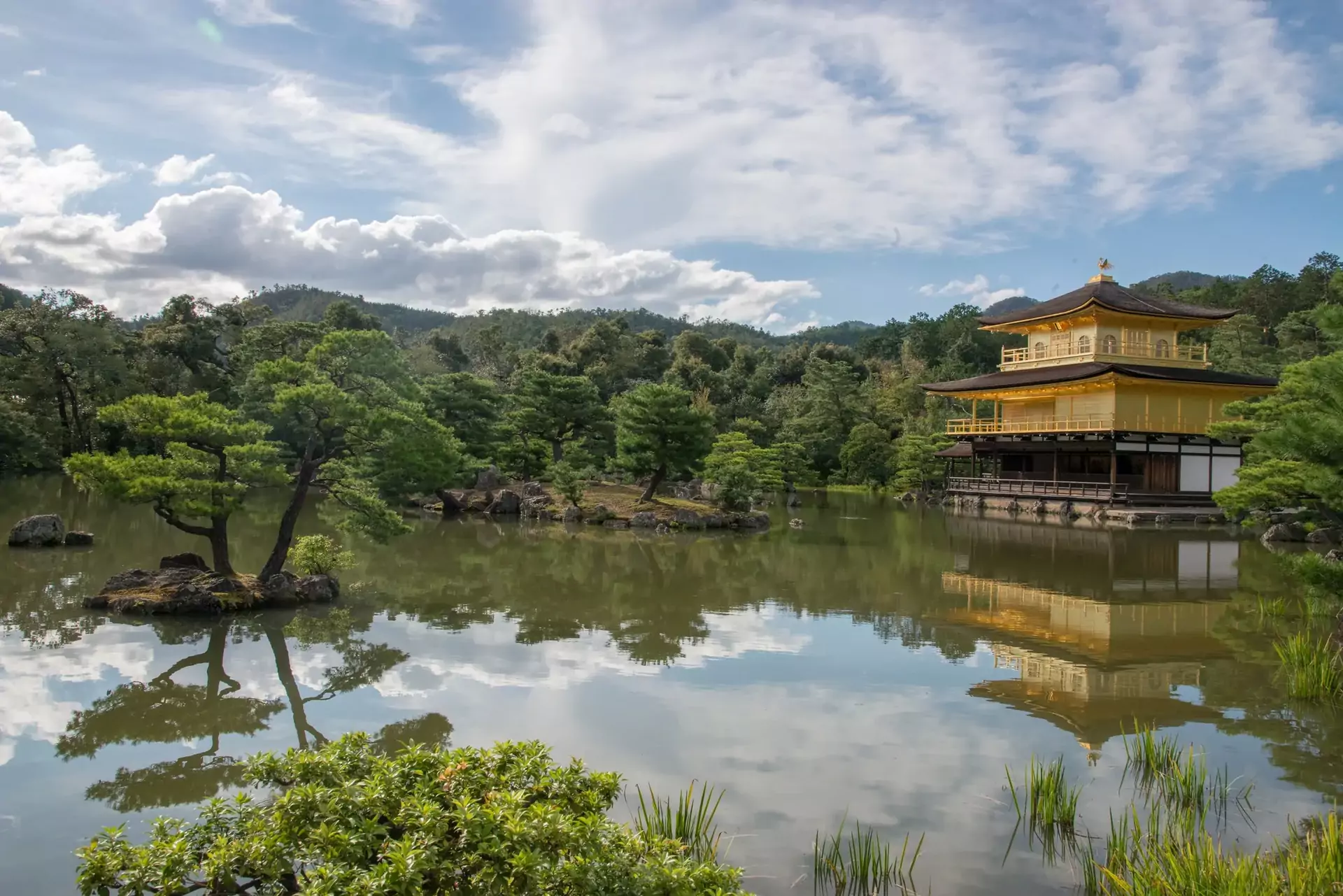
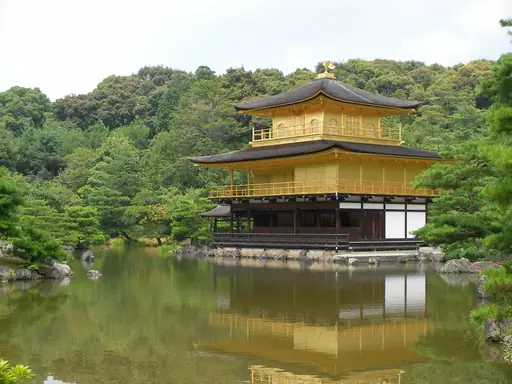
Kinkaku-ji is the popular name of Rokuon-ji, a Zen temple affiliated with Shokoku-ji. The land once held a villa of the Saionji clan. In 1397 the shogun Ashikaga Yoshimitsu acquired it and began building his Kitayama villa. After his death in 1408 it became a Zen temple as he had wished. The temple survived the Onin War and first opened to the public in 1894. The temple was listed by UNESCO in 1994 with other historic monuments of ancient Kyoto.
The Golden Pavilion has three storeys and each uses a different style. The first floor follows the shinden style of the Heian period, the second the warrior house style of the Kamakura period and the third a Chinese Zen style. Gold leaf covers the upper two floors and the roof has a phoenix figure. The second floor holds a shrine to Kannon. The original building burned down in 1950 and the pavilion you see now was rebuilt in 1955.
The pavilion is only one stop on a route through the grounds, which cover about 132,000 m². The route goes through the main gate and past the belfry, then along the Kyoko-chi Pond with its small islands. Beyond the pavilion it goes past the main hall, the Rikushu Pine and Ryumon Falls, a small waterfall topped by a carp-shaped stone. Further on are Anmin Pond and the Sekkatei tea house, a tea room built in the Edo period. The Fudo-do hall holds a stone Fudo statue hidden from view and shown only on Setsubun and 16 August.
The temple is open every day of the year from 09:00 – 17:00 with admission at JP¥500 (£2.37), though hours can change for special exhibitions. The route is one way and most people take about an hour. The pavilion looks different in each season. Snow in winter is especially photogenic and the best reflection comes when the pond is still. Arriving at opening or in the last hour usually means thinner crowds.
The easiest route from Kyoto Station is the Karasuma Line underground to Kitaoji Station, seven stops and about 15 minutes. The bus terminal is next to the station. Bus 204 or 205 leaves from the blue boarding area and reaches the Kinkakuji-michi stop in about 11 minutes. From there it's roughly a 5-minute walk to the entrance. Bus 205 also runs direct from Kyoto Station, but it makes many stops and the ride can take about 45 minutes in traffic. Starting at Shijo Kawaramachi take the Hankyu line one stop to Karasuma and change to the Karasuma Line underground, then follow the same route. City buses from Shijo are slow. On weekends and holidays bus 102 is another option while bus 109 runs in late April to early May and in the autumn peak. From Kansai Airport (KIX) the Haruka express reaches Kyoto Station in about 75 minutes and you continue by underground. The temple has a car park, but central Kyoto roads are often congested so public transport works better.
Most visitors stay in central Kyoto and reach the temple with one underground ride and a short bus trip. The Kyoto Station area has the widest choice of hotels and the easiest connections. Karasuma Oike and Kawaramachi are closer to restaurants and shops and the Karasuma Line links them to Kitaoji Station. Staying in the north of the city puts you near Kinkaku-ji and other temples in the Kinugasa area. Choices in that area are fewer, mostly small guesthouses and business hotels with quieter evenings. Being close lets you arrive at 09:00 when the grounds are calmest and the light is soft. Rooms across Kyoto fill quickly during cherry blossom season and the autumn foliage, so it helps to book early for those weeks.
Food at the temple itself is limited, so most visitors eat before or after the visit. You'll find a few shops and snack stands around the entrance area, but nothing that replaces a proper meal.
For a full meal, central Kyoto has a wide range of options. Tofu dishes, seasonal vegetables, noodles and set meals are common while tea houses serve matcha with Japanese sweets. The streets around Kitaoji Station have casual restaurants and cafes and Kyoto Station has many more. Weekend lunchtimes are busy, so an early or late meal helps avoid waits. The visit takes about an hour, so it fits well before a meal.
Log in to add this place to a travel list and get a summary of all recommended items for your whole trip.
We calculate the average costs when travelling to destinations and compare those with the living costs at your home. With this you can get an estimate of how expensive or cheap the destination is for you.
To customise this, you can set up which location and price level are used for the calculations in your account settings.
The exchange rate price factor shows how expensive or cheap a currency currently is compared to its historical average. It's a quick way to see if a country is currently more or less affordable due to exchange rate changes.
