






Was this page helpful?

| Opening hours: |
|
||||
|---|---|---|---|---|---|
| Public website: | asi.nic.in |
| Power Grid: |
230 V, 50 Hz Plug: Type C , Type D , Type M
Type C:
   Read about power adapters |
|---|---|
| Currency: |
Indian Rupee (INR) £1 ≈ ₹126.52 |
| Cashless info: |
Rating 4/5
Cashless payments are becoming more common in India, especially in urban areas. Credit cards and mobile payment apps like Google Pay, Paytm, and PhonePe are widely accepted in cities.
Save with a travel credit card |
| eSIM providers: |
Best value: Saily Flexibility: Airalo Read our in-depth comparison |
| Tipping: | Tipping is appreciated in India but not mandatory. A 10% tip in restaurants is common. Tipping taxi drivers and hotel staff is also customary, typically 10-15% for good service. |
|---|---|
| Public drinking: | Public drinking is not commonly seen in India. Alcohol is typically consumed in licensed bars, restaurants, and hotels. |
| Public smoking: | Smoking is prohibited in many indoor public spaces, including restaurants, bars, and public transport stations. |
| Independence Day (15 August) |
A national holiday celebrated with flag hoisting and parades |
|---|---|
| Diwali (October-November) |
The Festival of Lights, celebrated with fireworks and festivities |
| Emergency contact: | Emergency Number: 112 |
|---|---|
| Taxi apps: | Ola, Uber |
| Other: | India is a vast and diverse country with a rich cultural heritage, offering a wide range of experiences from ancient temples to modern cities. Prepare for varying infrastructure and safety conditions depending on the region. |
The best times to travel section shows how the months compare for a visit, so you can find the time of year that fits what you want to do.
Background colours of the months:
The colour shows the typical temperature: yellow (hot), green (mild) and blue (cold). How strong the colour is shows the travel season: full colour means high season, soft colour means shoulder season and soft-striped means off season.
Weather symbols:
Each month has one symbol showing what the weather is typically like, such as hot and sunny, freezing or a rainy or snowy season. Use them to quickly spot months that match the weather you want, or to avoid the ones that don't.
Crowdedness:
The people icon shows how busy the place usually is. The more people, the more crowded it gets.
Additional notes:
The grey info boxes point out special things worth knowing, like recurring weather issues or seasonal events.
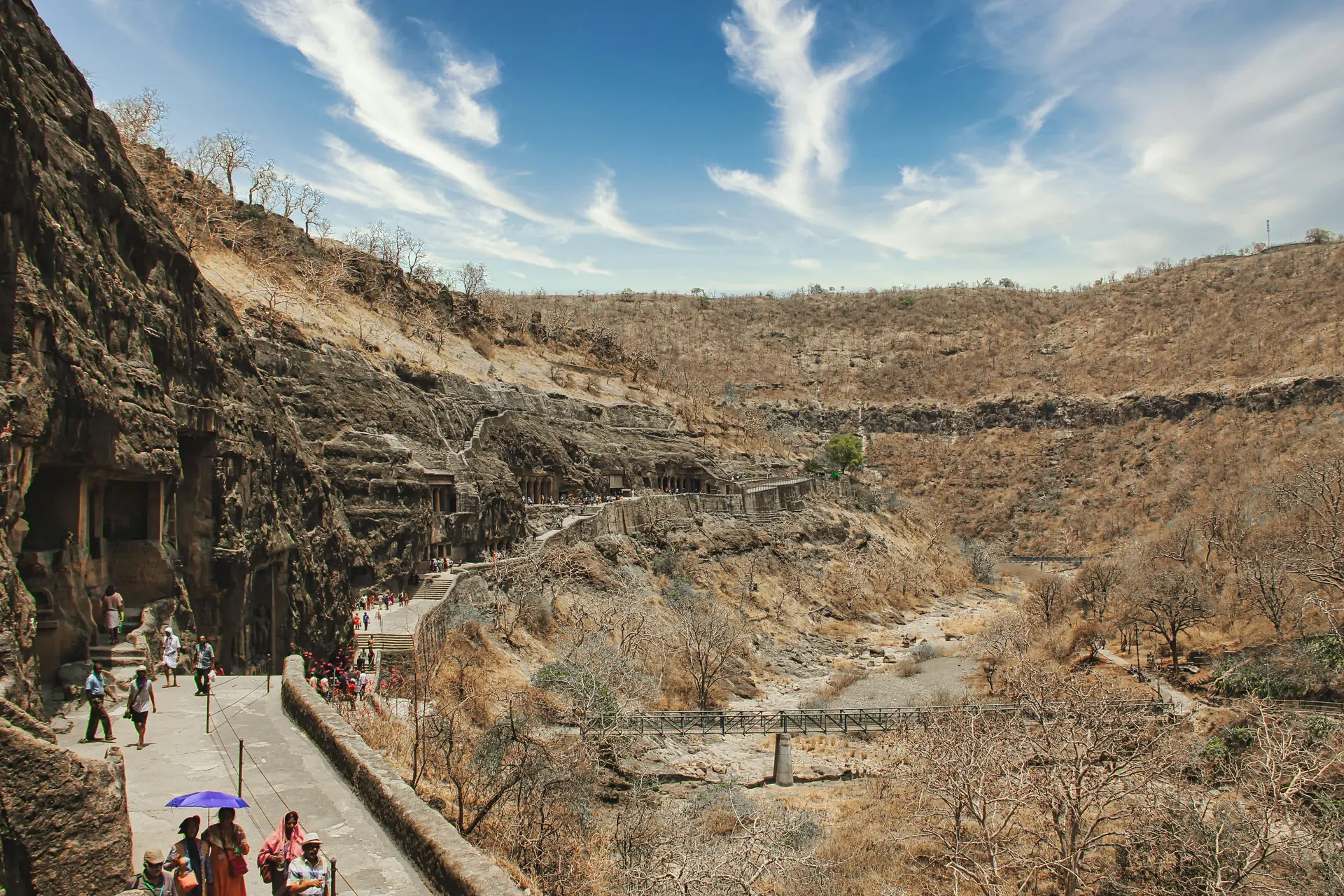
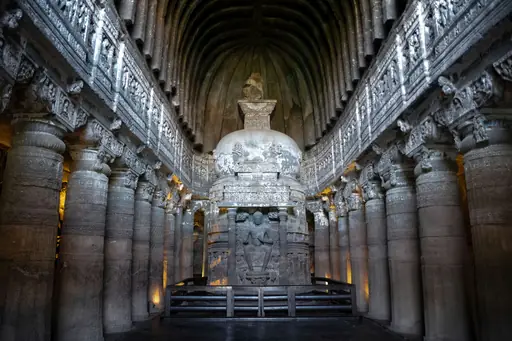
Located in Ajanta of India’s Maharashtra state, these caves are a collection of ancient Buddhist rock-cut temples and monasteries. Carved into a winding cliffside along the Waghora River they date back to the 2nd century BCE through the 6th century CE. The site showcases intricate sculptures and murals that tell stories from Buddhist mythology. Visitors encounter detailed carvings of Buddha figures and scenes depicting daily life in ancient India.
The caves are organized into two main phases of construction. Early structures focus on simple monastic cells while later additions feature grand halls with elaborate ceiling designs. Each cave contains unique artworks including paintings that have survived centuries despite exposure to elements. The colors remain visible due to careful preservation efforts over time. Many travelers note the precision in depicting clothing patterns and facial expressions.
Exploring Ajanta requires walking along a narrow path beside the river before reaching the entrance. Paths are marked with signs pointing toward specific caves such as Cave 1 known for its large Buddha statue or Cave 19 which holds some of the oldest surviving murals. Guides often explain how monks lived and studied here while pointing out architectural details like vaulted ceilings and carved pillars.
Visiting Ajanta involves planning around weather conditions since heavy rains can make paths slippery. The nearest major city is Aurangabad which provides transportation links to other parts of Maharashtra. Photography is allowed in most areas but flash use may be restricted inside caves with fragile artworks. Respecting local rules helps protect this heritage site for future visitors.
The Ajanta Caves, located in Maharashtra, India, are accessible via a combination of road and rail transport. The nearest major city is Aurangabad, approximately 100 kilometers away, which connects to the caves by well-maintained highways. Travelers can reach Aurangabad by train or bus from cities like Mumbai (around 4–5 hours by train) or Hyderabad (approximately 6 hours). From Aurangabad, local taxis, auto-rickshaws or guided tours provide transport to the cave site, situated about 30 kilometers northeast of the city. The caves are open daily from 9:00 AM to 5:30 PM, with entry fees applicable for foreign visitors. Visitors should plan for early morning visits to avoid crowds and explore the intricate rock-cut Buddhist monuments effectively.
Near the Ajanta Caves, lodging ranges from modest guesthouses to boutique heritage properties, catering to budget travelers and those seeking a more immersive experience. Many homestays offer basic rooms with shared bathrooms for ₹1,200 – 2,500 (£9.47 – 19.73) per night, while mid‑range hotels provide private accommodations, Wi‑Fi and continental breakfasts at ₹3,000 – 5,500 (£23.67 – 43.40). For a touch of luxury, heritage resorts in nearby Aurangabad feature colonial architecture, spa services and fine dining, with rates around ₹8,000 – 12,000 (£63.13 – 94.70) per night. The area is renowned for its eco‑friendly homestays that blend local culture with sustainable practices, making them popular among eco‑tourists and cultural enthusiasts alike.
Log in to add this place to a travel list and get a summary of all recommended items for your whole trip.
We calculate the average costs when travelling to destinations and compare those with the living costs at your home. With this you can get an estimate of how expensive or cheap the destination is for you.
To customise this, you can set up which location and price level are used for the calculations in your account settings.
The exchange rate price factor shows how expensive or cheap a currency currently is compared to its historical average. It's a quick way to see if a country is currently more or less affordable due to exchange rate changes.
