









Was this page helpful?

| Public website: | www.tajmahal.gov.in |
|---|
| Power Grid: |
230 V, 50 Hz Plug: Type C , Type D , Type M
Type C:
   Read about power adapters |
|---|---|
| Currency: |
Indian Rupee (INR) £1 ≈ ₹126.52 |
| Cashless info: |
Rating 4/5
Cashless payments are becoming more common in India, especially in urban areas. Credit cards and mobile payment apps like Google Pay, Paytm, and PhonePe are widely accepted in cities.
Save with a travel credit card |
| eSIM providers: |
Best value: Saily Flexibility: Airalo Read our in-depth comparison |
| Tipping: | Tipping is appreciated in India but not mandatory. A 10% tip in restaurants is common. Tipping taxi drivers and hotel staff is also customary, typically 10-15% for good service. |
|---|---|
| Public drinking: | Public drinking is not commonly seen in India. Alcohol is typically consumed in licensed bars, restaurants, and hotels. |
| Public smoking: | Smoking is prohibited in many indoor public spaces, including restaurants, bars, and public transport stations. |
| Independence Day (15 August) |
A national holiday celebrated with flag hoisting and parades |
|---|---|
| Diwali (October-November) |
The Festival of Lights, celebrated with fireworks and festivities |
| Emergency contact: | Emergency Number: 112 |
|---|---|
| Taxi apps: | Ola, Uber |
| Other: | India is a vast and diverse country with a rich cultural heritage, offering a wide range of experiences from ancient temples to modern cities. Prepare for varying infrastructure and safety conditions depending on the region. |
The best times to travel section shows how the months compare for a visit, so you can find the time of year that fits what you want to do.
Background colours of the months:
The colour shows the typical temperature: yellow (hot), green (mild) and blue (cold). How strong the colour is shows the travel season: full colour means high season, soft colour means shoulder season and soft-striped means off season.
Weather symbols:
Each month has one symbol showing what the weather is typically like, such as hot and sunny, freezing or a rainy or snowy season. Use them to quickly spot months that match the weather you want, or to avoid the ones that don't.
Crowdedness:
The people icon shows how busy the place usually is. The more people, the more crowded it gets.
Additional notes:
The grey info boxes point out special things worth knowing, like recurring weather issues or seasonal events.
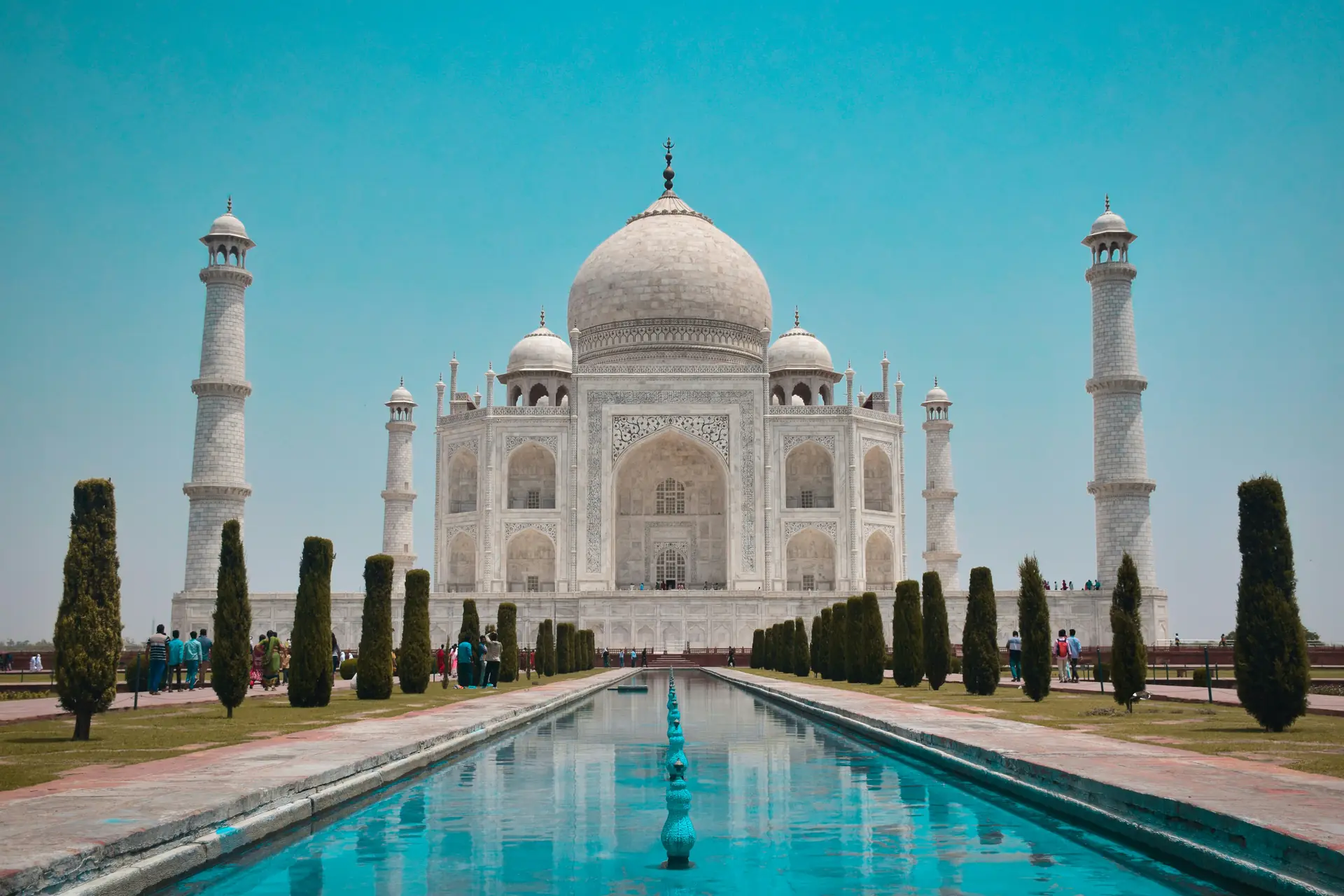
The Taj Mahal stands as a testament to human creativity and devotion. Built in the 1600s by Emperor Shah Jahan, it was created to honor his wife Mumtaz Mahal. The structure combines elements from Persian, Islamic and Indian architecture creating a design that feels both grand and harmonious. Its white marble surfaces reflect light differently throughout the day revealing subtle shifts in color and mood.
Visitors approach through a wide plaza where symmetry guides movement toward the main gateway. The central dome rises above four slender minarets framing the space with clean lines. Inside, intricate carvings and delicate patterns cover walls while calligraphy adds poetic verses from the Quran. The gardens surrounding the monument follow traditional Mughal layouts using water channels and carefully placed trees to enhance visual balance.
The site draws people seeking history or quiet reflection rather than flashy experiences. Guides explain how artisans spent decades shaping stone with hand tools achieving details that machines cannot replicate today. Sunrise visits often feel peaceful allowing time to appreciate textures without crowds. Evening hours bring softer illumination highlighting the building’s form while night tours illuminate its outlines against darkness.
Preservation efforts focus on protecting marble from pollution and maintaining original construction methods. Ongoing research explores structural stability ensuring future generations can experience the monument as intended. For many travelers this place represents more than a historical site; it shows how art and engineering can work together to produce something enduring beyond individual lifetimes.
The Taj Mahal in Agra, India, is accessible via major transportation hubs including airports and railways. The nearest airport is Agra Airport (AGR), located approximately 10 kilometers from the monument, offering domestic flights from key Indian cities such as Delhi, Mumbai and Jaipur. For rail access, Agra Cantt Railway Station serves as a primary entry point, with frequent trains connecting it to major cities like Delhi (about 200 km away) via Shatabdi Express or other intercity services. Buses operated by UPSRTC and private operators also link Agra to nearby towns and tourist destinations. Visitors may reach the Taj Mahal via auto-rickshaws, taxis or guided tours from the city center, with entry gates located on the eastern side near the main entrance.
Near the Taj Mahal, accommodations range from budget guesthouses to luxury heritage resorts. Boutique homestays in the old city offer authentic local flavor and easy access to the monument’s early‑morning view. Mid‑range hotels provide comfortable rooms with modern amenities while still reflecting Mughal architectural motifs. For travelers seeking opulence, heritage palaces converted into boutique hotels boast sprawling courtyards, antique furnishings and panoramic views of the Taj at sunset. Many properties offer complimentary breakfast featuring regional delicacies and guided tours of Agra’s historic sites. The area is renowned for its blend of traditional Indian hospitality and contemporary convenience, catering to both solo explorers and families.
Log in to add this place to a travel list and get a summary of all recommended items for your whole trip.
We calculate the average costs when travelling to destinations and compare those with the living costs at your home. With this you can get an estimate of how expensive or cheap the destination is for you.
To customise this, you can set up which location and price level are used for the calculations in your account settings.
The exchange rate price factor shows how expensive or cheap a currency currently is compared to its historical average. It's a quick way to see if a country is currently more or less affordable due to exchange rate changes.
