









Was this page helpful?

| Opening hours: |
|
||
|---|---|---|---|
| Public website: | www.angkorenterprise.gov.kh |
| Power Grid: |
230 V, 50 Hz Plug: Type A , Type C
Type A:
  Read about power adapters |
|---|---|
| Currency: |
Cambodian Riel (KHR) £1 ≈ KHR 5,432.97 |
| Cashless info: |
Rating 3/5
Cashless payment options are available in larger cities, particularly in tourist areas. Credit cards are accepted in many establishments, but cash is still preferred.
Save with a travel credit card |
| eSIM providers: |
Best value: Saily Flexibility: Airalo Read our in-depth comparison |
| Tipping: | Tipping is appreciated in Cambodia but not mandatory. In restaurants, a 5-10% tip is common. Taxi drivers and hotel staff also appreciate small tips. |
|---|---|
| Public drinking: | Public drinking is generally permitted, especially in designated areas. However, excessive drinking in public places may be frowned upon. |
| Public smoking: | Smoking is prohibited in indoor public places, such as restaurants, bars, and public transport. |
| Khmer New Year (April) |
A major festival with national celebrations and events |
|---|---|
| Pchum Ben (Sept-Oct) |
A festival for honouring ancestors, with cultural events and ceremonies |
| Emergency contact: | Emergency Numbers: 117 (Police), 119 (Ambulance), 118 (Fire) |
|---|---|
| Taxi apps: | Grab |
| Other: | Cambodia is famous for the ancient temples of Angkor Wat, vibrant markets, and rich cultural heritage. It is a popular destination for history and adventure enthusiasts. |
The best times to travel section shows how the months compare for a visit, so you can find the time of year that fits what you want to do.
Background colours of the months:
The colour shows the typical temperature: yellow (hot), green (mild) and blue (cold). How strong the colour is shows the travel season: full colour means high season, soft colour means shoulder season and soft-striped means off season.
Weather symbols:
Each month has one symbol showing what the weather is typically like, such as hot and sunny, freezing or a rainy or snowy season. Use them to quickly spot months that match the weather you want, or to avoid the ones that don't.
Crowdedness:
The people icon shows how busy the place usually is. The more people, the more crowded it gets.
Additional notes:
The grey info boxes point out special things worth knowing, like recurring weather issues or seasonal events.
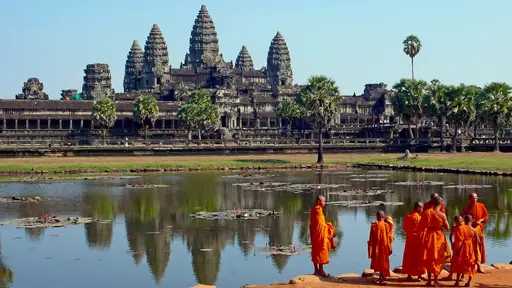
Angkor Wat stands as a remarkable example of ancient architecture in Cambodia. Built in the early 12th century it served as a Hindu temple before becoming Buddhist over time. The site covers more than five hundred acres and features intricate carvings that tell stories from mythology and daily life. Visitors can see towering stone structures aligned with precise geometry showing advanced planning skills.
The complex includes several temples surrounded by moats and walls made of sandstone. Each building has its own purpose ranging from religious ceremonies to royal burials. The central tower rises above the rest symbolizing Mount Meru a sacred place in Hindu cosmology. Walking through the grounds reveals bas-reliefs depicting battles and celestial scenes that remain clear despite centuries of exposure.
Angkor Wat attracts people seeking history culture and quiet moments away from busy cities. Early mornings bring soft light over the ruins making photography popular among travelers. Local guides share knowledge about symbolism in carvings and the role temples played in daily life. The site’s layout encourages slow walking allowing time to notice small details like weathered faces or worn steps.
Nearby villages offer markets where craftspeople sell textiles pottery and food. Travelers can try Cambodian meals such as amok or fresh fruit from nearby farms. Conservation work continues to protect the stone from erosion while balancing visitor needs. Angkor Wat remains a living reminder of past achievements inspiring new generations to preserve heritage.
Angkor Wat is accessible via Siem Reap International Airport (REP), located approximately 6 kilometers northeast of the city center. The airport offers flights from major Southeast Asian hubs and limited international connections. From REP, travelers can hire a taxi, use ride‑hailing services like Grab or take a local bus to reach Siem Reap town, where Angkor Archaeological Park is situated. A one‑hour drive from Siem Reap provides direct access to the temple complex. Public transportation options include shared vans and buses operating between Siem Reap and the temples. Private car rentals are available for those preferring flexible itineraries. The site’s proximity to major regional cities ensures diverse travel accessibility year‑round.
Siem Reap offers a spectrum of lodging that caters to every budget and taste. Budget travelers can find clean, basic rooms in hostels or guesthouses for as little as KHR 40,000 – 80,000 (£7.35 – 14.70) per night, often featuring shared kitchens and free Wi‑Fi. Mid‑range options include boutique hotels and serviced apartments with private bathrooms, air‑conditioning and on‑site dining around KHR 200,000 – 320,000 (£36.74 – 58.79) a night, many of which boast rooftop terraces overlooking the temple complex. Luxury seekers will discover upscale resorts and heritage villas offering spa services, infinity pools and personalized tour packages, typically priced between KHR 600,000 – 1,200,000 (£110.23 – 220.46) per night. The town’s central market area is renowned for its vibrant street‑food scene, making it easy to pair affordable accommodation with local culinary delights.
Log in to add this place to a travel list and get a summary of all recommended items for your whole trip.
We calculate the average costs when travelling to destinations and compare those with the living costs at your home. With this you can get an estimate of how expensive or cheap the destination is for you.
To customise this, you can set up which location and price level are used for the calculations in your account settings.
The exchange rate price factor shows how expensive or cheap a currency currently is compared to its historical average. It's a quick way to see if a country is currently more or less affordable due to exchange rate changes.
