

Africa › Libya › Leptis Magna

Leptis Magna

Scroll
Ancient Roman splendor in sand

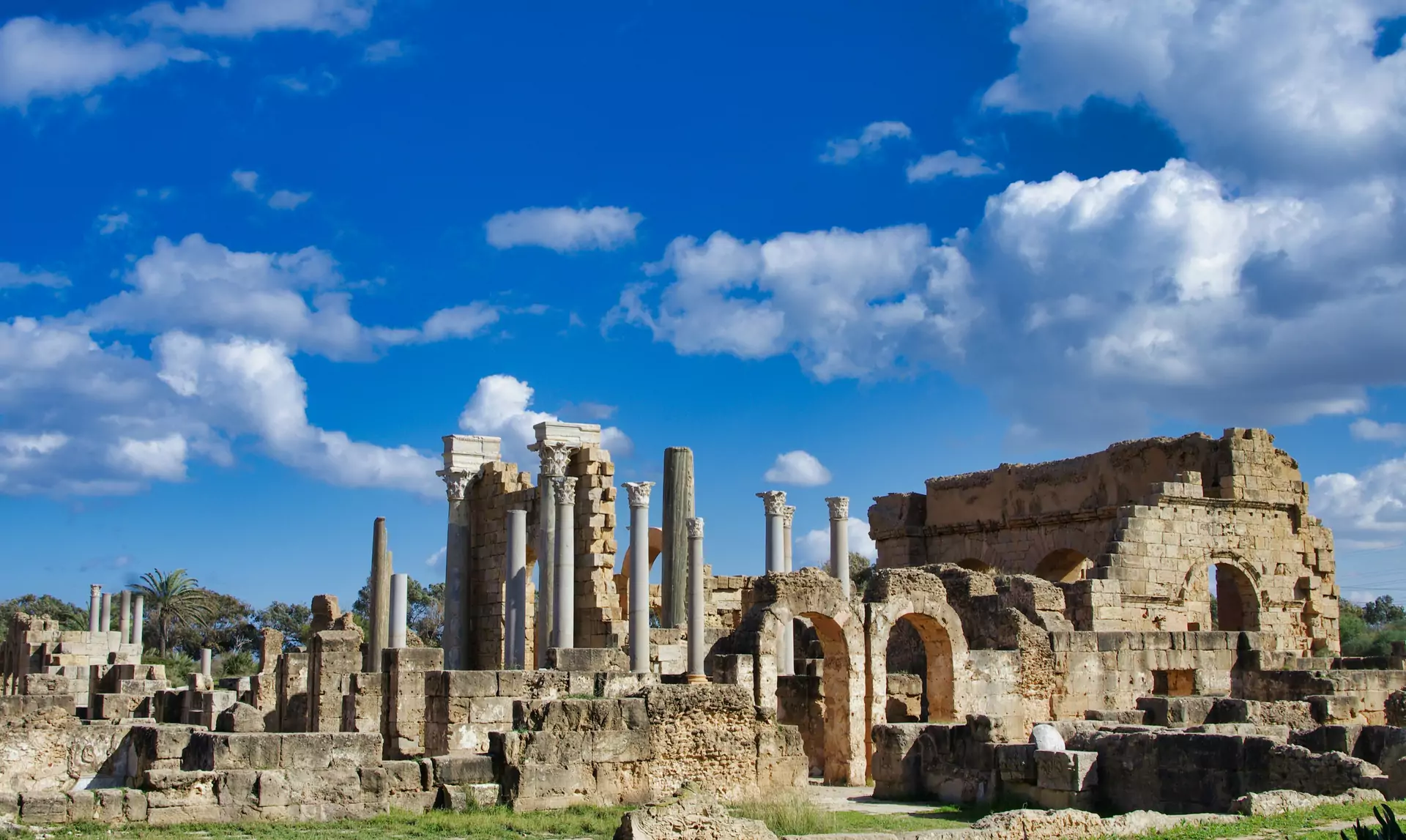
Leptis Magna stands as one of the most complete Roman archaeological sites outside Italy. Located on Libya’s Mediterranean coast, it features grand arches, a theater and well-preserved mosaics that reveal daily life from centuries ago. The city once thrived under imperial rule before declining due to earthquakes and shifting trade routes. Today, visitors can walk among ancient columns and explore ruins where history remains visible in stone. Conservation efforts continue to protect the site while allowing access for study and tourism.

City in Libya
Climate zone: Mediterranean

Mediterranean: Mid-latitude climates with hot, dry summers and mild, wet winters, typical of coastal regions around the Mediterranean Basin.

See climate table
Price level: $$$
$Cheap
$$Medium
$$$Expensive, upscale
$$$+Very expensive, luxury
See price details
Safety: 2.7
General Safety:3
Health & medical:2
Accessibility:3
Tap water:2
Read details
Tourist English: 2/5
English proficiency varies widely in Libya. Tour guides at Leptis Magna often speak basic to intermediate English, but communication with local service providers may be challenging. Having a few Arabic phrases or a translation app can be helpful for smoot
There is a travel warning issued for this country. Please check the website of your country's foreign office for the latest information.
Last update: 12 Oct 2026
* We earn a commission from some links on this page.
Leptis Magna Summary

These place ratings give you a quick overview of how well a destination matches different types of trips.

‘Best for’ scores:
The specific interest scores show where this place really shines – whether it's ideal for hiking, food & drink experiences, museums or other activities. These highlights help you understand what makes the destination special at a glance.

‘Your personal’ scores:
This reflects how well a place matches your personal preferences. You can adjust the importances of travel topics or other personal requirements categories in your account settings.

‘Suited for’ badges:
These give you a quick overview of how well a destination suits specific types of travellers, to help you find the places that match your lifestyle, preferences or travel situation.

Read how our scores work
Outstanding for ancient Roman ruins. Walk through remarkably preserved streets, explore amphitheaters and temples and experience one of the Mediterranean’s greatest archaeological sites.
Place score
5.3
Best at:
Historic sites
10
Ruins
9
Architecture
7
Guided tours
7
Less touristy
6
Personal score
?
Log in to see how this place matches your personal travel interests.
Suited for
👶 3
Families
🧓 3
Seniors
❤️ 6
Couples
🥗 5
Vegetarian
Libya – Quick facts
Power Grid: 230 V, 50 Hz
Plug: Type C , Type F
Type C:
Diagram of a Type C power plug
Type F:
Diagram of a Type F power plug

Read about power adapters
Currency: Libyan Dinar (LYD)
£1 ≈ LYD 8.555
Cashless info: Rating 2/5
Cashless payments are not as widely accepted in Libya, and cash is the primary method for most transactions. Credit cards are accepted in major hotels and international businesses, but mobile payment services are not common.

Save with a travel credit card
eSIM providers: We cannot recommend an eSIM provider for this country. We advise getting a local SIM card.
Tipping: Tipping in Libya is appreciated, though not mandatory. In restaurants, a 10-15% tip is customary if service charges are not included. Small tips are often given to taxi drivers and hotel staff.
Public drinking: Public drinking is prohibited in Libya, and alcohol is banned throughout the country. Alcohol consumption is limited to foreign diplomats and expatriates in private settings.
Public smoking: Smoking is widely accepted in Libya, including in public spaces like restaurants and cafes. However, there are some regulations against smoking in certain enclosed areas.
Revolution Day
(17 February)
Commemorates the start of the 2011 revolution
Eid al-Fitr
(variable)
Celebrations marking the end of Ramadan
Emergency contact: Emergency Number: 112 (Police), 124 (Ambulance)
Taxi apps: Careem, Uber
Other: Travel to Libya is strongly discouraged due to ongoing conflict and political instability. Always check for travel advisories before considering a visit.
Best times to travel

The best times to travel section shows how the months compare for a visit, so you can find the time of year that fits what you want to do.

Background colours of the months:
The colour shows the typical temperature: yellow (hot), green (mild) and blue (cold). How strong the colour is shows the travel season: full colour means high season, soft colour means shoulder season and soft-striped means off season.

Weather symbols:
Each month has one symbol showing what the weather is typically like, such as hot and sunny, freezing or a rainy or snowy season. Use them to quickly spot months that match the weather you want, or to avoid the ones that don't.

Crowdedness:
The people icon shows how busy the place usually is. The more people, the more crowded it gets.

Additional notes:
The grey info boxes point out special things worth knowing, like recurring weather issues or seasonal events.

for Leptis Magna, Libya
🌬️
Jan
🌬️
Feb
🌬️
Mar
☀️
Apr
☀️
May
🔥
Jun
🔥
Jul
🔥
Aug
🔥
Sep
☀️
Oct
☀️
Nov
🌬️
Dec
High season: March - May, Oct.
Shoulder season: Feb., Sep., Nov.
Crowdedness: 4 (Moderate tourist numbers)
Tap on a month for more info Hover over a month for more info
Security situation and entry rules can change at short notice; most governments advise against travel to Libya, check official travel advisories before planning
Visits to the ruins are best March to May and October, avoiding summer heat and winter rain
Ghibli desert winds spring to autumn bring dust and sudden heat spikes

Why travel to Leptis Magna?

Leptis Magna offers a rare opportunity to explore an ancient Roman city that rivals Pompeii or Ephesus but with a fraction of the crowds. What makes this site truly special is how intact many of the structures remain – the theater, amphitheater, forum and baths all give you a vivid sense of life in a thriving Roman colonial city at its peak. As the birthplace of Emperor Septimius Severus (193-211 CE), Leptis Magna received imperial patronage that transformed it into a city second only to Rome itself, housing over 100,000 people during its golden age. The site's preservation is remarkable – buried by sand until the early 20th century, many buildings, sculptures and even details like the public latrines remain in excellent condition. Walking through the cobbled streets and standing in the 16,000-seat amphitheater, you can almost hear the roar of ancient crowds. The coastal setting adds another dimension to your visit, with beautiful Mediterranean views that help you understand why this natural harbor became such an important center of trade. Just be aware that facilities are basic, with limited shade, so timing your visit to avoid the midday heat is essential.

🏯Places worth seeing
  • 1 Arch of Septimius Severus
  • 2 Hadrian's Baths
  • 3 Circus of Lepcis Magna
🎡Places for activities
  • 1 Lepcis Magna
  • 2 Old Forum
  • 3 Leptis Magna Museum
  • 4 Old Basilica
🎈Events
  • Archaeological Exhibitions
  • Cultural Heritage Day
  • UNESCO World Heritage Celebrations
  • Historical Reenactments
  • Photography Competitions
  • Local Cultural Festivals
  • Academic Conferences
  • Conservation Awareness Events
  • Guided Tour Special Events
  • Seasonal Archaeological Tours

Knowledge before you go

  • Hire local guide. Security requires organized tours for access.
  • Check Libya travel advisories; entry limited due to ongoing instability and risks.
  • Allow full day to explore Roman ruins including baths, theatre, basilica and arch.
  • Birthplace of Emperor Septimius Severus; features best-preserved Roman architecture outside Italy.

How to travel to Leptis Magna

Leptis Magna is located near the modern town of Al Khoms, about 130 km east of Tripoli. Most visitors reach the site as part of organized tours from Tripoli, which typically include transportation and a guide. If traveling independently, you can hire a taxi from Tripoli or take a shared taxi to Al Khoms, then arrange local transportation to the archaeological site. The nearest international gateway is Tripoli International Airport, with connections to various European and Middle Eastern cities. Due to Libya's political situation, it's essential to check current travel advisories and arrange proper permits and guides before planning your trip.

Access summary

  • From Tripoli International/Mitiga: Private car or tour vehicle, about 2 hours.
  • From Tripoli city: Drive east along coastal highway via Al Khums, roughly 120 km.
  • Security situation varies; visits usually arranged through licensed local tour operators.

Where to stay in Leptis Magna

Accommodation options near Leptis Magna are limited, with most visitors choosing to stay in Tripoli and visit as a day trip. In Al Khoms, there are a few basic hotels and guesthouses, though facilities may be modest. Some tour operators arrange stays at beach bungalows near the site, which offer a convenient base for exploration but can be basic in terms of amenities. For those seeking more comfort, Tripoli offers a wider range of accommodation options, from international hotels to local guesthouses, though the trade-off is a longer drive to the archaeological site.

Hotel recommendations

*by rating and popularity. Commissions have no influence on the rankings.
We couldn't find any nearby hotels for now.

How to get around Leptis Magna

Exploring Leptis Magna is primarily done on foot, as the archaeological site is extensive and requires walking to fully appreciate. A typical visit takes at least 3-4 hours to cover the main attractions. There are no transportation options within the site itself, so comfortable walking shoes are essential. For those with limited mobility, some areas may be challenging due to uneven terrain and ancient stone pathways. It's advisable to follow a logical route through the ruins to avoid backtracking – many visitors start at the Arch of Septimius Severus, then explore the baths, basilica, forum, market and theater.
Budget snapshot
Costs compared to home

We calculate the average costs when travelling to destinations and compare those with the living costs at your home. With this you can get an estimate of how expensive or cheap the destination is for you.

To customise this, you can set up which location and price level are used for the calculations in your account settings.

-83 %
Daily expenses in the region are around 83% lower than the average across United States. That means you'll spend a lot less on meals and getting around.
Exchange rate trend

The exchange rate price factor shows how expensive or cheap a currency currently is compared to its historical average. It's a quick way to see if a country is currently more or less affordable due to exchange rate changes.

-32 %
Your exchange rate (GBP to LYD) is 32% better than in recent years. That means travelling now is considerably cheaper compared to the past.

Travel costs

To help you plan your trip, we provide estimated daily costs per person (when travelling as a pair) for different travel styles. These numbers give you an idea of what you might spend each day at this destination, including accommodation, food, transport and activities.

Additionally, we also provide average hotel costs for different travel styles to give you an estimate for the accommodation only.

Please note that these are only estimates. The real costs depend on booking times, season and other factors.

Daily cost summary

Travel style categories explained:

Backpacker:
Staying in hostels or budget hotels, cooking your own meals or eating cheap and choosing low-cost activities.

Mid-range:
Staying in mid-range hotels, eating at a mix of restaurants and casual spots and enjoying a variety of activities.

Luxury:
Staying in luxury hotels, dining out at high-end restaurants and enjoying premium experiences without worrying about the price.

Backpacker Mid-range Luxury
💵 Total costs per day, including accommodation
£20
£44
£100
🏨 Accommodation per night, per person
£11
£30
£60
🍝 Food per day
£7
£12
£30
🚕 Transportation per day
£2
£2
£10
Food & Drink
🍽️ Restaurant Dinner, per person
£4.90
🍛 Lunch Set, per person
£2.50
🍟 Fast food combo
£2.10
🍝 Preparing your own food, per day
£2.70
☕ Cappuccino
£0.32
🍺 Beer in a restaurant, 0.5 l
£0.41
Transportation
🚌 Public transport ticket
£0.37
🚕 Taxi Ride, 10 km / 6 mi
£6
⛽ Petrol, 1 l
£0.31
Other
🎞️ Cinema ticket
£3.30
👩‍⚕️ Doctor's consult
£23
🤧 Cold medication
£3.70
💇 Basic haircut
£1.10

Safety information overview

General safety
3
Security situations in Libya can change rapidly. Travel with reputable tour operators, stay informed about current conditions and follow local advice. Most archaeological areas are safe, but the broader political situation requires caution and advance planning. Always check government travel advisories before visiting.
Health & Medical
2
Medical facilities near Leptis Magna are limited. The nearest hospitals are in Al Khoms and Tripoli, with varying standards of care. Heat-related issues are common among visitors, especially during summer months. Bring necessary medications and ensure comprehensive travel insurance including evacuation coverage.
Accessi­bility
3
Leptis Magna presents significant challenges for visitors with mobility issues. The site features uneven terrain, ancient stone pathways, steps and limited modern infrastructure. Some main areas are accessible via smoother paths, but full exploration requires navigating rough ground and occasional climbs.
Tap water
2
Tap water in the Leptis Magna area is not recommended for drinking. Bottled water is essential and should be carried in sufficient quantities during your visit, as availability at the site may be limited. Dehydration is a risk, especially during hot months.

Looking for inspiration?

Discover
Best architecture destinations in Africa
Africa's architectural heritage spans an enormous chronological range, from the ancient stone complexes of the northeast and the monumental earthen mosque traditions of the west to…
Read more
Discover
Top architecture destinations and iconic landmarks
Architecture travel spans everything from ancient ceremonial complexes and medieval urban cores to the grands projets of the twentieth century and contemporary buildings that draw…
Read more
Discover
Top ancient ruins destinations and archaeological sites
The world's most significant ancient ruin destinations range from the ceremonial complexes of early river civilisations and the monumental remains of classical empires to the less…
Read more
Discover
Top historical destinations and historic sites
The most compelling history destinations are places where the past is still physically present and legible in the landscape, the architecture and the daily life of the people who…
Read more
Discover
Best ancient ruins destinations in Africa
Africa's ancient sites span a wider chronological range than any other continent, with the Nile Valley alone containing a sequence of monumental construction that stretches across…
Read more
Discover
Best historical destinations in Africa
Africa's historical record is the deepest on earth, encompassing the origins of humanity itself alongside the rise and fall of great empires, ancient trading civilisations and…
Read more
Discover
Most beautiful beaches and coastal escapes
For a lot of people, a beach is the whole point of a holiday, but what makes a beach day perfect really depends on personal taste. Some travellers want isolation and the feeling…
Read more
Discover
Stunning national parks and wilderness areas
National parks exist because someone decided that certain landscapes were too important to lose. The best of them protect ecosystems, wildlife and natural processes that would…
Read more
Discover
Intimate escapes and romantic getaways
The most memorable trips for couples tend to have less to do with luxury and more to do with the quality of shared experience. A place that slows you down, removes the usual…
Read more
Was this page helpful?
Feedback

