









Was this page helpful?

| Public website: | burg-eltz.de |
|---|
| Power Grid: |
230 V, 50 Hz Plug: Type C , Type F
Type C:
  Read about power adapters |
|---|---|
| Currency: |
Euro (EUR) £1 ≈ €1.19 |
| Cashless info: |
Rating 4/5
Cards are widely accepted, especially in urban areas, but small establishments may prefer cash. Be prepared for occasional cash-only situations.
Save with a travel credit card |
| eSIM providers: |
Best value: Saily Flexibility: Airalo Read our in-depth comparison |
| Tipping: | Tipping is common in restaurants, typically 5-10%. For taxis, it is customary to round up to the nearest euro. Tipping in cash is more common than adding it to card payments. |
|---|---|
| Public drinking: | Public drinking is allowed in most parts of Germany, especially in beer gardens and public events, but some local regulations may restrict it in specific areas. |
| Public smoking: | Smoking is prohibited indoors in public places such as restaurants, trains, and buses. Designated smoking areas are available outside many buildings. |
| Oktoberfest (September) |
Huge crowds in Munich. Expect high hotel rates and crowded transport. |
|---|---|
| Christmas (December) |
Christmas markets are popular, expect crowded cities and higher prices. |
| Labour Day (May) |
Many shops are closed, and there are celebrations throughout the country. |
| Emergency contact: | Police: 110, Emergency Number: 112 (Fire, Ambulance) |
|---|---|
| Taxi apps: | Uber, Free Now, myTaxi |
| Other: | Germany is well-equipped for tourists, with good public transport and high-quality facilities. However, be prepared for language barriers in some rural areas. |
The best times to travel section shows how the months compare for a visit, so you can find the time of year that fits what you want to do.
Background colours of the months:
The colour shows the typical temperature: yellow (hot), green (mild) and blue (cold). How strong the colour is shows the travel season: full colour means high season, soft colour means shoulder season and soft-striped means off season.
Weather symbols:
Each month has one symbol showing what the weather is typically like, such as hot and sunny, freezing or a rainy or snowy season. Use them to quickly spot months that match the weather you want, or to avoid the ones that don't.
Crowdedness:
The people icon shows how busy the place usually is. The more people, the more crowded it gets.
Additional notes:
The grey info boxes point out special things worth knowing, like recurring weather issues or seasonal events.
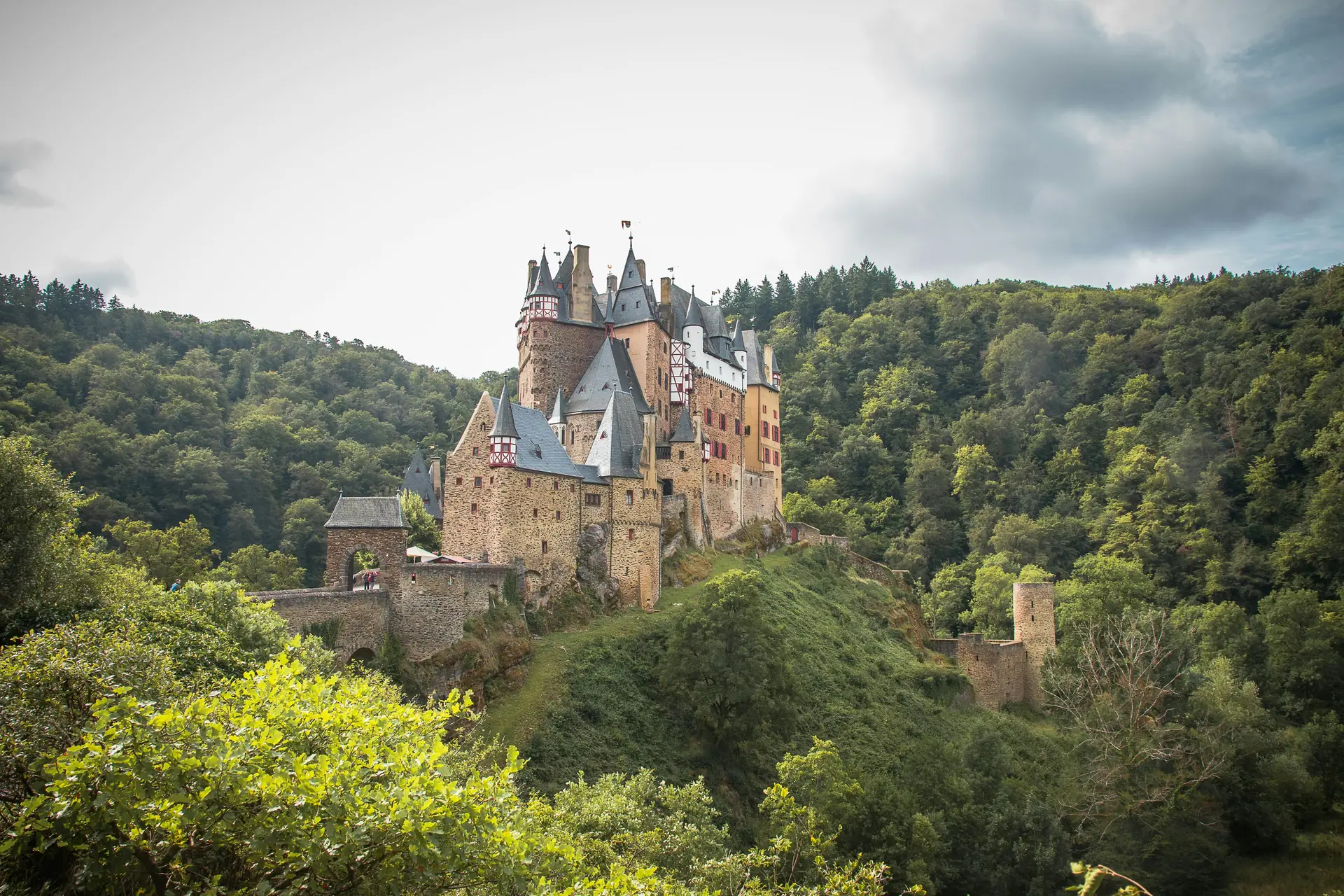
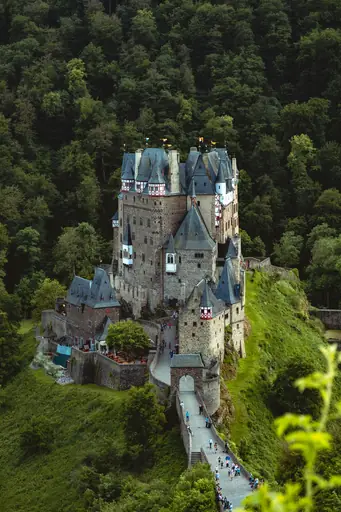
Burg Eltz is on a rock spur about 60 m high, with the Elzbach on three sides. More than 3 km² of the surrounding Eltz Forest is a nature reserve. The Eltz family appears in a document from 1157. Parts of the original castle, including the Romanesque keep called Platteltz, still stand. After the Eltz Feud with the archbishop of Trier in the 1330s, parts of the defences were taken down, but the castle itself was never destroyed in war and was spared in 1689.
Around the courtyard are the houses of three family lines, the Rübenach, Rodendorf and Kempenich houses, built between about 1150 and 1650. Together they housed about 180 people. Eight towers rise up to 35 m. The Rübenach house has timber-frame turrets and a late Gothic chapel apse, while the Rodendorf houses hold an early Renaissance banner hall.
The guided tour covers rooms such as the Knight's Hall, the Banner Hall, the Rodendorf kitchen, a decorated bed chamber and an armoury. Exhibits are labelled in German and a free English flyer is available at the entrance. The treasury is included in the ticket and holds more than 500 objects, with a focus on gold and silver work from Augsburg and Nuremberg. There's also porcelain and a collection of weapons.
Rooms can only be seen on a guided tour. Tours start at regular intervals from 09:30 in the upper courtyard and last about 35 to 40 minutes. The castle is open daily from late March or April to the start of November. A visit usually takes 2.5 to 3 hours counting the walk from the car park. The courtyard is cobbled and the tour includes stairs. Parts of the castle can be under scaffolding during restoration work.
Burg Eltz is easiest to reach by car, with parking near Wierschem and a walk or shuttle bus up to the castle. Enter Burg Eltz, Wierschem in a sat-nav to reach the car parks. Parking costs €4 (£3.37) for a day and the shuttle bus runs every 10 minutes for €2 (£1.68) per person and trip. On foot, you can follow the road from the car park past a viewing platform or take a footpath that passes another viewpoint. Public transport is slower. Trains stop at Hatzenport on the Moselle. From there bus 365 goes to the castle car park twice an hour every day while the castle is open. Another way is to walk from the Ringelsteiner Mühle near Moselkern, about 2.5 km each way or hike the 13 km Eltzer Burgpanorama trail, which takes about four hours. From Cologne it's about 110 km and roughly an hour and a half by car. Frankfurt Airport (FRA) and Cologne Bonn Airport (CGN) are the nearest major airports, both roughly two hours away by road.
The villages around Burg Eltz have small guesthouses and holiday apartments, with Wierschem and Moselkern the closest places to stay. Cochem, Treis-Karden and Koblenz are bigger bases on the Moselle and the Rhine, with many more hotels and more places to eat in the evening. Cochem is a popular choice because it has its own castle, wine-village streets and train connections along the Moselle. Rooms fill up in summer and in autumn during the wine season, so book ahead for those months. The castle is closed from November to late March, which makes a winter stay in the area better suited to the Moselle towns than to a Burg Eltz visit. Without a car, Cochem or another town on the Moselle rail line suits you best, since trains to Hatzenport connect to bus 365.
Food at Burg Eltz is simple. The Bailey, the castle's outer courtyard, has a self-service restaurant with snacks, drinks and cakes and views of the castle and the valley. Access to the grounds and the restaurant needs a valid entry ticket, so a coffee stop there counts as part of the paid visit.
There's usually little else to eat on the way to the castle, so the villages of Wierschem and Moselkern and the town of Cochem are the places to look for a full meal. Moselle wines, especially Riesling, are on most menus in the villages and towns nearby. Pack a drink and a snack if you plan to hike to the castle, since the trails go through forest away from the villages.
Log in to add this place to a travel list and get a summary of all recommended items for your whole trip.
We calculate the average costs when travelling to destinations and compare those with the living costs at your home. With this you can get an estimate of how expensive or cheap the destination is for you.
To customise this, you can set up which location and price level are used for the calculations in your account settings.
The exchange rate price factor shows how expensive or cheap a currency currently is compared to its historical average. It's a quick way to see if a country is currently more or less affordable due to exchange rate changes.
