









Was this page helpful?

| Opening hours: |
|
|---|
| Power Grid: |
220 V, 50 Hz Plug: Type A , Type B
Type A:
  Read about power adapters |
|---|---|
| Currency: |
Thai Baht (THB) £1 ≈ THB 44.93 |
| Cashless info: |
Rating 5/5
Cashless payments are widely accepted in Thailand, especially in major cities. Mobile payments such as Line Pay, GrabPay, and Apple Pay are common.
Save with a travel credit card |
| eSIM providers: |
Best value: Saily Flexibility: Airalo Read our in-depth comparison |
| Tipping: | Tipping is not mandatory in Thailand, but it is appreciated. In restaurants, leaving 10% is common. Taxi fares are rounded up, and small tips for hotel staff are encouraged. |
|---|---|
| Public drinking: | Public drinking is generally not allowed in Thailand, though alcohol is available in licensed venues like bars and restaurants. Laws around drinking in public can be strictly enforced in some areas. |
| Public smoking: | Smoking is prohibited in many indoor public spaces, including shopping centres and restaurants, but designated smoking areas are common. |
| Songkran (13–15 April) |
Thai New Year celebrated with water fights |
|---|---|
| Father's Day (King Bhumibol Memorial Day) (5 December) |
Honours the late King Bhumibol, with ceremonies across the country |
| Emergency contact: | Emergency Numbers: 191 (Police), 1155 (Tourist Police), 1669 (Ambulance), 199 (Fire) |
|---|---|
| Taxi apps: | Grab, Bolt |
| Other: | Thailand is known for its vibrant culture, beautiful beaches, and rich history. Popular activities include visiting temples, experiencing the vibrant nightlife, and enjoying the country’s diverse cuisine. |
The best times to travel section shows how the months compare for a visit, so you can find the time of year that fits what you want to do.
Background colours of the months:
The colour shows the typical temperature: yellow (hot), green (mild) and blue (cold). How strong the colour is shows the travel season: full colour means high season, soft colour means shoulder season and soft-striped means off season.
Weather symbols:
Each month has one symbol showing what the weather is typically like, such as hot and sunny, freezing or a rainy or snowy season. Use them to quickly spot months that match the weather you want, or to avoid the ones that don't.
Crowdedness:
The people icon shows how busy the place usually is. The more people, the more crowded it gets.
Additional notes:
The grey info boxes point out special things worth knowing, like recurring weather issues or seasonal events.
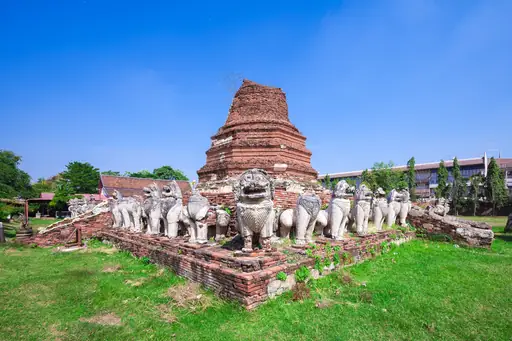
Wat Chiang Man dates back to the founding of Chiang Mai in 1296, commissioned by King Mengrai. The temple complex comprises various buildings including the ancient Chedi Chang Lom, supported by 15 elephant statues and the main viharn (prayer hall), which showcases intricate Lanna architecture and contains some of the city’s oldest Buddha images.
The temple also houses rare and historically significant Buddha statues made from crystal and marble, attracting both worshippers and art lovers. Its tranquil atmosphere reflects centuries of Buddhist practice intertwined with local traditions.
Although beautifully preserved, some areas of Wat Chiang Man feature narrow, steep stairs and uneven flooring, which may pose challenges for visitors with limited mobility. Photography inside the prayer halls is usually permitted but should be done respectfully.
Visitors are advised to dress modestly, covering shoulders and knees and to remove shoes before entering the temple buildings. Being an active spiritual site, maintaining quiet and respectful behavior ensures a meaningful experience.
Wat Chiang Man is located within the old city walls of Chiang Mai, making it accessible by foot or bicycle from most central locations. Visitors often use tuk-tuks or songthaews to reach the temple from popular areas like the Night Bazaar or the train station. Chiang Mai International Airport connects the city with domestic and international flights.
Chiang Mai offers a range of accommodations from guesthouses and boutique hotels in the old city to luxury resorts. Staying near the old city provides easy access to temples like Wat Chiang Man and other cultural sites.
Log in to add this place to a travel list and get a summary of all recommended items for your whole trip.
We calculate the average costs when travelling to destinations and compare those with the living costs at your home. With this you can get an estimate of how expensive or cheap the destination is for you.
To customise this, you can set up which location and price level are used for the calculations in your account settings.
The exchange rate price factor shows how expensive or cheap a currency currently is compared to its historical average. It's a quick way to see if a country is currently more or less affordable due to exchange rate changes.
