







Was this page helpful?

| Opening hours: |
|
||
|---|---|---|---|
| Public website: | ibaraki-kairakuen.jp |
| Power Grid: |
100 V, 50 Hz Plug: Type A
Type A:
 Read about power adapters |
|---|---|
| Currency: |
Japanese Yen (JPY) £1 ≈ JP¥210 |
| Cashless info: |
Rating 4/5
Cashless payments are becoming more common, especially in cities, with some shops still preferring cash. Be prepared for occasional cash-only situations in rural areas.
Save with a travel credit card |
| eSIM providers: |
Best value: Saily Flexibility: Airalo Read our in-depth comparison |
| Tipping: | Tipping is not customary in Japan and can be considered rude. Excellent service is the norm, and tipping is unnecessary in most places. |
|---|---|
| Public drinking: | Public drinking is legal and commonly accepted, particularly during festivals and events. |
| Public smoking: | Smoking is prohibited in indoor public places but allowed in designated outdoor areas. Some restaurants may have smoking sections. |
| New Year (January) |
One of the most important holidays, expect crowded temples and high prices. Plan ahead. |
|---|---|
| Golden Week (April-May) |
The busiest travel time, expect high demand for accommodation and transport. |
| Obon (August) |
A time to honour ancestors, many businesses close, and transport can be crowded. |
| Emergency contact: | Emergency Number: 110 (Police), 119 (Fire & Ambulance) |
|---|---|
| Taxi apps: | Uber, JapanTaxi, DiDi |
| Other: | Japan is a country of respect, so understanding local customs and etiquette is important. Public transport is efficient, but can be crowded during peak hours. |
The best times to travel section shows how the months compare for a visit, so you can find the time of year that fits what you want to do.
Background colours of the months:
The colour shows the typical temperature: yellow (hot), green (mild) and blue (cold). How strong the colour is shows the travel season: full colour means high season, soft colour means shoulder season and soft-striped means off season.
Weather symbols:
Each month has one symbol showing what the weather is typically like, such as hot and sunny, freezing or a rainy or snowy season. Use them to quickly spot months that match the weather you want, or to avoid the ones that don't.
Crowdedness:
The people icon shows how busy the place usually is. The more people, the more crowded it gets.
Additional notes:
The grey info boxes point out special things worth knowing, like recurring weather issues or seasonal events.
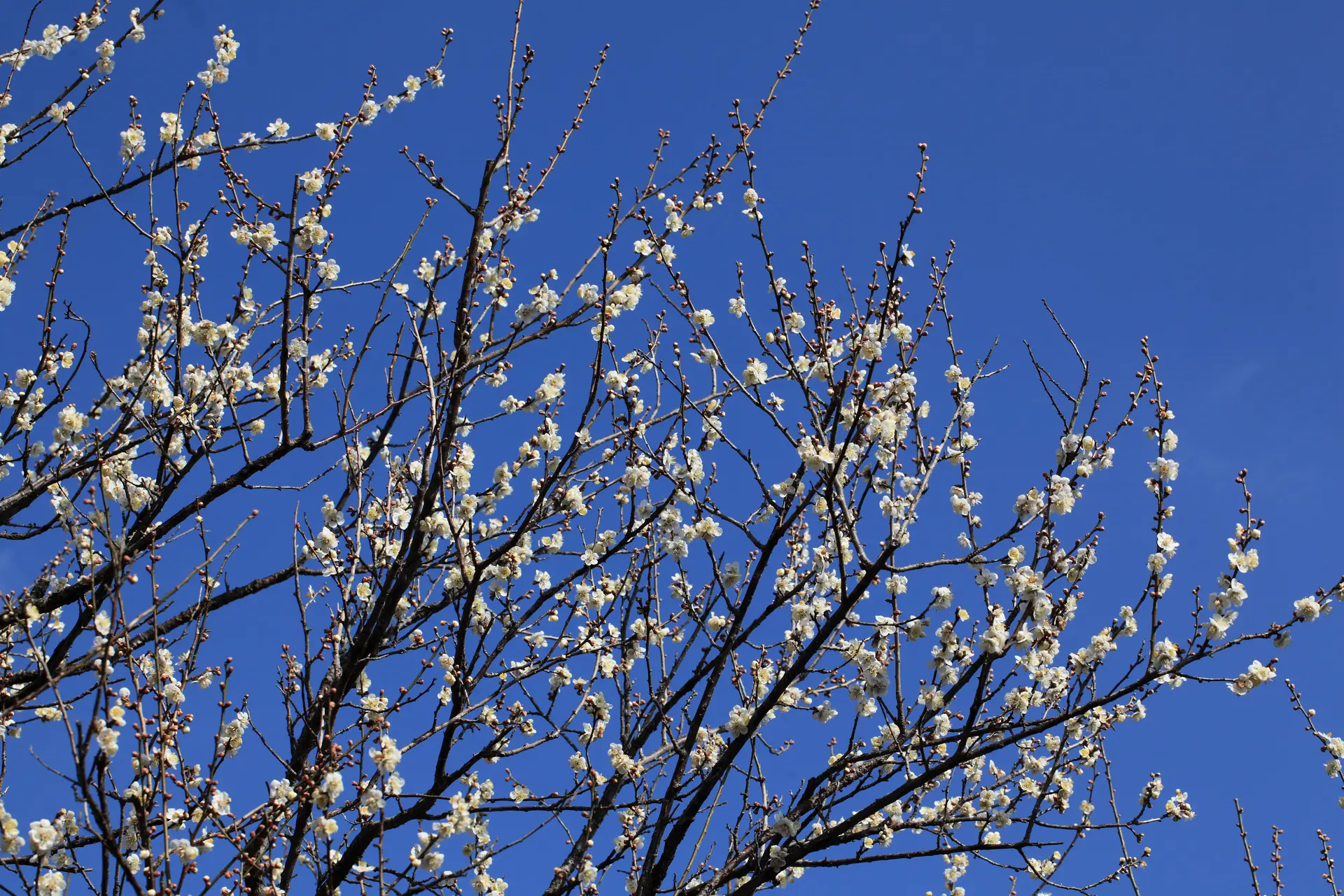
Kairaku-en is best known as a plum garden. More than 3,000 trees of over 100 varieties fill the grounds, with white, pink and red blossoms that bloom from late February into March. It counts among the three great gardens of Japan with Kenroku-en in Kanazawa and Koraku-en in Okayama. Unlike the other two, it was meant for everyone to visit. The name means roughly a park to be enjoyed together.
Tokugawa Nariaki, the lord of the Mito domain, built the garden in 1842. He is said to have planted the plums partly for their fruit as well as their beauty. Today the plum groves are just inside the entrance, with winding paths between the trees. Beyond them the garden has a bamboo grove and cedar woods, which are cool and shady in summer.
The Kobuntei is a traditional pavilion that Nariaki used for gatherings. Its upper floor has views over the garden and Senba Lake. Visitors pay a separate fee to go in. It opens for fewer hours in winter than in the warmer months. Tokiwa Shrine is next door and honours Tokugawa Mitsukuni and Nariaki.
Other seasons bring other flowers. Cherry blossoms and azaleas come in spring while Japanese bush clover blooms in autumn. The Mito Plum Festival runs through the plum season, with food stalls and events on the grounds. Plan on one to two hours for a relaxed walk. The garden is open every day and general admission is about JP¥320 (£1.52). It's usually busiest on festival weekends.
Trains are the easiest way to reach Kairaku-en. From Tokyo, take a JR Joban Line limited express to Mito, which takes roughly 80 minutes. Kanto Tetsudo buses run from the north exit of Mito Station to the Kairakuen bus stop in about 15 minutes. Walking from Mito Station along Senba Lake takes around 30 minutes. During the plum festival, some trains on the Joban Line stop at a temporary station beside the garden, so check timetables before you go. This saves the bus ride in the crowds. Ibaraki Airport (IBR) is south of Mito and is linked to the city by bus, which takes about 40 minutes. By car, Mito is roughly two hours from Tokyo depending on traffic. Parking near the garden fills up fast during the festival, so many visitors use the train instead.
Mito is the practical base. The city has a good range of business hotels near the station, within a short bus ride of the garden. Rooms are usually easy to find outside the plum festival and prices are often lower than in Tokyo. Most visitors treat Kairaku-en as a day trip from Tokyo since the Joban Line express makes it easy. Staying overnight in Mito lets you reach the garden when it opens and see the plums with fewer people. Hitachi further up the coast and the Oarai coast are other options if you want a seaside stay. Book early for festival weekends in late February and early March.
Food around Kairaku-en is casual. During the plum festival, stalls on the grounds and nearby streets sell snacks and sweets, including plum flavoured treats. Mito is also known for natto, the fermented soybean dish, which appears in many local restaurants and souvenir shops.
You'll find cafes and restaurants in the streets around Mito Station, about 15 minutes away by bus. Some places near the garden may close early outside the festival, so eat in town if you plan a late lunch.
Convenience stores and supermarkets near the station are handy for picnic supplies. Vegetarians should ask about fish stock, which is common in many dishes.
Log in to add this place to a travel list and get a summary of all recommended items for your whole trip.
We calculate the average costs when travelling to destinations and compare those with the living costs at your home. With this you can get an estimate of how expensive or cheap the destination is for you.
To customise this, you can set up which location and price level are used for the calculations in your account settings.
The exchange rate price factor shows how expensive or cheap a currency currently is compared to its historical average. It's a quick way to see if a country is currently more or less affordable due to exchange rate changes.
