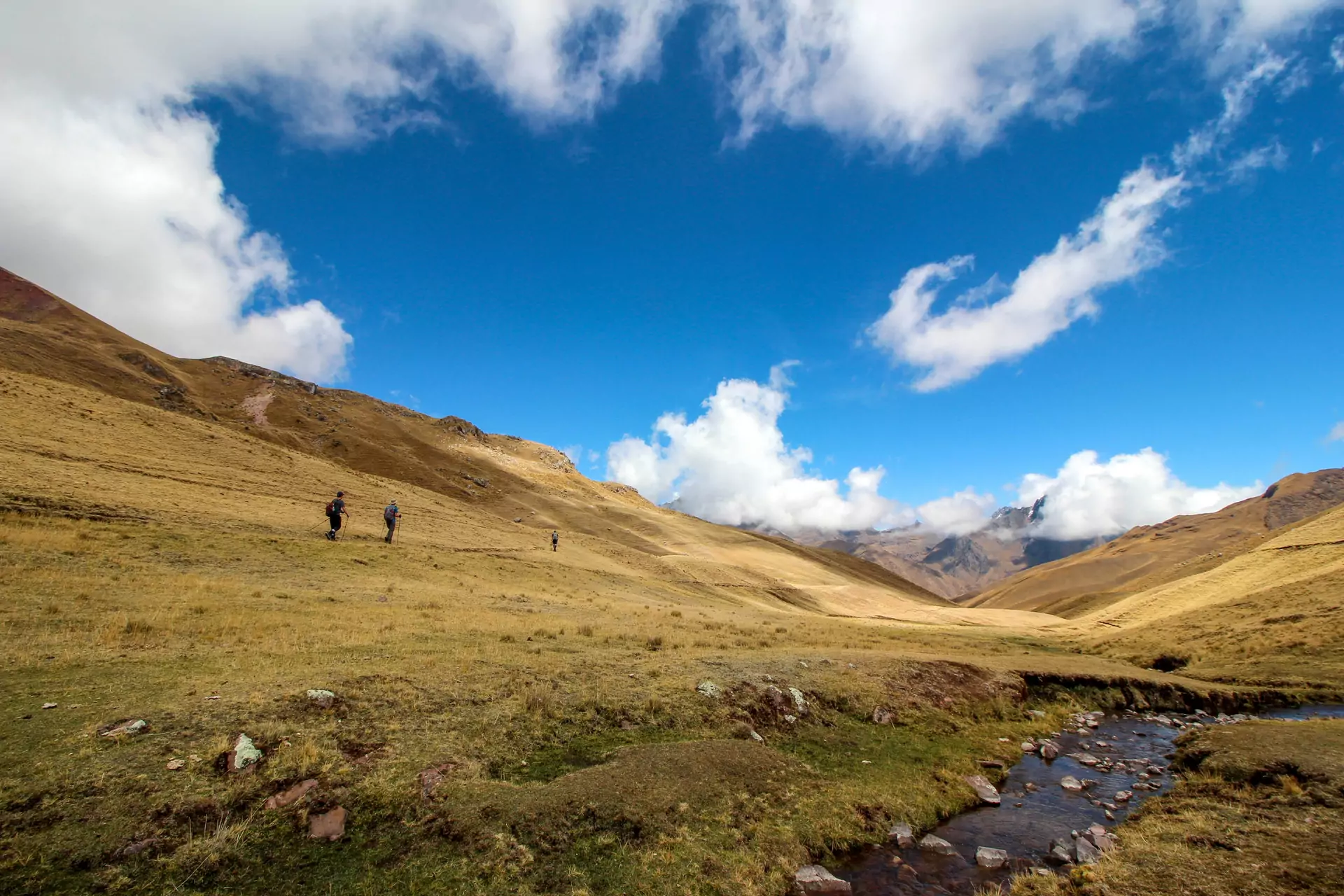


Max, Unsplash License, https://unsplash.com/de/fotos/menschen-die-auf-einem-grasbewachsenen-hugel-spazieren-gehen-IhYUveoXvpc
South America › Andes

Andes

Scroll
Majestic peaks echo ancient Andean legends

The Andes stretch over seven countries in South America creating a long chain of high peaks volcanic fields and deep valleys. This mountain range shapes weather patterns across the continent influencing rainfall and temperature far beyond its slopes. Many people live on terraced farms or small towns at different elevations where crops such as potatoes quinoa and maize grow. The Andes are home to unique wildlife including llamas alpacas and condors while ancient cultures left behind ruins that attract visitors today.

Mountain Range
Climate zone: Tundra

Tundra: Polar climates where warmest month remains cool, allowing only low-growing vegetation above permafrost or seasonally frozen ground.

See climate table
Price level: $$$
$Cheap
$$Medium
$$$Expensive, upscale
$$$+Very expensive, luxury
See price details
Safety: 4.3
General Safety:5
Health & medical:4
Accessibility:2
Tap water:3
Read details
Tourist English: 3/5
In most Andean towns, especially popular tourist spots like Cusco and La Paz, English is widely understood by guides, hotel staff and shopkeepers. In remote villages, basic Spanish phrases help bridge gaps.
Last update: 16 Oct 2026
* We earn a commission from some links on this page.
Andes Summary

These place ratings give you a quick overview of how well a destination matches different types of trips.

‘Best for’ scores:
The specific interest scores show where this place really shines – whether it's ideal for hiking, food & drink experiences, museums or other activities. These highlights help you understand what makes the destination special at a glance.

‘Your personal’ scores:
This reflects how well a place matches your personal preferences. You can adjust the importances of travel topics or other personal requirements categories in your account settings.

‘Suited for’ badges:
These give you a quick overview of how well a destination suits specific types of travellers, to help you find the places that match your lifestyle, preferences or travel situation.

Read how our scores work
Great at towering peaks and challenging treks that reveal breathtaking vistas. Its high‑altitude villages celebrate vibrant Andean traditions while offering encounters with llamas, condors and ancient ruins.
Place score
8.1
Best at:
Mountains
10
Historic sites
10
Natural sites
10
Traditional culture
10
Ruins
10
Personal score
?
Log in to see how this place matches your personal travel interests.
Suited for
👶 4
Families
🧓 3
Seniors
👩 8
Solo
❤️ 8
Couples
Best times to travel

The best times to travel section shows how the months compare for a visit, so you can find the time of year that fits what you want to do.

Background colours of the months:
The colour shows the typical temperature: yellow (hot), green (mild) and blue (cold). How strong the colour is shows the travel season: full colour means high season, soft colour means shoulder season and soft-striped means off season.

Weather symbols:
Each month has one symbol showing what the weather is typically like, such as hot and sunny, freezing or a rainy or snowy season. Use them to quickly spot months that match the weather you want, or to avoid the ones that don't.

Crowdedness:
The people icon shows how busy the place usually is. The more people, the more crowded it gets.

Additional notes:
The grey info boxes point out special things worth knowing, like recurring weather issues or seasonal events.

for Andes
☀️
Jan
☀️
Feb
☀️
Mar
☀️
Apr
🌨️
May
🌨️
Jun
🌨️
Jul
🌨️
Aug
🌨️
Sep
🌨️
Oct
❄️
Nov
☀️
Dec
High season: Jan. - Feb., June - Aug.
Shoulder season: March - May, Sep. - Dec.
Crowdedness: 4 (Moderate tourist numbers)
Tap on a month for more info Hover over a month for more info
Climate and season vary a lot by region: central Andes (Peru, Bolivia) best May to September, Patagonian Andes best December to March, Ecuador and Colombia mild year-round and drier June to September, ski season June to September in Chile and Argentina
Inca Trail to Machu Picchu closed every February for maintenance
Inti Raymi festival in Cusco on 24 June, accommodation fills up well in advance

Why travel to Andes?

The Andes, stretching over 7,000 km from Venezuela to Chile and Argentina, offer a unique blend of natural beauty, cultural depth and adventure that appeals to travelers seeking both relaxation and exploration. The range’s diverse ecosystems – from cloud forests in the north to glacial peaks in Patagonia – provide opportunities for hiking, wildlife spotting and photography without the crowds found at more commercial destinations. In Peru, Machu Picchu remains a highlight, but lesser‑known sites such as Choquequirao or the Sacred Valley offer equally impressive Inca architecture with fewer tourists. The highlands of Bolivia feature the surreal Salar de Uyuni and the vibrant markets of La Paz, where visitors can learn about traditional weaving and local cuisine. Chile’s Torres del Paine National Park presents dramatic granite spires and turquoise lakes, ideal for multi‑day treks that showcase Patagonia’s raw wilderness. Beyond natural attractions, the Andes host a tapestry of indigenous cultures. Engaging with Quechua or Aymara communities provides insight into centuries‑old traditions, from agricultural practices to music and dance. Culinary experiences – like tasting quinoa-based dishes in Ecuador or sampling empanadas in Argentina – add another layer of connection. Whether you’re trekking the Inca Trail, exploring volcanic landscapes or simply enjoying panoramic vistas, the Andes reward travelers with authentic encounters, varied climates and a sense of place that is both grounded and inspiring.

Knowledge before you go

  • Pack layered clothing; Andean temperatures vary widely during day and night.
  • Acclimate gradually by spending a day at moderate altitude before high‑altitude hikes, reducing risk of altitude sickness.
  • Carry bottled water and electrolytes; tap water is unsafe in most Andean towns and villages.
  • Learn basic Quechua phrases; locals appreciate effort and it often opens doors to hidden trails and authentic experiences.

How to travel to Andes

The Andes mountain range spans over seven countries in South America, including Venezuela, Colombia, Ecuador, Peru, Bolivia, Chile and Argentina. Access to this region is primarily through major cities such as Bogotá (Colombia), Quito (Ecuador), Lima (Peru), La Paz (Bolivia), Santiago (Chile) and Buenos Aires (Argentina). International travelers can reach these hubs via commercial flights from global airports, followed by domestic flights or overland transport to Andean regions. Road access is limited in some areas due to rugged terrain, but buses and private vehicles operate on key routes like the Pan-American Highway. High-altitude passes require acclimatization for safety. Border crossings exist between neighboring countries, though some may have seasonal restrictions.

Access summary

  • From Lima (LIM): Flight to Cusco (1h30).
  • From Quito (UIO): Bus to Otavalo (3h); From Bogotá (BOG): Flight to Quito (1h).
  • By train from Cusco to Puno, 10h.

Where to stay in Andes

In the Andean highlands, lodging ranges from modest hostels and family-run guesthouses to upscale lodges perched on dramatic cliffs. Many towns offer budget-friendly cabins with basic amenities, ideal for trekkers seeking simplicity and local flavor. Mid‑range options often feature rustic chalets equipped with Wi‑Fi, communal kitchens and panoramic views of snow‑capped peaks. Luxury accommodations are concentrated in resort villages such as Machu Picchu’s base camp area or the Peruvian highlands, offering spa services, gourmet dining and guided excursions. The region is renowned for its eco‑lodges that blend sustainable design with traditional Andean architecture, providing guests an immersive experience while minimizing environmental impact.

Hotel recommendations

*by rating and popularity. Commissions have no influence on the rankings.
We couldn't find any nearby hotels for now.

How to get around Andes

The Andes mountain range spans over seven countries in South America, offering diverse terrain and climates. Travelers can explore by road, train or on foot depending on accessibility. In Peru and Bolivia, the scenic train from Cusco to La Raya provides access to high-altitude passes, while Chile and Argentina feature well-maintained highways like Route 40 for car travel. For remote areas, buses connect major cities such as Quito and Bogotá to mountain towns. Hiking is popular on trails like the Inca Trail or Torres del Paine’s W Circuit, though altitude requires acclimatization. Local services often include shared vans (colectivos) between villages. Air travel connects distant regions quickly but may involve short flights over rugged peaks. Always check seasonal road conditions and altitude safety guidelines before departing.
Budget snapshot
Costs compared to home

We calculate the average costs when travelling to destinations and compare those with the living costs at your home. With this you can get an estimate of how expensive or cheap the destination is for you.

To customise this, you can set up which location and price level are used for the calculations in your account settings.

-60 %
Daily expenses in the region are around 60% lower than the average across United States. That means you'll spend a lot less on meals and getting around.
Exchange rate trend

The exchange rate price factor shows how expensive or cheap a currency currently is compared to its historical average. It's a quick way to see if a country is currently more or less affordable due to exchange rate changes.

---
We currently don't have exchange rates for this place

Travel costs (Data for Los Andes, Chile - 58 km away)

To help you plan your trip, we provide estimated daily costs per person (when travelling as a pair) for different travel styles. These numbers give you an idea of what you might spend each day at this destination, including accommodation, food, transport and activities.

Additionally, we also provide average hotel costs for different travel styles to give you an estimate for the accommodation only.

Please note that these are only estimates. The real costs depend on booking times, season and other factors.

Daily cost summary

Travel style categories explained:

Backpacker:
Staying in hostels or budget hotels, cooking your own meals or eating cheap and choosing low-cost activities.

Mid-range:
Staying in mid-range hotels, eating at a mix of restaurants and casual spots and enjoying a variety of activities.

Luxury:
Staying in luxury hotels, dining out at high-end restaurants and enjoying premium experiences without worrying about the price.

Backpacker Mid-range Luxury
💵 Total costs per day, including accommodation
£30
£65
£180
🏨 Accommodation per night, per person
£14
£34
£86
🍝 Food per day
£14
£27
£79
🚕 Transportation per day
£3
£5
£15
Food & Drink
🍽️ Restaurant Dinner, per person
£8
🍛 Lunch Set, per person
£5.50
🍟 Fast food combo
£4
🍝 Preparing your own food, per day
£4.80
☕ Cappuccino
£1.70
🍺 Beer in a restaurant, 0.5 l
£2.20
Transportation
🚌 Public transport ticket
£0.60
🚕 Taxi Ride, 10 km / 6 mi
£9
⛽ Petrol, 1 l
£0.95
Other
🎞️ Cinema ticket
£4.10
👩‍⚕️ Doctor's consult
£44
🤧 Cold medication
£4.20
💇 Basic haircut
£9.50

Safety information overview

General safety
5
The Andes in South America generally offer a safe travel experience, with low crime rates and well‑established tourist infrastructure. Visitors should stay on marked trails, avoid isolated areas after dark and respect local customs to ensure personal safety.
Health & Medical
4
The Andes offer high‑altitude training benefits, clean mountain air and low pollution levels. Medical facilities in major towns are modern, with experienced doctors and emergency services. Travelers should acclimatize slowly, stay hydrated, avoid altitude sickness and carry basic first‑aid supplies.
Accessi­bility
2
The Andes offer mixed accessibility: well‑developed roads and cable cars reach many peaks, yet remote trails remain rugged and poorly marked. Elevation changes can strain visitors; plan acclimatization, carry proper gear and use guided tours for safer exploration.
Tap water
3
Tap water in the Andes of South America is generally safe to drink, especially in larger towns and cities where municipal supplies meet international standards. Rural villages may rely on filtered or bottled water; public fountains are common in tourist hubs, ensuring easy hydration.

Looking for inspiration?

Discover
Top digital nomad destinations and remote work hubs in 2026
Working from anywhere in the world sounds simple until you actually try it and the best digital nomad destinations look different depending on what kind of remote worker you are.…
Read more
Discover
Best couple holiday destinations
Travelling as a couple sounds simple enough, yet the best couple holiday destinations mean something different to almost every pair. What feels romantic to one couple can feel like…
Read more
Discover
Best destinations for first-time travellers
A first trip abroad works best somewhere that eases you in, rather than throwing every possible culture shock and logistical headache at you at once. Some first-time travellers…
Read more
Discover
Best scenic drive destinations in South America
South America has real appeal for road trippers willing to cover serious distance, with some of its best drives stretching across entire regions rather than a single afternoon.…
Read more
Discover
Best destinations to visit in June in South America
June splits South America firmly in two, with the far south deep in winter while other regions hit some of their best months of the year. Patagonia's short travel season has…
Read more
Discover
Best travel destinations for seniors
Senior travel covers a wide range, from slow, low effort trips built around comfort to more independent trips for travellers who still want to cover plenty of ground. Some…
Read more
Discover
Most beautiful beaches and coastal escapes
For a lot of people, a beach is the whole point of a holiday, but what makes a beach day perfect really depends on personal taste. Some travellers want isolation and the feeling…
Read more
Discover
Stunning national parks and wilderness areas
National parks exist because someone decided that certain landscapes were too important to lose. The best of them protect ecosystems, wildlife and natural processes that would…
Read more
Discover
Intimate escapes and romantic getaways
The most memorable trips for couples tend to have less to do with luxury and more to do with the quality of shared experience. A place that slows you down, removes the usual…
Read more
Was this page helpful?
Feedback