












Was this page helpful?

| Opening hours: |
|
||||
|---|---|---|---|---|---|
| Public website: | skycityauckland.co.nz |
| Power Grid: |
230 V, 50 Hz Plug: Type I
Type I:
 Read about power adapters |
|---|---|
| Currency: |
New Zealand Dollar (NZD) £1 ≈ NZ$2.34 |
| Cashless info: |
Rating 5/5
Cashless payments are widely accepted across New Zealand, and credit cards are commonly used, especially in urban areas and tourist spots.
Save with a travel credit card |
| eSIM providers: |
Best value: Saily Flexibility: Airalo Read our in-depth comparison |
| Tipping: | Tipping is not expected in New Zealand, though it is appreciated for exceptional service. 5-10% in restaurants and small tips for taxi and hotel staff are common. |
|---|---|
| Public drinking: | Public drinking is generally allowed in some designated areas but may be restricted in others. Consumption of alcohol in public places may require a permit. |
| Public smoking: | Smoking is restricted in many public areas, especially indoor spaces and public transport. |
| Waitangi Day (6 February) |
A national holiday celebrating the signing of the Treaty of Waitangi |
|---|
| Emergency contact: | Emergency Number: 111 (Police, Fire, Ambulance) |
|---|---|
| Taxi apps: | Uber, Ola |
| Other: | New Zealand is known for its stunning landscapes, from beaches and mountains to national parks and cultural experiences. |
The best times to travel section shows how the months compare for a visit, so you can find the time of year that fits what you want to do.
Background colours of the months:
The colour shows the typical temperature: yellow (hot), green (mild) and blue (cold). How strong the colour is shows the travel season: full colour means high season, soft colour means shoulder season and soft-striped means off season.
Weather symbols:
Each month has one symbol showing what the weather is typically like, such as hot and sunny, freezing or a rainy or snowy season. Use them to quickly spot months that match the weather you want, or to avoid the ones that don't.
Crowdedness:
The people icon shows how busy the place usually is. The more people, the more crowded it gets.
Additional notes:
The grey info boxes point out special things worth knowing, like recurring weather issues or seasonal events.
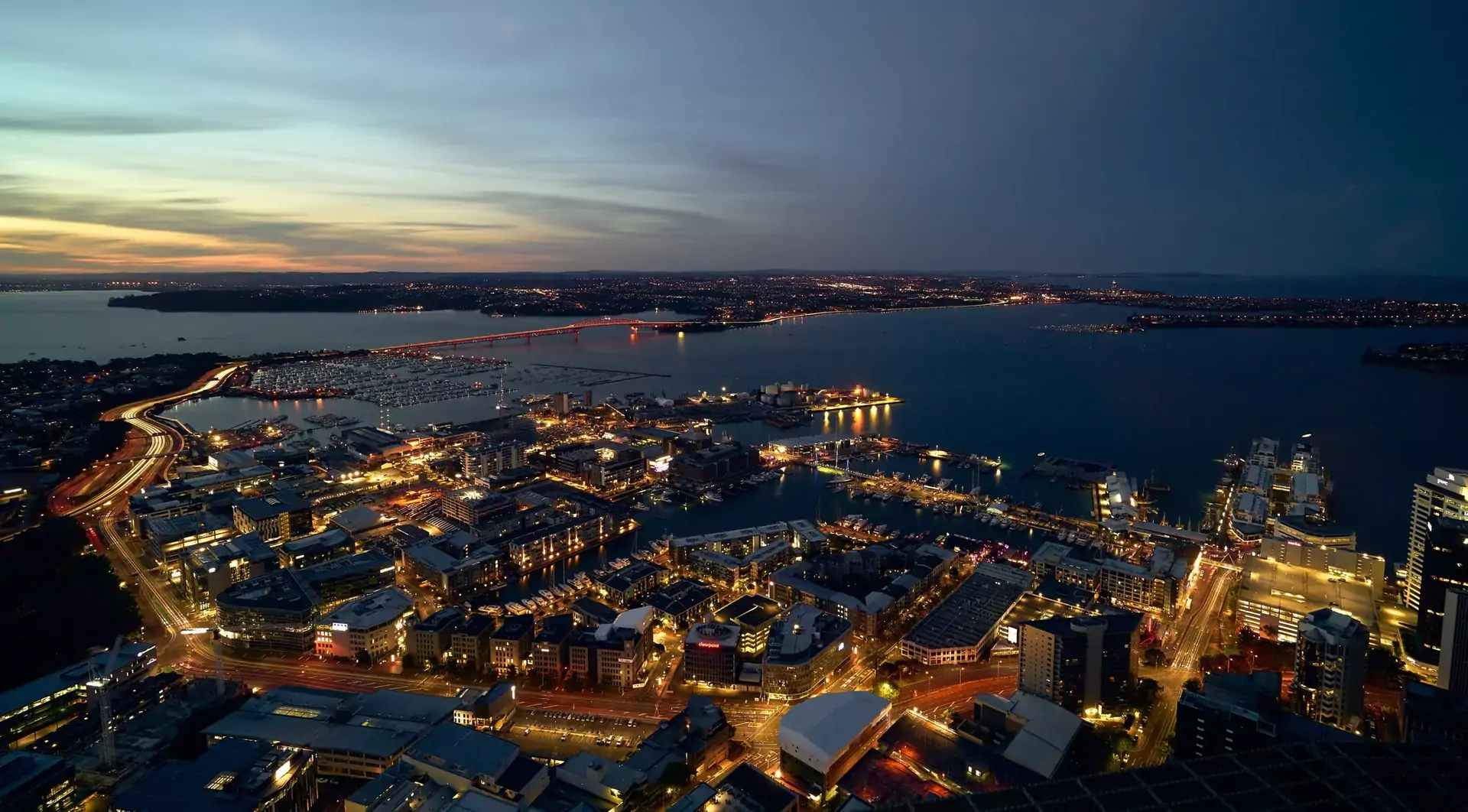
The Sky Tower, completed in 1997, is not only Auckland's tallest structure at 328 meters but was the tallest freestanding tower in the Southern Hemisphere for many years. Architecturally impressive, it is constructed of reinforced concrete and steel and offers three main observation levels, each with floor-to-ceiling glass for panoramic city and harbor views. The main deck even features glass floor panels that provide a thrilling look straight down to the street below.
For thrill seekers, the tower features the SkyJump – a controlled 192-meter base jump where jumpers can reach speeds up to 85 km/h. The SkyWalk allows visitors to walk around the pergola at 192 meters height strapped to safety cables. Dining options include the unique Orbit 360° revolving restaurant and a brasserie buffet, all providing stunning views. The tower also serves as a key telecommunications hub and is a cultural icon in Auckland.
While visiting, be aware that admission prices can be steep and those with a fear of heights might find the glass floors and activities challenging. The tower sways slightly in high winds, but its design adheres to very strict safety standards including earthquake resilience. It can get quite busy during peak tourist seasons, so planning visits during weekdays or early mornings may offer a more peaceful experience.
The external lighting was upgraded to LED in late 2019 to reduce carbon emissions, doubling the number of lights and making the tower a spectacular night-time landmark over Auckland's skyline. Overall, the Sky Tower offers an exciting mix of awe-inspiring views, thrill-seeking activities and fine dining, making it a must-visit for anyone traveling to Auckland.
Sky Tower is located in the heart of Auckland’s Central Business District, easily accessible by public transport, taxi or on foot if staying nearby. Visitors flying into Auckland International Airport can take a short 30-minute taxi or shuttle ride to downtown Auckland. Multiple bus and train lines connect to the city center, making it convenient to visit the tower.
Accommodations around Sky Tower are abundant in Auckland’s city center, ranging from luxury hotels to boutique lodgings. Staying nearby offers easy walking access to the tower and other downtown attractions. There are also many mid-range hotels and serviced apartments suitable for a variety of budgets.
Log in to add this place to a travel list and get a summary of all recommended items for your whole trip.
We calculate the average costs when travelling to destinations and compare those with the living costs at your home. With this you can get an estimate of how expensive or cheap the destination is for you.
To customise this, you can set up which location and price level are used for the calculations in your account settings.
The exchange rate price factor shows how expensive or cheap a currency currently is compared to its historical average. It's a quick way to see if a country is currently more or less affordable due to exchange rate changes.
