








Was this page helpful?

| Opening hours: |
|
||
|---|---|---|---|
| Public website: | www.parlament.ch |
| Power Grid: |
230 V, 50 Hz Plug: Type C , Type J
Type C:
  Read about power adapters |
|---|---|
| Currency: |
Swiss Franc (CHF) £1 ≈ CHF 1.10 |
| Cashless info: |
Rating 5/5
Switzerland is very cashless-friendly, with credit and debit cards widely accepted. Mobile payments like Apple Pay and Google Pay are also increasingly common.
Save with a travel credit card |
| eSIM providers: |
Best value: Saily Flexibility: Airalo Read our in-depth comparison |
| Tipping: | Tipping is appreciated but not mandatory in Switzerland. Most service charges are included in bills. In restaurants, rounding up to the nearest 5 CHF or leaving 5-10% is common. Taxi drivers and hotel staff appreciate small tips for exceptional service. |
|---|---|
| Public drinking: | Public drinking is allowed and socially acceptable in Switzerland, but being disruptive is frowned upon. Alcohol can be consumed in parks, trains, and outdoor events. |
| Public smoking: | Smoking is banned indoors in public places but allowed in designated areas. Outdoor smoking is common. |
| Swiss National Day (August) |
Expect celebrations, parades, and fireworks throughout the country. |
|---|---|
| Christmas (December) |
Markets and festive events are common, with tourist areas being busier than usual. |
| Easter (March/April) |
Many attractions are closed, but some areas offer special events and celebrations. |
| Emergency contact: | Emergency Number: 112 (Police, Fire, Ambulance) |
|---|---|
| Taxi apps: | Uber, Bolt |
| Other: | Switzerland is famous for its natural beauty, well-organised transport, and multilingual culture. The Swiss Travel Pass is highly recommended for tourists. |
The best times to travel section shows how the months compare for a visit, so you can find the time of year that fits what you want to do.
Background colours of the months:
The colour shows the typical temperature: yellow (hot), green (mild) and blue (cold). How strong the colour is shows the travel season: full colour means high season, soft colour means shoulder season and soft-striped means off season.
Weather symbols:
Each month has one symbol showing what the weather is typically like, such as hot and sunny, freezing or a rainy or snowy season. Use them to quickly spot months that match the weather you want, or to avoid the ones that don't.
Crowdedness:
The people icon shows how busy the place usually is. The more people, the more crowded it gets.
Additional notes:
The grey info boxes point out special things worth knowing, like recurring weather issues or seasonal events.
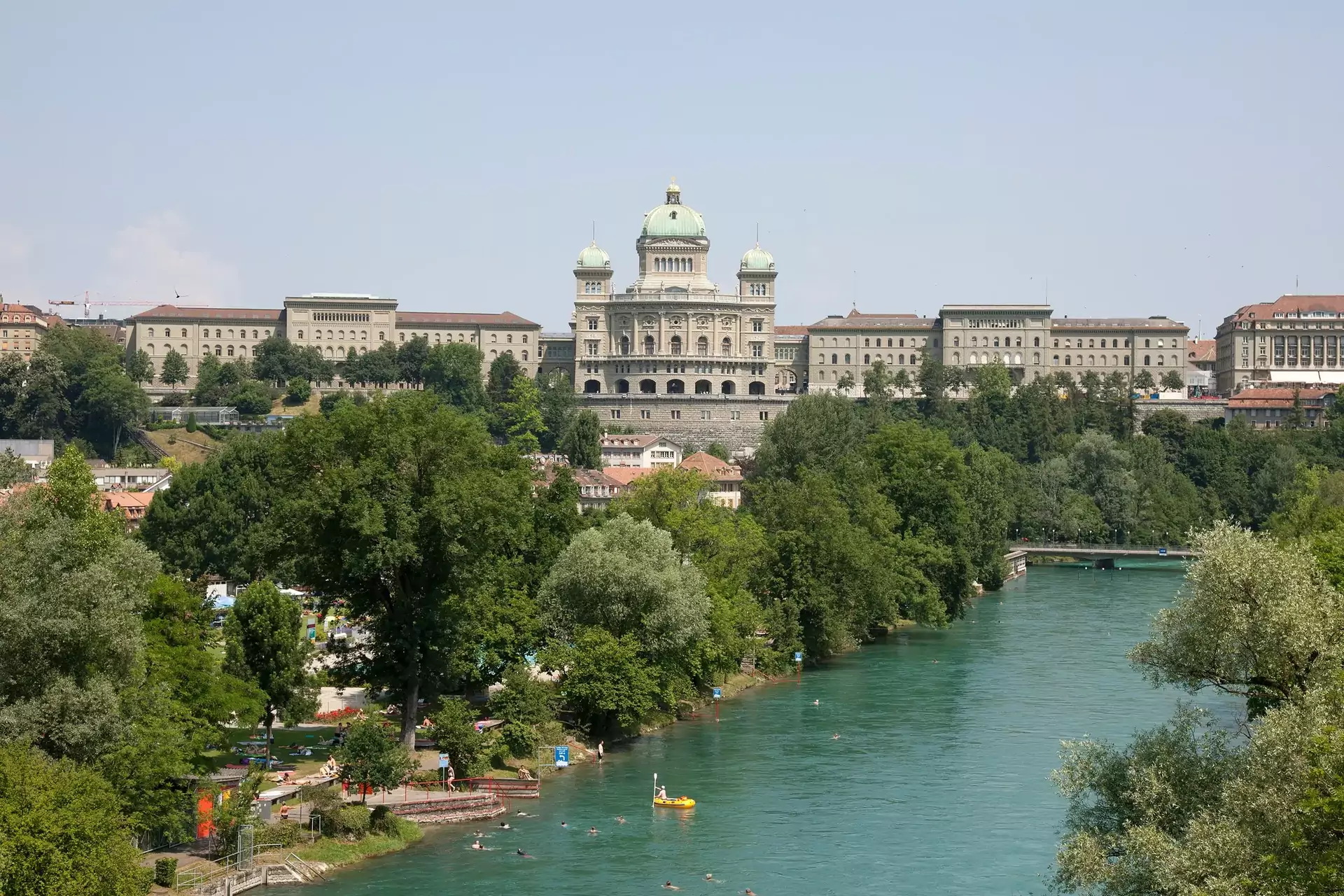
The Federal Palace was constructed in stages between 1852 and 1902, designed by architect Hans Wilhelm Auer, displaying the Renaissance Revival style. It houses the Swiss Federal Assembly – the National Council and Council of States – as well as the Federal Council. The palace’s stonework features a rich variety of sandstone and marble sourced from across Switzerland, symbolizing the country’s unity amid diversity.
The central domed hall is adorned with historic and symbolic artwork, including the cantonal coats of arms arranged thoughtfully to emphasize federal unity. Inside, imposing murals showcase Switzerland’s political heritage and cultural values, accompanied by statues of legendary historical figures like William Tell.
Though it is an active government building, the Federal Palace hosts guided public tours that provide insight into Swiss politics and the building’s artistic heritage. Some areas may be restricted during parliamentary sessions. Visitors should book tours in advance and be aware of potential closures on certain days.
The palace is surrounded by the spacious Bundesplatz square, a lively social space with fountains and seasonal events including Christmas markets and light shows. It offers scenic views of the nearby Aare River and Bern’s famous Gurten mountain, combining politics with cultural and natural beauty.
The Federal Palace is centrally located in Bern, Switzerland's capital city. Visitors can reach Bern by train from major Swiss cities or via Bern Airport for regional flights. From the city center, the building is easily accessible on foot, public buses or by taxi. Bern’s compact size allows for convenient exploration of nearby attractions on foot.
Bern offers a variety of accommodation options from elegant hotels to charming boutique guesthouses, many within walking distance from the Federal Palace and close to public transport links.
Log in to add this place to a travel list and get a summary of all recommended items for your whole trip.
We calculate the average costs when travelling to destinations and compare those with the living costs at your home. With this you can get an estimate of how expensive or cheap the destination is for you.
To customise this, you can set up which location and price level are used for the calculations in your account settings.
The exchange rate price factor shows how expensive or cheap a currency currently is compared to its historical average. It's a quick way to see if a country is currently more or less affordable due to exchange rate changes.
