









Was this page helpful?

| Public website: | www.madrid.es |
|---|
| Power Grid: |
230 V, 50 Hz Plug: Type C , Type F
Type C:
  Read about power adapters |
|---|---|
| Currency: |
Euro (EUR) £1 ≈ €1.19 |
| Cashless info: |
Rating 5/5
Cashless payment is widely accepted in Spain, particularly in urban areas and tourist destinations. Credit and debit cards are commonly used, and mobile payment options are available in many establishments.
Save with a travel credit card |
| eSIM providers: |
Best value: Saily Flexibility: Airalo Read our in-depth comparison |
| Tipping: | Tipping is not mandatory in Spain but appreciated for good service. In restaurants, rounding up the bill or leaving 5-10% is customary. Taxi drivers and hotel staff may also be tipped, though it is less common. |
|---|---|
| Public drinking: | Public drinking is restricted in some regions, particularly in tourist-heavy cities. Local laws may vary. |
| Public smoking: | Smoking is banned indoors in public places but allowed in designated outdoor areas. |
| La Tomatina (August) |
A famous tomato-throwing festival, expect large crowds in Buñol. |
|---|---|
| Semana Santa (March/April) |
Religious parades and events make this a busy time in major cities. |
| Christmas (December) |
Markets and festive celebrations, with tourist areas becoming busier. |
| Emergency contact: | Emergency Number: 112 (Police, Fire, Ambulance) |
|---|---|
| Taxi apps: | Cabify, Bolt, Uber |
| Other: | Spain is known for its diverse culture, stunning architecture, and vibrant festivals. Public transport is reliable and efficient, making it easy to explore. |
The best times to travel section shows how the months compare for a visit, so you can find the time of year that fits what you want to do.
Background colours of the months:
The colour shows the typical temperature: yellow (hot), green (mild) and blue (cold). How strong the colour is shows the travel season: full colour means high season, soft colour means shoulder season and soft-striped means off season.
Weather symbols:
Each month has one symbol showing what the weather is typically like, such as hot and sunny, freezing or a rainy or snowy season. Use them to quickly spot months that match the weather you want, or to avoid the ones that don't.
Crowdedness:
The people icon shows how busy the place usually is. The more people, the more crowded it gets.
Additional notes:
The grey info boxes point out special things worth knowing, like recurring weather issues or seasonal events.
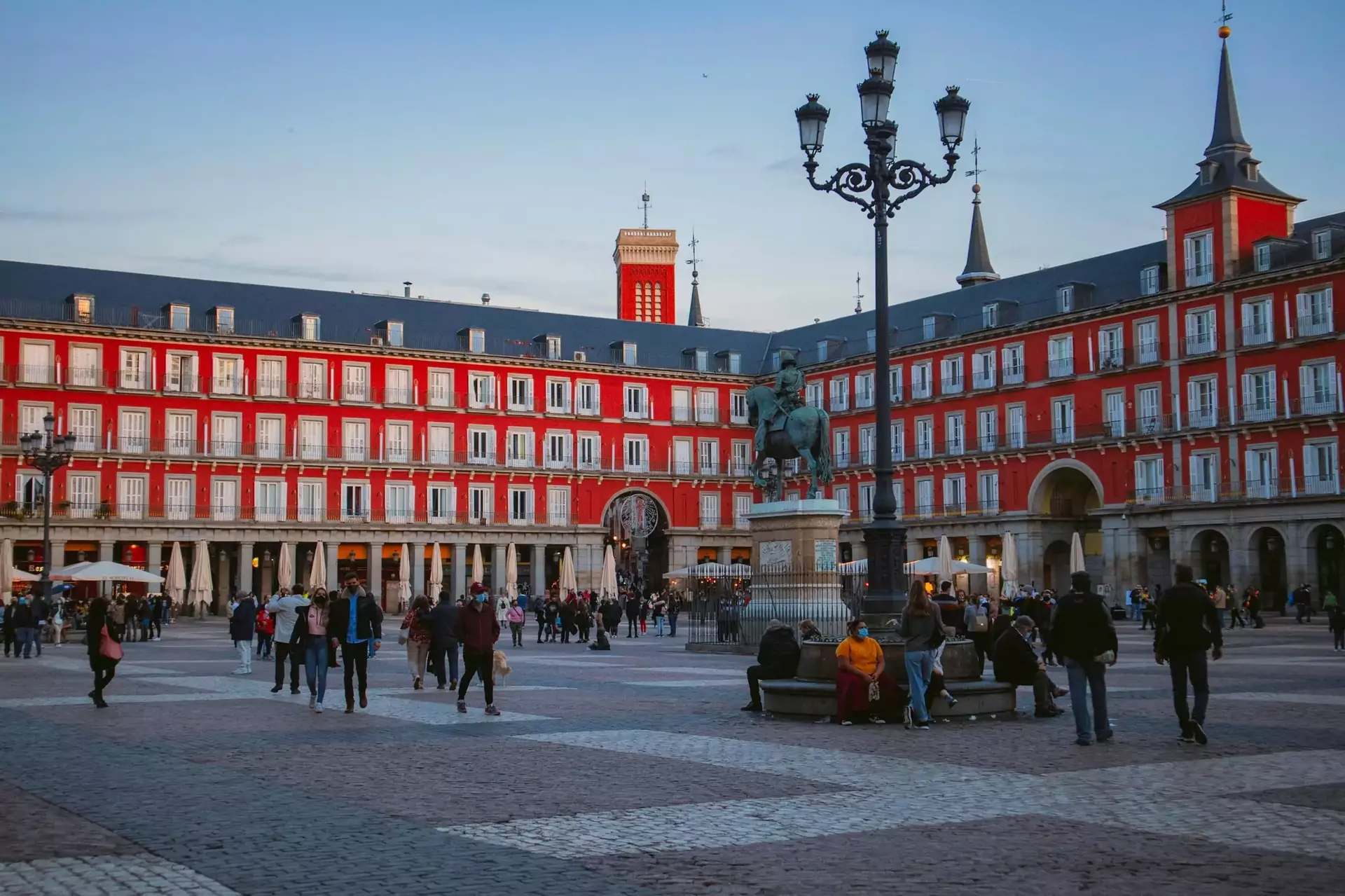
Plaza Mayor was built during the reign of Philip III in the 17th century and has retained its historic charm despite centuries of events ranging from festive markets to serious political gatherings. It was originally used for markets, bullfights and public executions, giving it a deep-rooted connection to Spain's turbulent history.
The square is surrounded by uniform three-story residential buildings with a distinctive terracotta-tiled roof and hundreds of balconies. The famed Casa de la Panadería, with its ornate frescoes, anchors one end and the grand Arco de Cuchilleros provides a picturesque entryway. The space is pedestrianized, fostering a leisurely atmosphere amid bustling cafes and street performers.
Visitors should be cautious of tourist traps in the form of overpriced restaurants and souvenirs around the square. While lively and rich in culture, the area can get extremely crowded, especially during festivals and holidays, making it challenging to find seating or quiet moments.
The plaza comes alive during Christmas, with a vibrant market and beautiful decorations, making it a magical time to visit. Overall, Plaza Mayor is a quintessential Madrid experience, perfect for history buffs and those wanting to experience authentic local ambiance in a stunning setting.
Plaza Mayor is centrally located in Madrid's historic district, with nearby metro stations including Sol, Opera and La Latina. Visitors arriving via Adolfo Suárez Madrid-Barajas Airport can take the metro or taxi to the city center within 20-30 minutes.
Madrid's historic center offers a wide range of accommodations from boutique hotels to luxury options, ideal for visitors wanting close access to Plaza Mayor and other city highlights.
Log in to add this place to a travel list and get a summary of all recommended items for your whole trip.
We calculate the average costs when travelling to destinations and compare those with the living costs at your home. With this you can get an estimate of how expensive or cheap the destination is for you.
To customise this, you can set up which location and price level are used for the calculations in your account settings.
The exchange rate price factor shows how expensive or cheap a currency currently is compared to its historical average. It's a quick way to see if a country is currently more or less affordable due to exchange rate changes.
