










Was this page helpful?

| Opening hours: |
|
||||||
|---|---|---|---|---|---|---|---|
| Public website: | www.alhambra-patronato.es |
| Power Grid: |
230 V, 50 Hz Plug: Type C , Type F
Type C:
  Read about power adapters |
|---|---|
| Currency: |
Euro (EUR) £1 ≈ €1.19 |
| Cashless info: |
Rating 5/5
Cashless payment is widely accepted in Spain, particularly in urban areas and tourist destinations. Credit and debit cards are commonly used, and mobile payment options are available in many establishments.
Save with a travel credit card |
| eSIM providers: |
Best value: Saily Flexibility: Airalo Read our in-depth comparison |
| Tipping: | Tipping is not mandatory in Spain but appreciated for good service. In restaurants, rounding up the bill or leaving 5-10% is customary. Taxi drivers and hotel staff may also be tipped, though it is less common. |
|---|---|
| Public drinking: | Public drinking is restricted in some regions, particularly in tourist-heavy cities. Local laws may vary. |
| Public smoking: | Smoking is banned indoors in public places but allowed in designated outdoor areas. |
| La Tomatina (August) |
A famous tomato-throwing festival, expect large crowds in Buñol. |
|---|---|
| Semana Santa (March/April) |
Religious parades and events make this a busy time in major cities. |
| Christmas (December) |
Markets and festive celebrations, with tourist areas becoming busier. |
| Emergency contact: | Emergency Number: 112 (Police, Fire, Ambulance) |
|---|---|
| Taxi apps: | Cabify, Bolt, Uber |
| Other: | Spain is known for its diverse culture, stunning architecture, and vibrant festivals. Public transport is reliable and efficient, making it easy to explore. |
The best times to travel section shows how the months compare for a visit, so you can find the time of year that fits what you want to do.
Background colours of the months:
The colour shows the typical temperature: yellow (hot), green (mild) and blue (cold). How strong the colour is shows the travel season: full colour means high season, soft colour means shoulder season and soft-striped means off season.
Weather symbols:
Each month has one symbol showing what the weather is typically like, such as hot and sunny, freezing or a rainy or snowy season. Use them to quickly spot months that match the weather you want, or to avoid the ones that don't.
Crowdedness:
The people icon shows how busy the place usually is. The more people, the more crowded it gets.
Additional notes:
The grey info boxes point out special things worth knowing, like recurring weather issues or seasonal events.
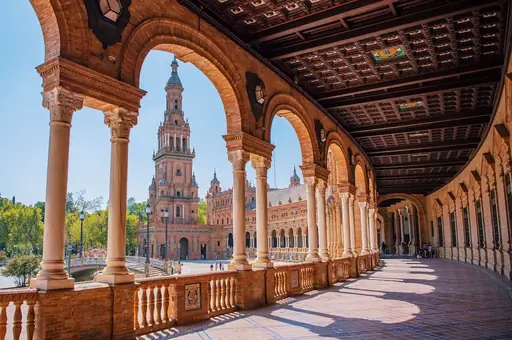
Granada stands as a historic hub in southern Spain where Moorish and Christian influences shape daily life. The Alhambra dominates the skyline with its intricate stonework and serene courtyards. Visitors encounter ornate arches that reflect centuries of cultural exchange. The site’s layout reveals careful planning from medieval rulers who valued both beauty and practicality.
The palace complex includes the Nasrid Palaces known for their delicate tilework and carved wooden ceilings. Each room tells a story through patterns that avoid figurative images, focusing instead on geometry and nature. The Court of the Lions features a central fountain supported by twelve stone lions, symbolizing strength and balance. Gardens like the Generalife provide tranquil spaces with fountains and fruit trees, showing how water was integrated into architecture.
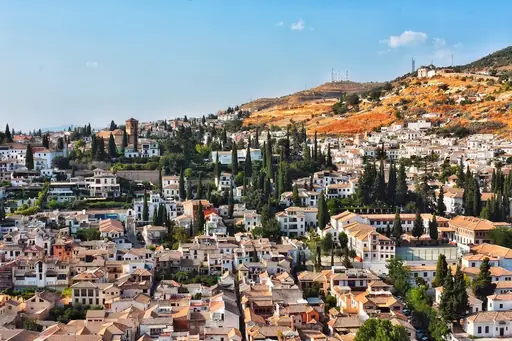
Beyond the palace walls lies Granada’s old town where narrow streets lead to markets selling spices and handmade goods. The Albaicín district retains its medieval layout with whitewashed houses and hidden plazas. Local cafes serve traditional dishes like gazpacho and tapas paired with sherry wine from nearby vineyards. Evening brings cooler temperatures making outdoor exploration comfortable even in summer.
Modern Granada balances preservation with daily life. Conservation efforts protect historic structures while new businesses adapt old buildings for contemporary use. Public transport connects the city center to neighborhoods like Realejo known for street art and multicultural influences. The region’s climate supports agriculture with olive groves and almond trees thriving in the surrounding hills creating a landscape that feels both ancient and alive.
The Alhambra in Granada, Spain, is accessible via several transportation methods. The nearest major airport is Federico García Lorca Granada Airport (GRX), located approximately 25 kilometers east of the city center. Regular bus services and taxis connect the airport to central Granada, with travel time averaging around 30–40 minutes depending on traffic. For rail access, Granada’s Santa Justa train station offers regional trains from Madrid, Seville and Córdoba, with journeys taking 2–3 hours from these cities. The city center is walkable, but buses and the Metro de Granada provide additional local transit options for visitors exploring nearby neighborhoods or attractions like the Albaicín district.
Granada’s historic center offers a spectrum of lodging that caters to every budget and taste. Boutique guesthouses tucked into the winding streets of Albaicín provide intimate rooms with traditional Andalusian décor, often featuring rooftop terraces overlooking the Alhambra’s silhouette. Mid‑range hotels in the city’s core combine modern amenities with classic Spanish charm, offering comfortable rooms, on‑site dining and convenient access to public transport. For travelers seeking luxury, upscale resorts just outside the old town boast expansive suites, private pools and panoramic views of the Sierra Nevada. Many accommodations emphasize local craftsmanship – hand‑woven textiles, ceramic tiles and wrought‑iron balconies – allowing guests to experience authentic Andalusian hospitality while staying within walking distance of the palace complex.
Log in to add this place to a travel list and get a summary of all recommended items for your whole trip.
We calculate the average costs when travelling to destinations and compare those with the living costs at your home. With this you can get an estimate of how expensive or cheap the destination is for you.
To customise this, you can set up which location and price level are used for the calculations in your account settings.
The exchange rate price factor shows how expensive or cheap a currency currently is compared to its historical average. It's a quick way to see if a country is currently more or less affordable due to exchange rate changes.
