










Was this page helpful?

| Opening hours: |
|
||
|---|---|---|---|
| Public website: | www.annefrank.org |
| Power Grid: |
230 V, 50 Hz Plug: Type C , Type F
Type C:
  Read about power adapters |
|---|---|
| Currency: |
Euro (EUR) £1 ≈ €1.19 |
| Cashless info: |
Rating 5/5
The Netherlands is highly cashless, with almost all businesses accepting card payments. Contactless payments and mobile apps are widely used, and cash is not always necessary.
Save with a travel credit card |
| eSIM providers: |
Best value: Saily Flexibility: Airalo Read our in-depth comparison |
| Tipping: | Tipping is appreciated but not compulsory in the Netherlands. In restaurants, a tip of 5-10% is standard. Taxi drivers usually expect a small tip or rounding up, and hotel staff appreciate small tips. |
|---|---|
| Public drinking: | Public drinking is allowed in most places in the Netherlands, including parks and on the streets. However, there are some restrictions in specific areas or during festivals. |
| Public smoking: | Smoking is banned indoors in public spaces, including bars, restaurants, and public transport. Smoking areas are designated in many public places. |
| King's Day (April) |
A national holiday with celebrations, parades, and festivals. Expect large crowds, especially in cities like Amsterdam. |
|---|---|
| Christmas (December) |
Festivities are widespread, but cities can be crowded, and prices for accommodation may rise. |
| Sinterklaas (December) |
Celebrations for the Dutch Christmas tradition, expect family-oriented events and high demand for accommodation. |
| Emergency contact: | Emergency Number: 112 (Police, Fire, Ambulance) |
|---|---|
| Taxi apps: | Uber, Bolt, Ola |
| Other: | The Netherlands has a well-developed infrastructure and public transport system. Be prepared for high bike usage in cities like Amsterdam, and expect occasional rain throughout the year. |
The best times to travel section shows how the months compare for a visit, so you can find the time of year that fits what you want to do.
Background colours of the months:
The colour shows the typical temperature: yellow (hot), green (mild) and blue (cold). How strong the colour is shows the travel season: full colour means high season, soft colour means shoulder season and soft-striped means off season.
Weather symbols:
Each month has one symbol showing what the weather is typically like, such as hot and sunny, freezing or a rainy or snowy season. Use them to quickly spot months that match the weather you want, or to avoid the ones that don't.
Crowdedness:
The people icon shows how busy the place usually is. The more people, the more crowded it gets.
Additional notes:
The grey info boxes point out special things worth knowing, like recurring weather issues or seasonal events.
The Anne Frank House preserves the original building where Anne Frank and seven others hid from Nazi persecution during World War II. The Secret Annex, hidden behind a movable bookcase, is hauntingly preserved largely as it was during their two years of hiding before their arrest in 1944.
The museum reveals Anne’s story through quotes, photographs, videos and original artifacts including her famous red-checked diary. Visitors explore the cramped hiding place and adjacent exhibition space that contextualizes the Holocaust and the broader fight against discrimination.
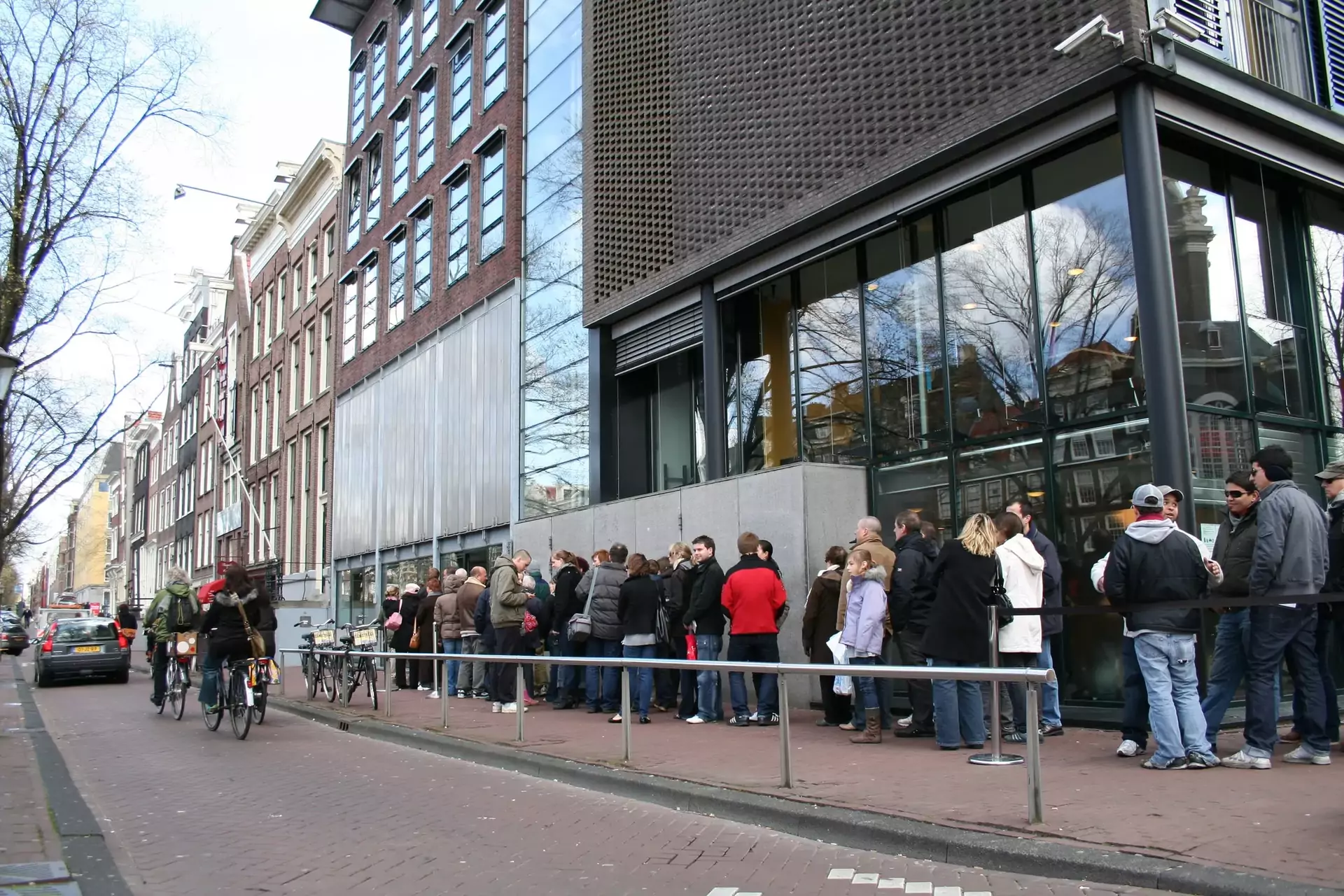
Despite being a relatively small space, the museum attracts over a million visitors annually, which can create crowding. It’s highly recommended to book tickets online well in advance. The visit is often emotional and reflective, offering deep insights into the life of Anne Frank and the tragedy of the Holocaust.
Photography is limited inside the annex to preserve the solemn atmosphere and visitors are asked to maintain respect while touring the space. The museum also hosts educational programs to promote tolerance and human rights, ensuring Anne’s legacy resonates with future generations.
The Anne Frank House is located in central Amsterdam along the Prinsengracht canal close to the Westerkerk. Visitors can reach it on foot from Amsterdam Central Station within about 20 minutes or by tram lines 13 or 17 to the Westermarkt stop nearby. Amsterdam Schiphol Airport serves international travelers with frequent train and taxi connections to the city center.
Amsterdam’s city center offers a broad range of accommodations near the Anne Frank House, from boutique hotels to mid-range and luxury options, making it easy to explore the museum and other city highlights on foot.
Log in to add this place to a travel list and get a summary of all recommended items for your whole trip.
We calculate the average costs when travelling to destinations and compare those with the living costs at your home. With this you can get an estimate of how expensive or cheap the destination is for you.
To customise this, you can set up which location and price level are used for the calculations in your account settings.
The exchange rate price factor shows how expensive or cheap a currency currently is compared to its historical average. It's a quick way to see if a country is currently more or less affordable due to exchange rate changes.
