








Was this page helpful?

| Opening hours: |
|
|---|
| Power Grid: |
230 V, 50 Hz Plug: Type C , Type F
Type C:
  Read about power adapters |
|---|---|
| Currency: |
Euro (EUR) £1 ≈ €1.19 |
| Cashless info: |
Rating 4/5
Cards are widely accepted, especially in urban areas, but small establishments may prefer cash. Be prepared for occasional cash-only situations.
Save with a travel credit card |
| eSIM providers: |
Best value: Saily Flexibility: Airalo Read our in-depth comparison |
| Tipping: | Tipping is common in restaurants, typically 5-10%. For taxis, it is customary to round up to the nearest euro. Tipping in cash is more common than adding it to card payments. |
|---|---|
| Public drinking: | Public drinking is allowed in most parts of Germany, especially in beer gardens and public events, but some local regulations may restrict it in specific areas. |
| Public smoking: | Smoking is prohibited indoors in public places such as restaurants, trains, and buses. Designated smoking areas are available outside many buildings. |
| Oktoberfest (September) |
Huge crowds in Munich. Expect high hotel rates and crowded transport. |
|---|---|
| Christmas (December) |
Christmas markets are popular, expect crowded cities and higher prices. |
| Labour Day (May) |
Many shops are closed, and there are celebrations throughout the country. |
| Emergency contact: | Police: 110, Emergency Number: 112 (Fire, Ambulance) |
|---|---|
| Taxi apps: | Uber, Free Now, myTaxi |
| Other: | Germany is well-equipped for tourists, with good public transport and high-quality facilities. However, be prepared for language barriers in some rural areas. |
The best times to travel section shows how the months compare for a visit, so you can find the time of year that fits what you want to do.
Background colours of the months:
The colour shows the typical temperature: yellow (hot), green (mild) and blue (cold). How strong the colour is shows the travel season: full colour means high season, soft colour means shoulder season and soft-striped means off season.
Weather symbols:
Each month has one symbol showing what the weather is typically like, such as hot and sunny, freezing or a rainy or snowy season. Use them to quickly spot months that match the weather you want, or to avoid the ones that don't.
Crowdedness:
The people icon shows how busy the place usually is. The more people, the more crowded it gets.
Additional notes:
The grey info boxes point out special things worth knowing, like recurring weather issues or seasonal events.
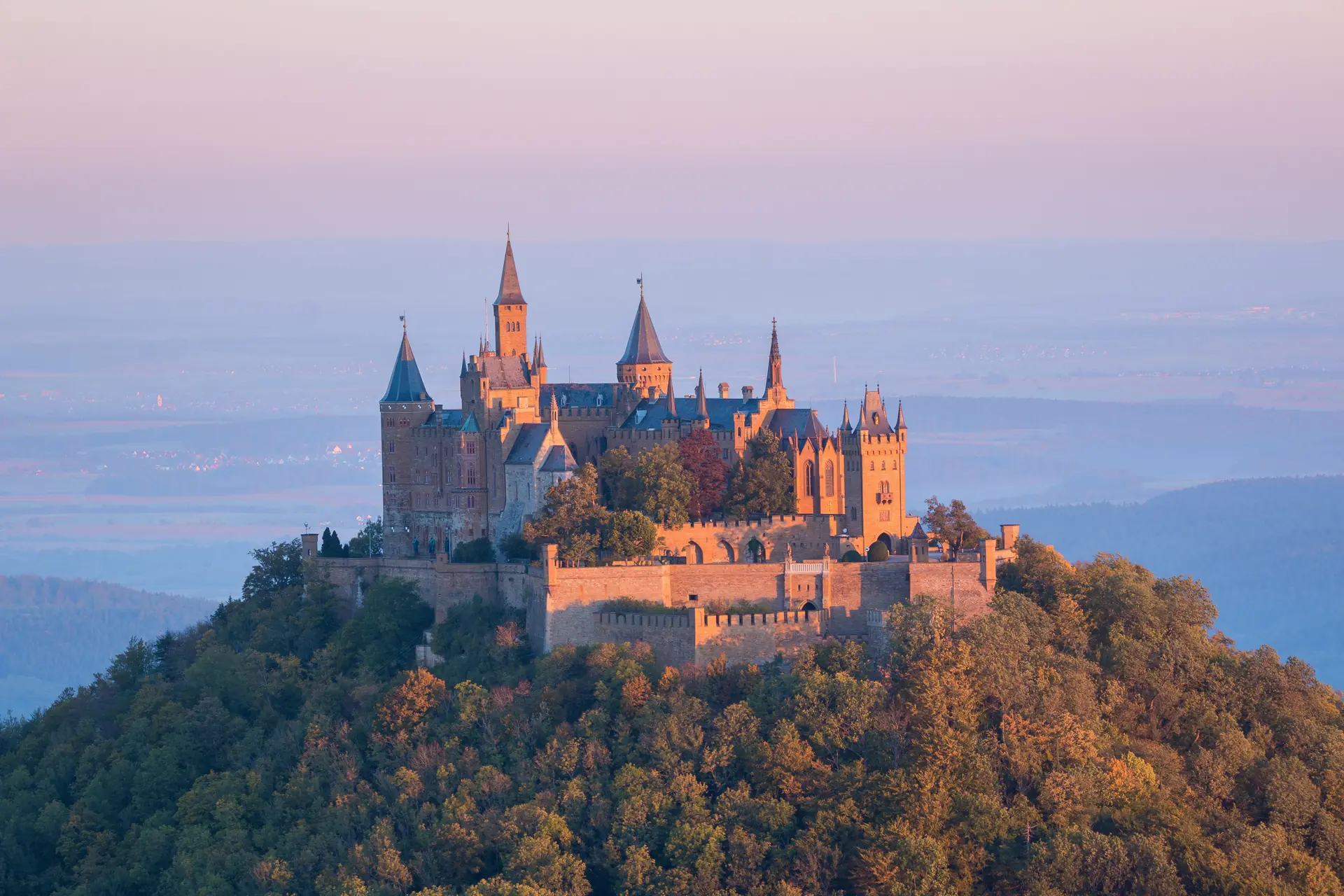
Hohenzollern Castle crowns an isolated, cone-shaped hill that rises to 855 m above sea level on the Alb's edge, just south of Hechingen. It's the ancestral seat of the House of Hohenzollern, the family that produced the kings of Prussia and the German emperors. What stands here today is a neo-Gothic fortress of towers, bastions and battlements, finished in 1867 as a monument to the family and still privately owned by both its Prussian and its Swabian line.
The hill has carried three castles. The first is mentioned in writing around 1267 and was probably built about two centuries earlier. After it was captured and destroyed in 1423 a larger castle went up from 1454. It was later turned into a fortress during the Thirty Years' War before falling into decay. Only the St. Michael's Chapel survives from the medieval buildings. In 1819 the young Prussian crown prince Frederick William climbed the hill to see his ancestors' castle in ruins. As King Frederick William IV he had it rebuilt from 1850 on, with the architect Friedrich August Stüler and the military engineer Moritz von Prittwitz designing the new complex.
The visit has two parts. Outside, the ramparts, bastions and courtyards give wide views over the Alb and the plain below. The casemates (vaulted cellars) and both castle chapels can be seen without a guide. Inside, the museum rooms show the family's collections with stops such as the family tree hall, the Blue Salon and the Count's Hall. The route ends in the treasury, which holds the diamond-set crown of Wilhelm II and keepsakes tied to Frederick the Great and Queen Luise. The coffins of Frederick the Great and his father Frederick William I also lay in the castle until German reunification.
Allow two to three hours. You can explore the grounds at your own pace. A free castle app gives audio commentary in German, English and French (headphones are expected). The way from the Eagle's Gate up to the inner courtyard is paved with cobblestones and has steps and slopes, so shoes with good grip help. Long or pointed objects such as hiking sticks and umbrellas aren't allowed in the rooms but can be left at the information office.
Most visitors come by train to Hechingen or by car to the castle's car park. Trains run from Tübingen and Stuttgart to Hechingen station and the ride from Stuttgart takes around an hour. A few metres from the platform a bus (lines 306 and 344, run by HVB Hechingen) goes to the car park, but departures are limited so check the timetable first. The castle's website also lists train tickets for up to five people that include this bus. By car the castle is about 60 km southwest of Stuttgart. From the A81 take the Empfingen exit and follow the B463 toward Balingen and then the B27 toward Hechingen. From Tübingen the B27 leads to the Burg Hohenzollern exit and a road through the forest up to the car park, which has room for cars and buses. Stuttgart Airport (STR) is the nearest large airport, roughly an hour away by car. From the car park a shuttle bus runs about every 15 minutes to the Eagle's Gate. You can also walk uphill in around 25 minutes.
There's no hotel at the castle, so most people stay in the towns around the hill. Hechingen is the closest base, about 4 km from the castle with hotels and guesthouses and a train station that connects to the castle bus. The villages around the hill have a few more guesthouses and suit you best if you're arriving by car. Tübingen, 28 km away, has the widest choice of hotels and flats and an old town on the Neckar, which works well for a longer trip that pairs the castle with a university town. Stuttgart is another option, about an hour by train, with a much larger range of rooms but a longer day on the move. Rooms near the castle are limited, so book ahead for summer weekends and for the days around events such as the winter market.
Food at the castle is limited to a restaurant inside the museum grounds and a few options at the car park, so it helps to plan a meal around your visit. The castle restaurant sits within the ticketed area and serves hot food from late morning to late afternoon. Dogs are welcome there as long as they don't disturb other guests. Cooking in this part of Baden-Württemberg is Swabian, with Spätzle (soft egg noodles) and Maultaschen (filled pasta pockets) on many menus. Near the car park a shop and a kiosk usually sell drinks and snacks.
The towns below have more choice, with bakeries, supermarkets and restaurants in Hechingen. Eating there before or after the visit works well if you arrive late in the day or the castle kitchen has already closed.
Log in to add this place to a travel list and get a summary of all recommended items for your whole trip.
We calculate the average costs when travelling to destinations and compare those with the living costs at your home. With this you can get an estimate of how expensive or cheap the destination is for you.
To customise this, you can set up which location and price level are used for the calculations in your account settings.
The exchange rate price factor shows how expensive or cheap a currency currently is compared to its historical average. It's a quick way to see if a country is currently more or less affordable due to exchange rate changes.
