






Was this page helpful?

| Opening hours: |
|
||||
|---|---|---|---|---|---|
| Public website: | www.tokyo-skytree.jp |
| Power Grid: |
100 V, 50 Hz Plug: Type A
Type A:
 Read about power adapters |
|---|---|
| Currency: |
Japanese Yen (JPY) £1 ≈ JP¥210 |
| Cashless info: |
Rating 4/5
Cashless payments are becoming more common, especially in cities, with some shops still preferring cash. Be prepared for occasional cash-only situations in rural areas.
Save with a travel credit card |
| eSIM providers: |
Best value: Saily Flexibility: Airalo Read our in-depth comparison |
| Tipping: | Tipping is not customary in Japan and can be considered rude. Excellent service is the norm, and tipping is unnecessary in most places. |
|---|---|
| Public drinking: | Public drinking is legal and commonly accepted, particularly during festivals and events. |
| Public smoking: | Smoking is prohibited in indoor public places but allowed in designated outdoor areas. Some restaurants may have smoking sections. |
| New Year (January) |
One of the most important holidays, expect crowded temples and high prices. Plan ahead. |
|---|---|
| Golden Week (April-May) |
The busiest travel time, expect high demand for accommodation and transport. |
| Obon (August) |
A time to honour ancestors, many businesses close, and transport can be crowded. |
| Emergency contact: | Emergency Number: 110 (Police), 119 (Fire & Ambulance) |
|---|---|
| Taxi apps: | Uber, JapanTaxi, DiDi |
| Other: | Japan is a country of respect, so understanding local customs and etiquette is important. Public transport is efficient, but can be crowded during peak hours. |
The best times to travel section shows how the months compare for a visit, so you can find the time of year that fits what you want to do.
Background colours of the months:
The colour shows the typical temperature: yellow (hot), green (mild) and blue (cold). How strong the colour is shows the travel season: full colour means high season, soft colour means shoulder season and soft-striped means off season.
Weather symbols:
Each month has one symbol showing what the weather is typically like, such as hot and sunny, freezing or a rainy or snowy season. Use them to quickly spot months that match the weather you want, or to avoid the ones that don't.
Crowdedness:
The people icon shows how busy the place usually is. The more people, the more crowded it gets.
Additional notes:
The grey info boxes point out special things worth knowing, like recurring weather issues or seasonal events.
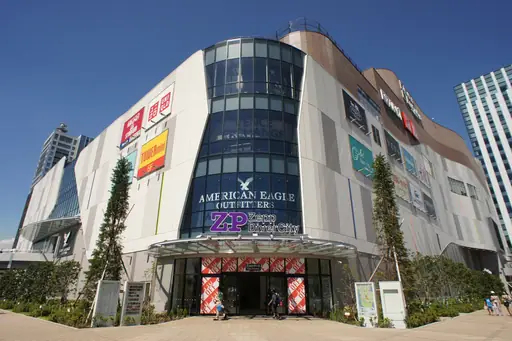
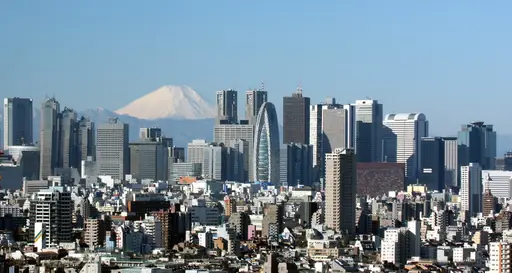
Tokyo Skytree is a broadcasting tower in Sumida Ward, 634 m tall. It opened to the public in 2012 as Japan's highest structure and carries digital television signals for the Tokyo area. Visitors can go up to two observation levels and on a clear day Mount Fuji is visible in the distance. The entrance is inside the Solamachi shopping complex at the base of the tower. Most visits start indoors on the fourth floor, where tickets are bought or exchanged.
The first level is the Tembo Deck at 350 m, spread over floors 340 to 350. Floor-to-ceiling windows give 360-degree views over the city and part of floor 340 has a glass floor with a view straight down. Floor 345 has shops and a restaurant as well as a red postbox shaped like the tower. The cafe, a photo service and the ticket counter for the next level are on floor 350.
A second lift takes you up to the Tembo Galleria at 450 m. Its main feature is a sloping walkway of about 110 m that rises from floor 445 to floor 450 with open views the whole way. It gives a higher view of the same skyline and costs extra, either as part of a combo ticket or on its own.
Allow about an hour for the decks, more if you also want to see the shops and the aquarium at the base. The tower is open every day of the year with last admission around 20:00, though hours can change on special days. Adult weekday tickets start at JP¥2,100 (£9.97) for the Tembo Deck and JP¥3,100 (£14.72) for the combo with the Galleria. Everything inside is reached by lift, so no stairs need planning. Weekends and holidays cost a little more and are usually the busiest.
Trains are the easiest way to reach Tokyo Skytree and two stations serve it. Tokyo Skytree Station on the Tobu Skytree Line is a short walk from the tower. Oshiage (Skytree-mae) Station is about 5 minutes away along a direct passage and has the Hanzomon Line, the Toei Asakusa Line and the Keisei Oshiage Line. From Asakusa the Tobu line takes about 3 minutes. From Ueno the Ginza Line to Asakusa and then the Tobu line takes around 10 minutes. From Tokyo Station you can ride the JR Sobu Rapid Line to Kinshicho and change to the Hanzomon Line for Oshiage, about 15 minutes in total. Some Keikyu trains from Haneda Airport (HND) run straight onto the Toei Asakusa Line and reach Oshiage in around 40 minutes without a change. Narita Airport (NRT) is about 50 to 60 minutes away on the Keisei Access Express. The Skytree Shuttle bus also links the tower with Ueno Station and Tokyo Disney Resort. Driving is possible since Skytree Town has its own paid car park, though the trains are simpler in this part of Tokyo.
Most visitors stay somewhere in central Tokyo and ride out to Skytree, but the Oshiage area around the tower also has business hotels and apartment-style rooms. It suits you if the tower and Asakusa are a big part of the trip. Asakusa is the most popular alternative, about 3 minutes away on the Tobu line. It has a mix of hotels, guesthouses and hostels near the temple district and a more traditional feel in the evening. Ueno is another practical base with direct Ginza Line trains to Asakusa. Staying in a larger hub such as Tokyo Station or Shinjuku gives more choice and easy trains onward. Skytree is then a ride of roughly 15 to 40 minutes. Rooms across Tokyo can fill quickly during cherry blossom season and major holidays, so it helps to book early for those weeks.


Food at the tower itself comes down to a restaurant on floor 345 and a cafe on the observation floors, both with views over the city. Most visitors eat in the Solamachi complex below, which has restaurants and shops over several floors and a food market on the second floor. The choice runs from quick counters to sit-down meals and it works well before or after going up.
Convenience stores and supermarkets are easy to find in the surrounding blocks of Oshiage if you'd rather pick up something simple. Asakusa is a few minutes away by train and is the better bet for traditional Tokyo dishes such as tempura and soba. Skytree's own food options aren't the place for local specialities, so plan a proper meal elsewhere in the city.
Log in to add this place to a travel list and get a summary of all recommended items for your whole trip.
We calculate the average costs when travelling to destinations and compare those with the living costs at your home. With this you can get an estimate of how expensive or cheap the destination is for you.
To customise this, you can set up which location and price level are used for the calculations in your account settings.
The exchange rate price factor shows how expensive or cheap a currency currently is compared to its historical average. It's a quick way to see if a country is currently more or less affordable due to exchange rate changes.
