










Was this page helpful?

These place ratings give you a quick overview of how well a destination matches different types of trips.
‘Best for’ scores:
The specific interest scores show where this place really shines – whether it's ideal for hiking, food & drink experiences, museums or other activities. These highlights help you understand what makes the destination special at a glance.
‘Your personal’ scores:
This reflects how well a place matches your personal preferences. You can adjust the importances of travel topics or other personal requirements categories in your account settings.
‘Suited for’ badges:
These give you a quick overview of how well a destination suits specific types of travellers, to help you find the places that match your lifestyle, preferences or travel situation.
| Power Grid: |
230 V, 50 Hz Plug: Type C , Type F
Type C:
  Read about power adapters |
|---|---|
| Currency: |
Indonesian Rupiah (IDR) £1 ≈ IDR 24,141.20 |
| Cashless info: |
Rating 4/5
Cashless payments are becoming more common in urban areas of Indonesia, particularly in larger cities. Credit cards and mobile payment apps like GoPay and OVO are widely accepted in many establishments.
Save with a travel credit card |
| eSIM providers: |
Best value: Saily Flexibility: Airalo Read our in-depth comparison |
| Tipping: | Tipping is appreciated but not mandatory in Indonesia. A 5-10% tip is common in restaurants, and taxi drivers may expect small tips for good service. |
|---|---|
| Public drinking: | Public drinking is not commonly seen in Indonesia. Alcohol is consumed mainly in licensed establishments such as bars, restaurants, and hotels. |
| Public smoking: | Smoking is prohibited in many indoor public spaces, including restaurants, shopping centres, and public transport. |
| Independence Day (17 August) |
A national holiday with celebrations and ceremonies |
|---|---|
| Nyepi (March/April) |
The Balinese Day of Silence, celebrated with unique rituals and festivities |
| Emergency contact: | Emergency Number: 112 |
|---|---|
| Taxi apps: | GoJek, Grab |
| Other: | Indonesia is known for its stunning natural landscapes, including beaches, volcanoes, and jungles. It is a great destination for nature lovers and adventure seekers. |
The best times to travel section shows how the months compare for a visit, so you can find the time of year that fits what you want to do.
Background colours of the months:
The colour shows the typical temperature: yellow (hot), green (mild) and blue (cold). How strong the colour is shows the travel season: full colour means high season, soft colour means shoulder season and soft-striped means off season.
Weather symbols:
Each month has one symbol showing what the weather is typically like, such as hot and sunny, freezing or a rainy or snowy season. Use them to quickly spot months that match the weather you want, or to avoid the ones that don't.
Crowdedness:
The people icon shows how busy the place usually is. The more people, the more crowded it gets.
Additional notes:
The grey info boxes point out special things worth knowing, like recurring weather issues or seasonal events.
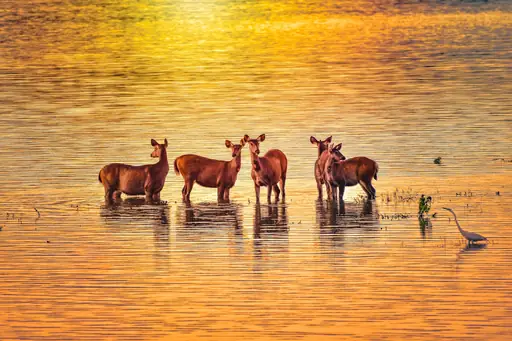
Ujung Kulon National Park, located on the western tip of Java’s Banten province, offers a unique blend of ecological significance and cultural heritage that makes it an appealing destination for travelers interested in nature and conservation. The park is best known as the sole habitat of the critically endangered Javan rhinoceros, providing visitors with a rare opportunity to observe this species in its natural environment under guided tours that prioritize minimal disturbance. Beyond the rhinos, Ujung Kulon features diverse ecosystems ranging from lowland dipterocarp forests to mangrove swamps and coastal wetlands. These habitats support a variety of wildlife, including hornbills, monitor lizards and numerous bird species, making it an attractive spot for birdwatchers and photographers seeking authentic tropical landscapes. The park’s coastline offers clear waters and sandy beaches that are less frequented by mass tourism, allowing travelers to experience quiet seaside walks and local fishing villages. Visitors can also explore the nearby Ujung Kulon Cultural Heritage Site, where traditional Javanese practices and community life provide insight into the region’s history. Access is facilitated through well-maintained trails and guided tours, ensuring safety while preserving the park’s fragile ecosystems. For those who value responsible travel, Ujung Kulon National Park presents a meaningful experience that combines wildlife observation, ecological education and cultural exploration in one of Java’s most protected natural areas.
Ujung Kulon National Park, located on the western tip of Java Island in Indonesia, is accessible primarily by road from the city of Serang or the port town of Anyer. The park lies approximately 150 kilometers from Jakarta, reachable via the Cilegon–Serang highway and then taking local roads toward the park entrance. Public transportation options include buses and private cars; however, travelers should note that road conditions may vary. For those arriving by sea, the nearest port is in Anyer, with a short drive or boat ride required to enter the park. Visitors often combine a trip here with nearby attractions such as the Cirebon Palace or the coastal town of Labuan.
Near Ujung Kulon National Park, accommodations range from modest homestays in nearby villages to eco‑lodges that blend into the forest canopy. Budget travelers can find simple guesthouses for IDR 200,000 – 300,000 (£8.31 – 12.47) per night, offering basic rooms with shared bathrooms and local meals. Mid‑range options include boutique bungalows built from reclaimed timber, priced around IDR 600,000 – 900,000 (£24.94 – 37.41), featuring private verandas overlooking mangrove swamps. For those seeking higher comfort, eco‑resorts provide solar‑powered cabins, organic dining and guided wildlife tours, with rates between IDR 1,500,000 (£62.35) and IDR 3,000,000 (£124.70) per night. The area is renowned for its sustainable lodging that minimizes environmental impact while supporting community livelihoods.
We calculate the average costs when travelling to destinations and compare those with the living costs at your home. With this you can get an estimate of how expensive or cheap the destination is for you.
To customise this, you can set up which location and price level are used for the calculations in your account settings.
The exchange rate price factor shows how expensive or cheap a currency currently is compared to its historical average. It's a quick way to see if a country is currently more or less affordable due to exchange rate changes.
To help you plan your trip, we provide estimated daily costs per person (when travelling as a pair) for different travel styles. These numbers give you an idea of what you might spend each day at this destination, including accommodation, food, transport and activities.
Additionally, we also provide average hotel costs for different travel styles to give you an estimate for the accommodation only.
Please note that these are only estimates. The real costs depend on booking times, season and other factors.
Travel style categories explained:
Backpacker:
Staying in hostels or budget hotels, cooking your own meals or eating cheap and choosing low-cost activities.
Mid-range:
Staying in mid-range hotels, eating at a mix of restaurants and casual spots and enjoying a variety of activities.
Luxury:
Staying in luxury hotels, dining out at high-end restaurants and enjoying premium experiences without worrying about the price.
| Backpacker | Mid-range | Luxury | |
|---|---|---|---|
| 💵 Total costs per day, including accommodation | |||
| 🏨 Accommodation per night, per person | |||
| 🍝 Food per day | |||
| 🚕 Transportation per day |
| 🍽️ Restaurant Dinner, per person | |
|---|---|
| 🍛 Lunch Set, per person | |
| 🍟 Fast food combo | |
| 🍝 Preparing your own food, per day | |
| ☕ Cappuccino | |
| 🍺 Beer in a restaurant, 0.5 l |
| 🚌 Public transport ticket | |
|---|---|
| 🚕 Taxi Ride, 10 km / 6 mi | |
| ⛽ Petrol, 1 l |
| 🎞️ Cinema ticket | |
|---|---|
| 👩⚕️ Doctor's consult | |
| 🤧 Cold medication | |
| 💇 Basic haircut |
Log in to add this place to a travel list and get a summary of all recommended items for your whole trip.
