








Was this page helpful?

| Public website: | asi.nic.in |
|---|
| Power Grid: |
230 V, 50 Hz Plug: Type C , Type D , Type M
Type C:
   Read about power adapters |
|---|---|
| Currency: |
Indian Rupee (INR) £1 ≈ ₹126.52 |
| Cashless info: |
Rating 4/5
Cashless payments are becoming more common in India, especially in urban areas. Credit cards and mobile payment apps like Google Pay, Paytm, and PhonePe are widely accepted in cities.
Save with a travel credit card |
| eSIM providers: |
Best value: Saily Flexibility: Airalo Read our in-depth comparison |
| Tipping: | Tipping is appreciated in India but not mandatory. A 10% tip in restaurants is common. Tipping taxi drivers and hotel staff is also customary, typically 10-15% for good service. |
|---|---|
| Public drinking: | Public drinking is not commonly seen in India. Alcohol is typically consumed in licensed bars, restaurants, and hotels. |
| Public smoking: | Smoking is prohibited in many indoor public spaces, including restaurants, bars, and public transport stations. |
| Independence Day (15 August) |
A national holiday celebrated with flag hoisting and parades |
|---|---|
| Diwali (October-November) |
The Festival of Lights, celebrated with fireworks and festivities |
| Emergency contact: | Emergency Number: 112 |
|---|---|
| Taxi apps: | Ola, Uber |
| Other: | India is a vast and diverse country with a rich cultural heritage, offering a wide range of experiences from ancient temples to modern cities. Prepare for varying infrastructure and safety conditions depending on the region. |
The best times to travel section shows how the months compare for a visit, so you can find the time of year that fits what you want to do.
Background colours of the months:
The colour shows the typical temperature: yellow (hot), green (mild) and blue (cold). How strong the colour is shows the travel season: full colour means high season, soft colour means shoulder season and soft-striped means off season.
Weather symbols:
Each month has one symbol showing what the weather is typically like, such as hot and sunny, freezing or a rainy or snowy season. Use them to quickly spot months that match the weather you want, or to avoid the ones that don't.
Crowdedness:
The people icon shows how busy the place usually is. The more people, the more crowded it gets.
Additional notes:
The grey info boxes point out special things worth knowing, like recurring weather issues or seasonal events.
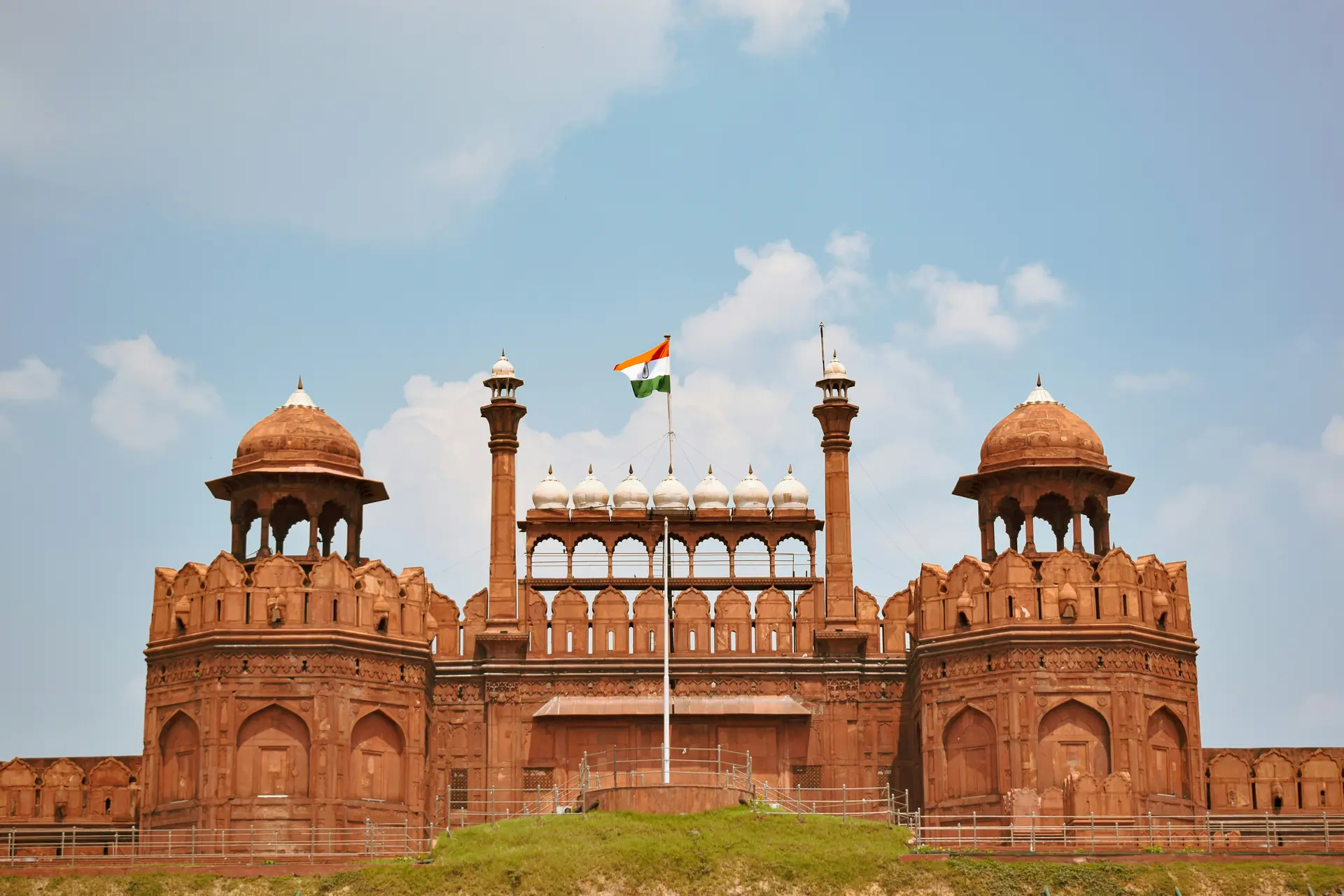
Red Fort stands as a monument from India’s past. Built by Emperor Shah Jahan in the 1600s it served as the main residence for Mughal rulers. The red sandstone walls rise high above the city and show how power was shown through design. Visitors walk along wide paths where processions once passed and listen to echoes of court life that shaped history.
The fort’s layout includes a series of gates courtyards and gardens arranged around a central axis. The Diwan-i-Am or Hall of Public Audience allowed the emperor to meet common people while the Diwan-i-Khas or Hall of Private Audience held special meetings. Each space tells part of a story about governance trade and daily life in an empire that stretched across much of South Asia.
Today Red Fort is a UNESCO World Heritage Site and a place where national events still happen. The annual flag hoisting on Independence Day draws crowds who gather to watch the ceremony from its ramparts. Nearby markets sell handicrafts and snacks letting travelers taste local flavors while learning about traditions that remain important in modern India.
Walking through Red Fort feels like stepping into layers of history. The stone walls have seen wars changes in rule and moments of celebration. Guides share facts about battles treaties and the people who lived here. For those interested in culture or architecture this site offers clear examples of how past decisions still influence life today.
The Red Fort in Delhi, India, is accessible via several transportation methods. The nearest metro station is Chandni Chowk (Line 3), offering a direct connection to the city’s transport network. For those using buses, Delhi Transport Corporation operates routes that stop near the fort. Taxis and auto-rickshaws are readily available from major hubs like New Delhi Railway Station or Indira Gandhi International Airport, with travel time typically ranging between 30–60 minutes depending on traffic. The site is well-connected by road to central Delhi areas, ensuring ease of access for visitors arriving by private vehicle via the Ring Road or Shahdara Marg.
Near the Red Fort, accommodations range from boutique heritage stays in restored colonial mansions to modern serviced apartments offering panoramic city views. Mid‑range guesthouses provide comfortable rooms with free Wi‑Fi and breakfast at modest rates of ₹2,500 – 4,000 (£19.80 – 31.68) per night, while luxury options feature spa services, rooftop dining and concierge assistance, typically starting around ₹12,000 (£95.04). Many visitors favor heritage hotels that preserve architectural details of the Mughal era, offering a cultural experience alongside contemporary amenities. For budget travelers, hostels and capsule rooms in nearby markets offer clean, affordable lodging with easy access to public transport and local eateries. The area’s blend of historic charm and modern convenience makes it ideal for all types of stays.
Log in to add this place to a travel list and get a summary of all recommended items for your whole trip.
We calculate the average costs when travelling to destinations and compare those with the living costs at your home. With this you can get an estimate of how expensive or cheap the destination is for you.
To customise this, you can set up which location and price level are used for the calculations in your account settings.
The exchange rate price factor shows how expensive or cheap a currency currently is compared to its historical average. It's a quick way to see if a country is currently more or less affordable due to exchange rate changes.
