


South America › Ecuador › Quito › Climate

Quito climate data

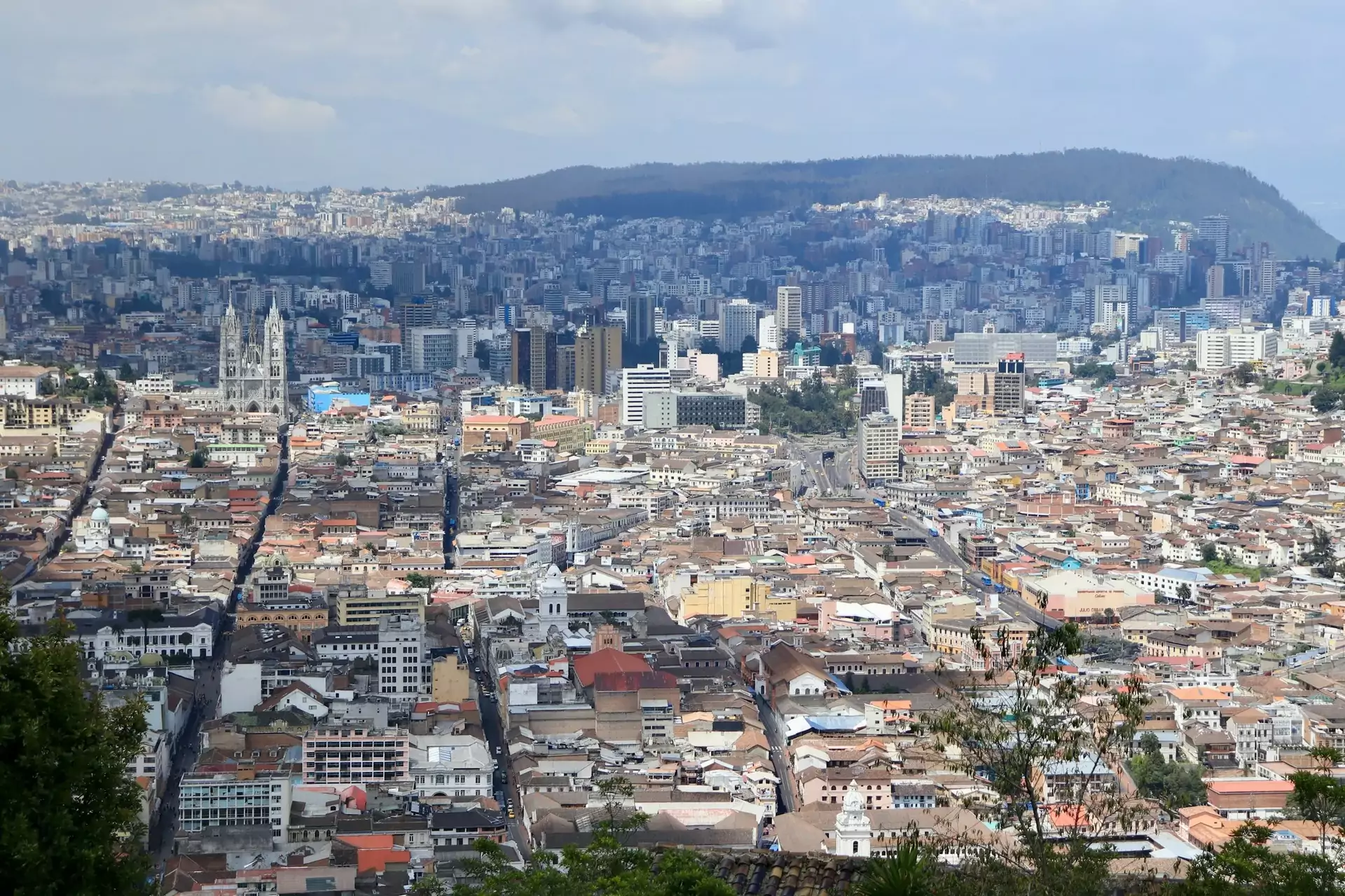
Quito features a subtropical highland climate with mild, spring-like temperatures year-round. Thanks to its equatorial location and high altitude, the city experiences little temperature variation but distinct wet and dry seasons. Expect cool mornings, mild afternoons, and chilly evenings, with dramatic weather shifts possible in a single day.

Best times to travel

The best times to travel section shows how the months compare for a visit, so you can find the time of year that fits what you want to do.

Background colours of the months:
The colour shows the typical temperature: yellow (hot), green (mild) and blue (cold). How strong the colour is shows the travel season: full colour means high season, soft colour means shoulder season and soft-striped means off season.

Weather symbols:
Each month has one symbol showing what the weather is typically like, such as hot and sunny, freezing or a rainy or snowy season. Use them to quickly spot months that match the weather you want, or to avoid the ones that don't.

Crowdedness:
The people icon shows how busy the place usually is. The more people, the more crowded it gets.

Additional notes:
The grey info boxes point out special things worth knowing, like recurring weather issues or seasonal events.

for Quito, Ecuador
🌧️
Jan
🌧️
Feb
⛈️
Mar
⛈️
Apr
⛈️
May
🌦️
Jun
🌦️
Jul
🌦️
Aug
🌦️
Sep
⛈️
Oct
⛈️
Nov
⛈️
Dec
High season: June - Sep.
Shoulder season: Jan. - Feb., May, Oct., Dec.
Crowdedness: 8 (Very crowded)
Tap on a month for more info Hover over a month for more info
Fiestas de Quito, the city's main celebration, runs late November to 6 December
Weather is mild year-round at 2,850 m altitude, mornings are usually clear and rain comes in the afternoon

The climate of Quito

Quito’s climate is shaped by its position near the equator and elevation of 2,850 metres. The city enjoys stable, moderate temperatures throughout the year, with average daytime highs of 18–22°C and nighttime lows of 8–10°C. Despite being in the tropics, Quito’s altitude keeps conditions spring-like, and the city rarely experiences extreme heat or cold. Sunshine is abundant, with 5–10 hours per day depending on the time of year, and daylight lasts about 12 hours year-round. UV radiation is high, so sun protection is essential even on cloudy days.

There are two main seasons: a dry season from June to September and a wet season from October to May.
The dry season brings clear skies, minimal rainfall, and the best mountain views, with July and August being the sunniest months. The wet season sees frequent afternoon showers, especially from February to April, the rainiest period, though mornings often remain clear. Rain can be heavy but usually brief, and lush green landscapes are the reward. Winds are generally light to moderate, but can pick up during storms or in the drier months. Fog is possible at any time, especially in the mornings or evenings, and the weather can change rapidly due to the city’s mountainous setting.

Average climate data for Quito, Ecuador
Month Jan Feb Mar Apr May Jun Jul Aug Sep Oct Nov Dec Year
Average maximum temperature (°C) 16 16 16 16 16 17 17 18 18 16 16 16 18
Average minimum temperature (°C) 9 9 9 9 9 8 8 8 8 9 9 9 8
Average precipitation (mm) 137 125 176 213 174 92 80 78 113 213 232 201 1,836
Average rainfall days (days) 26 23 27 28 29 26 24 26 26 30 29 30 323
Average relative humidity (%) 87 89 90 89 87 82 76 76 76 85 89 87 84
Average wind speed (km/h) 5 4 5 4 5 6 7 6 6 5 5 5 5
Average daily daylight hours (h) 12 12 12 12 12 12 12 12 12 12 12 12 12
Average daily sunshine hours (h) 5 5 5 5 5 7 8 8 8 7 6 5 6
Average cloud coverage (%) 60 64 64 64 56 40 35 30 36 55 65 62 53
Average UV index 4 3 4 4 4 4 4 4 4 4 4 4 4

Travel info

  • Dry Season (Jun–Sep): Mild (8–21°C), with clear skies, little rain, and excellent mountain views. Pack layers and sun protection. Ideal for sightseeing, hiking, and festivals.
  • Wet Season (Oct–May): Mild (9–20°C), with frequent afternoon showers, especially Feb–Apr. Bring a rain jacket, umbrella, and waterproof shoes. Mornings are often sunny, but weather can change quickly.
  • Year-round: Nights are chilly – always bring a jumper or jacket. Sun rises and sets at about the same time daily (6:15 am/pm). UV is very high, so use sun cream even on cloudy days.
  • General Tips: Dress in layers for rapid temperature changes. Acclimatise to the altitude before strenuous activity. Weather can shift quickly – always check the forecast and be prepared for both sun and rain.

The best time to visit Quito

The best time to visit Quito is during the dry season from June to September, when rainfall is lowest, skies are clearest, and mountain views are spectacular. These months offer the most reliable weather for outdoor activities, sightseeing, and exploring the city’s historic centre and surrounding Andean landscapes.

The worst time to visit Quito

The least favourable time to visit is from February to April, the peak of the rainy season. Heavy afternoon showers are frequent, which can disrupt hiking or outdoor plans. However, mornings are often clear, and the city is lush and green, so travel is still possible with flexible plans and rain gear.

Frequently asked questions

What is the climate like in Quito year-round?

Quito has a subtropical highland climate with mild, spring-like temperatures year-round. Average highs are 18–22°C, and lows are 8–10°C. There are distinct wet (Oct–May) and dry (Jun–Sep) seasons.

When is the rainy season in Quito?

The rainy season runs from October to May, with the heaviest rainfall from February to April. Showers are usually brief and occur in the afternoon, while mornings often remain sunny.

Does Quito experience extreme temperatures or snow?

No, Quito’s high altitude keeps temperatures moderate year-round. Frost and snow are extremely rare, and the city rarely gets hotter than 22°C or colder than 6°C at night.

How much sunshine does Quito get?

Quito enjoys 5–10 hours of sunshine per day, with the sunniest months in July and August. Daylight lasts about 12 hours year-round, with sunrise and sunset times changing little due to the equator.

What should I pack for Quito’s weather?

Pack layers, a jumper or jacket for chilly nights, and a rain jacket or umbrella for the wet season. Sun protection is essential year-round due to high UV radiation, even on cloudy days.

Is Quito windy or humid?

Humidity is moderate to high during the rainy season and lower in the dry season. Winds are generally light to moderate but can be brisk during storms or in drier months. Fog is possible, especially in the mornings.

Is altitude a concern for travellers in Quito?

Yes, Quito’s elevation (2,850 m) can cause mild altitude sickness. Take it easy your first day, stay hydrated, and avoid strenuous activity until acclimatised.

Minimum and maximum temperatures in Quito

The warmest month, with the highest average maximum temperature, is August (17.9 °C). The month with the lowest average maximum temperature is March (15.6 °C). Overall, the average maximum temperature over the whole year is 16.4 °C.

The month with the highest average minimum temperature is February (9.2 °C). The coldest month, with the lowest average minimum temperature, is July (7.7 °C). Overall, the average minimum temperature over the whole year is 8.6 °C.

Rainfall amount in Quito

The wettest month, with the highest amount of precipitation, is November (232.4 mm). The driest month, with the least amount of precipitation, is August (78.3 mm). Over the whole year there are 1,835.8 mm of rainfall on average.

Rainfall days in Quito

The month with the most days of rain is October (30.4 days). The month with the fewest days of rain is February (22.8 days). Over the whole year there are 323.1 days of rain on average.

Relative humidity in Quito

The month with the highest average relative humidity is March (90 %). The month with the lowest average relative humidity is August (75.8 %). The overall average relative humidity over the whole year is 84.3 %.

Wind speed in Quito

The windiest month, with the highest average wind speed, is July (6.9 km/h). The calmest month, with the lowest average wind speed, is April (4.3 km/h). The overall average wind speed over the whole year is 5.1 km/h.

Cloud coverage in Quito

The month with the cloudiest skies, so the highest cloud coverage, is November (65.1 %). The month with the clearest skies, so the lowest cloud coverage, is August (30.1 %). Over the whole year there is an average cloud coverage of 52.5 %.

Daylight hours and sunshine hours in Quito

Over the whole year there are 12 h of daylight per day on average.

The month with the most sunshine per day is September (Average sunshine: 8.1 h). The month with the least sunshine per day is December (Average sunshine: 4.9 h). Over the whole year there are 6.2 h of sunlight per day on average.

UV index in Quito

The months with the highest average UV index are January, March, April, May, June, July, August, September, October, November and December (UV index: 4). The month with the lowest average UV index is February (UV index: 3). Over the whole year the average UV index is 3.9.

Was this page helpful?
Feedback