

South America › Bolivia › Salar de Uyuni

Salar de Uyuni

Scroll
World's largest surreal salt mirror

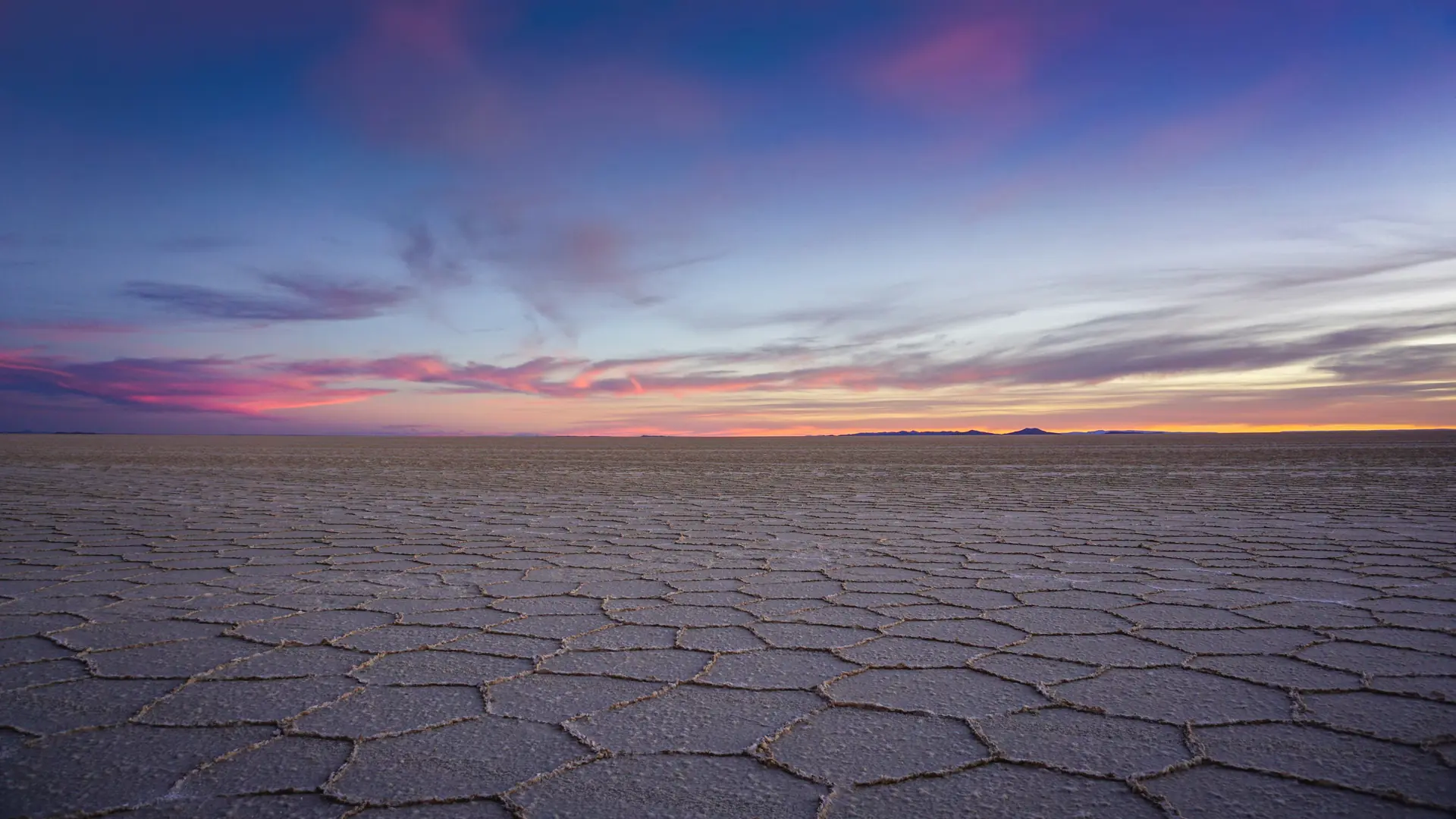
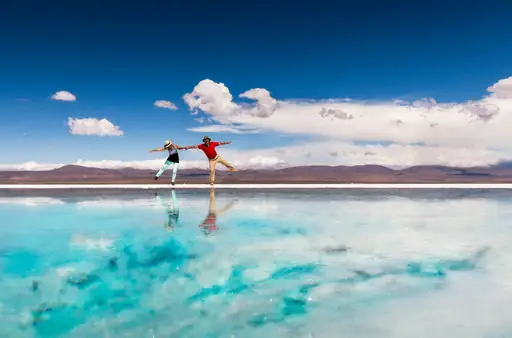
The Salar de Uyuni stretches across Bolivia like a vast white mirror after rain, covering over ten thousand square kilometers of salt crust. During the dry season, it becomes one of the largest flatlands on Earth, reflecting sky and landscape in perfect symmetry. Visitors can walk across this expanse or spot cacti growing from the ground where water would normally pool. The area is also home to flamingos and unique wildlife adapted to high-altitude conditions. Nearby towns provide basic lodging and meals for travelers exploring this unusual terrain.

Salt Flat in Bolivia
Climate zone: Cold desert

Cold desert: Arid climates with low precipitation and large temperature ranges, including cold winters, often found in continental interior deserts.

See climate table
Ticket price: $$$
$Cheap
$$Medium
$$$Expensive, upscale
$$$+Very expensive, luxury
Safety: 7.0
General Safety:8
Accessibility:3
Read details
Tourist English: 2/5
English proficiency is limited in the Uyuni area. Tour guides typically have basic to intermediate English skills sufficient for explaining attractions, but communication may be basic. In hotels and restaurants, expect minimal English, with Spanish being
Last update: 12 Oct 2026
* We earn a commission from some links on this page.
Salar de Uyuni Summary
World-famous for surreal salt flats. Walk vast mirror-like landscapes, photograph reflections, visit cactus islands and explore remote high-altitude deserts.
Public website: www.salardeuyuni.com
Bolivia – Quick facts
Power Grid: 220 V, 50 Hz
Plug: Type A , Type C
Type A:
Diagram of a Type A power plug
Type C:
Diagram of a Type C power plug

Read about power adapters
Currency: Bolivian Boliviano (BOB)
£1 ≈ BOB 15.88
Cashless info: Rating 3/5
Cashless payments are becoming more common in Bolivia, particularly in larger cities, but cash is still widely used, especially in rural areas.

Save with a travel credit card
eSIM providers: Best value: Saily
Flexibility: Airalo
Read our in-depth comparison
Tipping: Tipping is not mandatory in Bolivia, but leaving 10% in restaurants and small tips for taxi drivers or hotel staff is appreciated.
Public drinking: Public drinking is not common in Bolivia and is not widely accepted outside of private spaces or licensed establishments.
Public smoking: Smoking is allowed in designated smoking areas and licensed establishments but is prohibited in most indoor public spaces.
Dia del Trabajo (Labour Day)
(May)
Expect some business closures and public celebrations.
Carnival
(February)
Expect lively celebrations, street parties, and crowded events.
Emergency contact: Emergency Numbers: 110 (Police), 118 (Ambulance), 119 (Fire)
Taxi apps: Cabify, Uber
Other: Bolivia offers a range of natural attractions, including the Uyuni salt flats, the Amazon rainforest, and the high-altitude city of La Paz.
Best times to travel

The best times to travel section shows how the months compare for a visit, so you can find the time of year that fits what you want to do.

Background colours of the months:
The colour shows the typical temperature: yellow (hot), green (mild) and blue (cold). How strong the colour is shows the travel season: full colour means high season, soft colour means shoulder season and soft-striped means off season.

Weather symbols:
Each month has one symbol showing what the weather is typically like, such as hot and sunny, freezing or a rainy or snowy season. Use them to quickly spot months that match the weather you want, or to avoid the ones that don't.

Crowdedness:
The people icon shows how busy the place usually is. The more people, the more crowded it gets.

Additional notes:
The grey info boxes point out special things worth knowing, like recurring weather issues or seasonal events.

for Salar de Uyuni, Bolivia
🌦️
Jan
🌦️
Feb
☀️
Mar
☀️
Apr
☀️
May
☀️
Jun
☀️
Jul
☀️
Aug
☀️
Sep
☀️
Oct
☀️
Nov
☀️
Dec
High season: Jan. - Feb., May - Nov.
Shoulder season: March - April, Dec.
Tap on a month for more info Hover over a month for more info
Mirror effect needs a thin layer of water, mainly January to March, but some routes get closed
Nights drop to about -15 °C in June to August, at 3,650 m altitude
Isla Incahuasi and the salt hotels are reachable most easily in the dry months, April to November

Salar de Uyuni offers one of the most unique and surreal landscapes on Earth, where the boundless white salt crust stretches to the horizon, creating an almost extraterrestrial environment. During the wet season (December to April), a thin layer of water transforms the salt flats into the world's largest mirror, reflecting the sky so perfectly that the horizon disappears entirely. In the dry season (May to November), the crystallized salt forms fascinating hexagonal patterns across the vast expanse, offering equally spectacular but completely different photographic opportunities. Beyond the salt flats themselves, a multi-day tour reveals an astonishing variety of landscapes that seem plucked from a Salvador Dalí painting: blood-red lagoons filled with flamingos, steaming geysers, bizarre rock formations and islands covered in giant cacti rising from the salt. The area's extreme remoteness and high altitude (over 3,600 meters) create challenges, but the reward is experiencing one of the few remaining places on Earth that truly feels like visiting another world. Whether you're capturing perspective-defying photos that play with the endless white canvas or simply standing in awe of nature's grandeur, Salar de Uyuni delivers an experience that will fundamentally change how you see our planet.

Why travel to Salar de Uyuni?

🏯Places worth seeing
  • 1 Museo de la Llama y de la Sal Colchani
🎡Places for activities
  • 1 Colchani
  • 2 Salar de Uyuni
  • 3 Explora Lodge at Uyuni Salt Flats
  • 4 Railroad Museum
🏞️Natural landmarks
  • 1 Island of the Fish
  • 2 Red Lagoon
  • 3 Volcán Olca
🎈Events
  • Dakar Rally (when routed through Bolivia)
  • Festival de la Quinua
  • Carnival
  • Independence Day Celebrations
  • All Saints Day
  • Alasitas Festival
  • Easter Celebrations
  • Uyuni Anniversary
  • Winter Solstice Celebration
  • New Year's Celebrations

Knowledge before you go

  • Book a guided tour. Self-driving is extremely dangerous.
  • Visit during dry season (May-Nov) for vast white flats; wet season offers stunning mirror reflections.
  • Pack layers for high altitude cold nights and intense sun; bring altitude sickness meds if sensitive.
  • Opt for 3-day tour from Uyuni to explore lagoons, geysers, flamingos beyond just the salt flats.

How to travel to Salar de Uyuni

The most common gateway to Salar de Uyuni is the town of Uyuni in southwestern Bolivia. You can reach Uyuni by air via direct flights from La Paz or Cochabamba to Uyuni's small airport. Alternatively, long-distance buses connect Uyuni to major Bolivian cities, with the journey from La Paz taking approximately 9 hours. For those coming from Chile, direct buses operate from San Pedro de Atacama to Uyuni (a journey of about 8 hours including border crossing). Some travelers also arrive via organized tours that start in Chile or Argentina and end in Uyuni. The remoteness of the location means transportation options are limited and should be booked in advance, especially during high season.

Access summary

  • From Uyuni Airport (UYU): Short taxi to Uyuni town, then 4x4 tour.
  • From La Paz: 1-hour flight or overnight bus to Uyuni, tour start.
  • From San Pedro de Atacama (Chile): 3–4 day 4x4 tour crossing Altiplano.

Where to stay near Salar de Uyuni

Accommodation options around Salar de Uyuni range from basic to unique. In the town of Uyuni, you'll find a selection of budget hostels and mid-range hotels catering to tourists. For a truly memorable experience, consider staying in one of the famous salt hotels, where everything from walls to furniture is constructed from salt blocks. These range from basic to luxury options. On multi-day tours, accommodation is typically included but very basic, often with shared facilities and limited heating despite the freezing nighttime temperatures. Advance booking is essential, especially during the popular mirror effect season (December-April).

Hotel recommendations

*by rating and popularity. Commissions have no influence on the rankings.

How to get around Salar de Uyuni

The only practical way to explore Salar de Uyuni is through organized 4x4 tours, which are typically arranged as 1-day, 2-day or 3-day excursions from the town of Uyuni. These tours are conducted in shared 4x4 vehicles that accommodate up to 6 tourists plus a driver/guide. For a more comfortable experience, private tours can be arranged at a higher cost. Independent exploration is not recommended due to the lack of landmarks, extreme conditions and risk of getting lost on the vast salt flats. All movement within the area follows established routes to minimize environmental impact.
Budget snapshot
Costs compared to home

We calculate the average costs when travelling to destinations and compare those with the living costs at your home. With this you can get an estimate of how expensive or cheap the destination is for you.

To customise this, you can set up which location and price level are used for the calculations in your account settings.

-68 %
Daily expenses in the region are around 68% lower than the average across United States. That means you'll spend a lot less on meals and getting around.
Exchange rate trend

The exchange rate price factor shows how expensive or cheap a currency currently is compared to its historical average. It's a quick way to see if a country is currently more or less affordable due to exchange rate changes.

-44 %
Your exchange rate (GBP to BOB) is 44% better than in recent years. That means travelling now is a lot cheaper compared to the past.

Safety information overview

General safety
8
Salar de Uyuni is generally safe for travelers, with low crime rates and minimal political unrest. Visitors should stay hydrated, avoid isolated areas after sunset and respect local customs. Basic precautions – keeping valuables secure and following tour guides – ensure a worry‑free experience.
Accessi­bility
3
Salar de Uyuni offers limited accessibility: wide, flat salt flats are easy to walk on, but no paved roads or public transport reach the site. Facilities are minimal – no wheelchair ramps or accessible toilets – and extreme temperatures require careful planning for all visitors.

Looking for inspiration?

Discover
Best desert destinations in South America
South America's desert environments range from the Atacama, one of the world's driest and highest deserts, and the vast Patagonian cold desert steppe to the coastal fog deserts of…
Read more
Discover
Best spiritual destinations in South America
South America has ancient ruins, huge empty landscapes and living Indigenous traditions, which makes it a natural choice for travelers looking for something deeper than a regular…
Read more
Discover
Best destinations to visit in November in South America
South America heads toward early summer in November, with warmer weather and the first hints of the wet season arriving in several regions. Andean regions start to see more rain…
Read more
Discover
Best destinations to visit in July in South America
July draws some of the year's biggest crowds to parts of South America, even as the far south stays locked in winter. Andean trekking season is in full swing, and July counts…
Read more
Discover
Top desert destinations and arid landscapes
Desert travel offers some of the most visually arresting and physically demanding environments on earth, with the world's great sand seas, stone plateaus and salt flat systems…
Read more
Discover
Best destinations to visit in March in South America
South America settles into autumn in March, with the peak of summer travel and Carnival season both winding down. Carnival celebrations wrap up in early March in most years,…
Read more
Discover
Top photography destinations and scenic landscapes
A genuinely photogenic destination offers more than one good shot: it has the light, the composition and enough variety of conditions to reward repeat visits at different times of…
Read more
Discover
Best stargazing destinations in South America
South America's dark sky destinations are among the finest in the world, with high-altitude Andean deserts producing atmospheric conditions that have attracted major international…
Read more
Discover
Best rural retreat destinations in South America
South America's rural retreat offer is shaped by the continent's extraordinary landscape diversity, with Andean valley farmsteads, Patagonian estancias, cloud forest lodges and…
Read more
Discover
Best destinations to visit in September in South America
September marks the start of spring across South America, though winter conditions still linger in parts of the continent. Andean regions remain in their dry season, with stable…
Read more
Discover
Top stargazing destinations and dark sky reserves
The best dark sky destinations are found far from urban light pollution, typically in high-altitude deserts, remote island locations and vast uninhabited interior regions.…
Read more
Discover
Best destinations to visit in October in South America
Spring continues to build across South America in October, with conditions improving steadily in several regions at once. Andean regions remain largely in their dry season,…
Read more
Discover
Best couple vacation destinations in South America
South America suits couples who want passion in their surroundings as well as in each other. It is a continent of drama, from its landscapes to its dance floors. Some pairs come…
Read more
Discover
Best photography destinations in South America
A vast salt flat becomes a giant mirror during the wet season, creating one of the most surreal landscapes available to photograph anywhere on earth, while ancient mountain ruins…
Read more
Discover
Top rural retreat destinations and countryside getaways
Rural retreat travel is defined by the deliberate removal from urban pace and density, with landscape immersion, slower rhythms and direct engagement with food, nature and local…
Read more
Was this page helpful?
Feedback

