We use cookies and external services: MapTiler for interactive maps and Google Maps to show route duration/distance. Both may process personal data such as your IP address, including transfers outside the EU/EEA. See our privacy policy for details. By clicking ‘Accept all’, you consent to this.
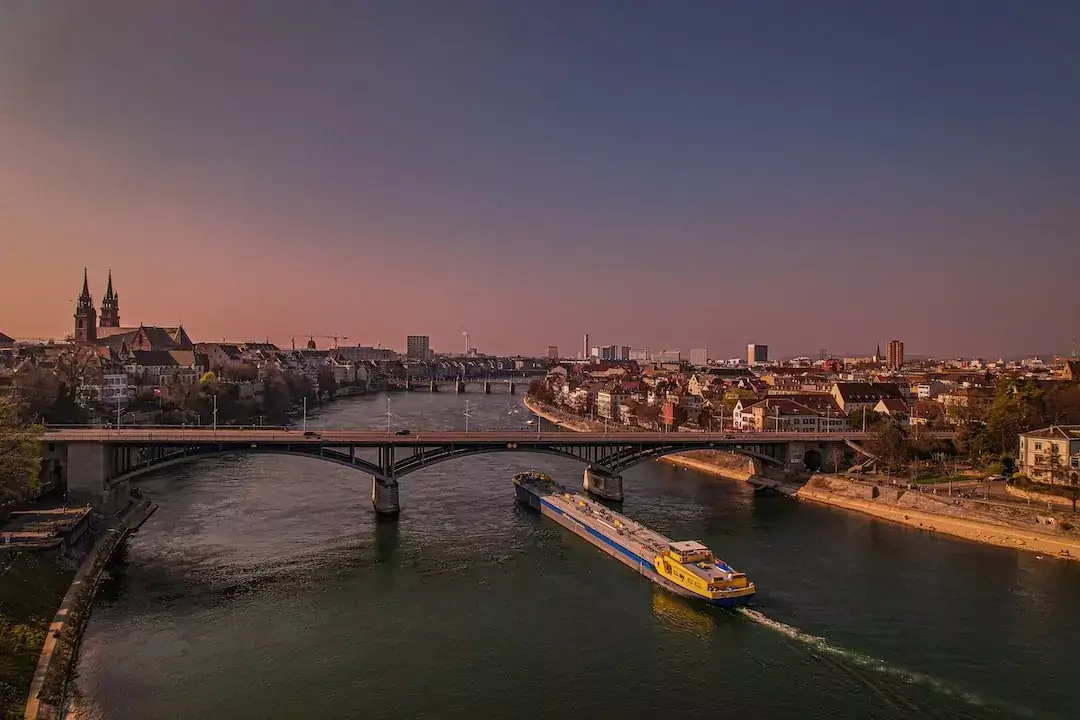
Basel, located in northern Switzerland along the Rhine, has a moderately continental climate with cold, grey winters and pleasantly warm summers. The city experiences significant seasonal changes, moderate rainfall throughout the year, and frequent sunshine in summer, making it a lively destination for both cultural events and outdoor activities.
The best times to travel section shows how the months compare for a visit, so you can find the time of year that fits what you want to do.
Background colours of the months:
The colour shows the typical temperature: yellow (hot), green (mild) and blue (cold). How strong the colour is shows the travel season: full colour means high season, soft colour means shoulder season and soft-striped means off season.
Weather symbols:
Each month has one symbol showing what the weather is typically like, such as hot and sunny, freezing or a rainy or snowy season. Use them to quickly spot months that match the weather you want, or to avoid the ones that don't.
Crowdedness:
The people icon shows how busy the place usually is. The more people, the more crowded it gets.
Additional notes:
The grey info boxes point out special things worth knowing, like recurring weather issues or seasonal events.
The climate of Basel
Basel’s climate is marked by clear seasonal contrasts. Winters (December–February) are cold and often grey, with average highs of 3–5°C and lows near -1°C. Snow is possible but not frequent or heavy, with about 37 cm annually – less than many other Swiss cities. Cold spells can drop temperatures below -10°C, while milder Atlantic periods bring above-freezing days. Winter days are short, with 2–3 hours of sunshine and around 8–9 hours of daylight. Rain or snow falls 5–7 days per month, and humidity is high, making the cold feel more intense.
Summers (June–August) are warm and lively, with average highs of 22–25°C and lows of 13–15°C. July is typically the hottest month, but short heatwaves above 32°C are possible. Rain is moderate but frequent, with 9–10 days of rain per month and occasional thunderstorms. Sunshine peaks in July and August, with up to 7–8 hours per day and long daylight hours. Spring (March–May) and autumn (September–November) are transitional, with mild temperatures (10–20°C), blooming gardens or colourful foliage, and moderate rainfall. May and June are the wettest months, while January and December are driest. Annual precipitation averages 900–1,300 mm, and Basel enjoys about 1,700–2,000 hours of sunshine per year. Winds are generally light to moderate, but can be brisk during storms, especially in winter and spring.
| Average climate data for Basel, Switzerland | |||||||||||||
|---|---|---|---|---|---|---|---|---|---|---|---|---|---|
| Month | Jan | Feb | Mar | Apr | May | Jun | Jul | Aug | Sep | Oct | Nov | Dec | Year |
| Average maximum temperature (°C) | 5 | 6 | 11 | 15 | 20 | 23 | 25 | 25 | 20 | 15 | 9 | 5 | 25 |
| Average minimum temperature (°C) | -1 | -0 | 2 | 5 | 9 | 12 | 14 | 14 | 11 | 7 | 3 | -0 | -1 |
| Average precipitation (mm) | 47 | 45 | 55 | 65 | 100 | 86 | 90 | 80 | 79 | 72 | 59 | 65 | 843 |
| Average rainfall days (days) | 9 | 8 | 10 | 10 | 13 | 11 | 10 | 10 | 9 | 10 | 10 | 10 | 120 |
| Average snowfall (mm) | 88 | 116 | 46 | 7 | 0 | 0 | 0 | 0 | 0 | 1 | 26 | 86 | 370 |
| Average snowfall days (days) | 3 | 3 | 1 | 0 | 0 | 0 | 0 | 0 | 0 | 0 | 1 | 3 | 11 |
| Average relative humidity (%) | 81 | 77 | 69 | 69 | 72 | 71 | 70 | 71 | 77 | 81 | 81 | 82 | 75 |
| Average daily daylight hours (h) | 9 | 10 | 11 | 13 | 15 | 15 | 15 | 14 | 12 | 10 | 9 | 8 | 12 |
| Average daily sunshine hours (h) | 2 | 3 | 4 | 5 | 5 | 6 | 7 | 6 | 5 | 3 | 2 | 1 | 4 |
| Average UV index | 1 | 2 | 3 | 5 | 6 | 7 | 7 | 6 | 5 | 3 | 1 | 1 | 4 |
Travel info
- Spring (March–May): Cool to mild, with highs from 11°C in March to 20°C in May. Gardens bloom and crowds are fewer. Pack layers and a rain jacket for variable weather and frequent showers.
- Summer (June–August): Warm and sunny, with highs of 22–25°C. Rain and thunderstorms are common, especially in June and August. Bring light clothing, sun protection, and an umbrella.
- Autumn (September–November): Mild to cool, with highs from 20°C in September to 8°C in November. Rain and wind increase; pack layers and rain gear. Early autumn is ideal for city walks and parks.
- Winter (December–February): Cold and often grey, with highs of 3–5°C and lows near -1°C. Snow is possible but not heavy. Bring insulated clothing and waterproof footwear.
- Rain falls year-round, with May and June being wettest and January driest.
- Sunshine peaks in July and August (up to 7–8 hours/day); winter is much cloudier with only 2–3 hours/day.
- Daylight ranges from 8 hours in winter to 16 hours in summer.
- Winds are generally light, but can be brisk during storms or in open areas.
The best time to visit Basel
The best time to visit Basel is from mid-May to mid-September, when temperatures are warm (18–25°C), days are long and sunny, and the city is vibrant with festivals, open-air events, and outdoor activities. Spring and early autumn are also pleasant for sightseeing, with blooming gardens or colourful foliage and fewer crowds.
The worst time to visit Basel
The least favourable time to visit Basel is from November to February, when days are short, temperatures are cold (3–5°C), and rain, snow, and fog are frequent. While the city is festive during the holidays, outdoor activities are limited and some attractions may have reduced hours.
Frequently asked questions
Basel’s annual average temperature is about 11°C. January is the coldest month (highs 3–5°C, lows -1°C), while July is the warmest (highs 24–25°C, lows 14–15°C).
Basel receives about 900–1,300 mm of precipitation annually. Rain falls year-round, with May and June being wettest. Snow is possible in winter, with about 37 cm per year, but heavy accumulation is rare.
Basel enjoys about 1,700–2,000 hours of sunshine per year. The sunniest months are July and August (up to 7–8 hours/day), while December and January are the least sunny (2–3 hours/day).
Late spring (May–June) and early autumn (September) are best for outdoor activities, with mild to warm temperatures, long days, and more sunshine. Summer is ideal for festivals and exploring the city’s parks.
Basel itself is not a major winter sports destination, but nearby Jura hills and the Alps offer skiing and snowboarding from December to March, when snow cover is more reliable.
Swimming outdoors is most comfortable in July and August, when air temperatures reach 24–25°C. The Rhine River is popular for swimming and rafting in summer.
Pack layers for spring and autumn, light clothing and sun protection for summer, and insulated, waterproof clothing for winter. An umbrella and windproof jacket are useful year-round.
Minimum and maximum temperatures in Basel
The warmest month, with the highest average maximum temperature, is July (25.2 °C). The month with the lowest average maximum temperature is January (4.5 °C). Overall, the average maximum temperature over the whole year is 14.9 °C.
The month with the highest average minimum temperature is July (14.4 °C). The coldest month, with the lowest average minimum temperature, is January (-1.2 °C). Overall, the average minimum temperature over the whole year is 6.4 °C.
Rainfall amount in Basel
The wettest month, with the highest amount of precipitation, is May (100 mm). The driest month, with the least amount of precipitation, is February (45.4 mm). Over the whole year there are 843 mm of rainfall on average.
Rainfall days in Basel
The month with the most days of rain is May (12.5 days). The month with the fewest days of rain is February (8.3 days). Over the whole year there are 120 days of rain on average.
Snowfall amount in Basel
The month with the most snowfall is February (116.5 mm). The months with the least snowfall are May, June, July, August and September (0 mm). Over the whole year there are 370.2 mm of snowfall on average.
Snowfall days in Basel
The month with the most days of snowfall is January (3 days). The months with the fewest days of snowfall are June and July (0 days). Over the whole year there are 11.5 days of snowfall on average.
Relative humidity in Basel
The month with the highest average relative humidity is December (82.3 %). The month with the lowest average relative humidity is March (69 %). The overall average relative humidity over the whole year is 75.1 %.
Daylight hours and sunshine hours in Basel
The month with the longest days, so the most daylight, is June (Average daylight: 15.1 h). The month with the shortest days, so the least daylight, is December (Average daylight: 8 h). Over the whole year there are 11.8 h of daylight per day on average.
The month with the most sunshine per day is July (Average sunshine: 7.1 h). The month with the least sunshine per day is December (Average sunshine: 1.1 h). Over the whole year there are 4.1 h of sunlight per day on average.
UV index in Basel
The months with the highest average UV index are June and July (UV index: 7). The months with the lowest average UV index are January, November and December (UV index: 1). Over the whole year the average UV index is 3.9.
- Basel climate overview
- Climate table
- Related travel information for Basel
- The best time to visit Basel
- The worst time to visit Basel
- Frequently asked questions
- Temperature summary
- Rainfall amount summary
- Rainfall days summary
- Snowfall amount summary
- Snowfall days summary
- Relative humidity summary
- Daylight hours and sunshine hours summary
- UV index summary
- Other recommended travel destinations