









Was this page helpful?

| Power Grid: |
220 V, 50 Hz Plug: Type A , Type C
Type A:
  Read about power adapters |
|---|---|
| Currency: |
Vietnamese Dong (VND) £1 ≈ ₫34,381 |
| Cashless info: |
Rating 4/5
Cashless payments are widely accepted in Vietnam, especially in larger cities and tourist areas. Cash is still commonly used in rural areas.
Save with a travel credit card |
| eSIM providers: |
Best value: Saily Flexibility: Airalo Read our in-depth comparison |
| Tipping: | Tipping is not customary in Vietnam, but small tips are appreciated for good service in restaurants, taxis, and hotels. |
|---|---|
| Public drinking: | Public drinking is generally allowed in Vietnam, but drinking in certain public spaces, like parks, may be regulated. |
| Public smoking: | Smoking is allowed in outdoor public spaces, but there are smoking restrictions in some indoor public areas. |
| Independence Day (2 September) |
Celebrates Vietnam’s independence from France |
|---|---|
| Tết (January/February) |
The most important holiday in Vietnam, typically in January or February |
| Emergency contact: | Emergency Numbers: 113 (Police), 115 (Ambulance), 114 (Fire) |
|---|---|
| Taxi apps: | Grab |
| Other: | Vietnam is famous for its vibrant cities, historic sites, and stunning landscapes like Ha Long Bay and the Mekong Delta, offering a rich and diverse travel experience. |
The best times to travel section shows how the months compare for a visit, so you can find the time of year that fits what you want to do.
Background colours of the months:
The colour shows the typical temperature: yellow (hot), green (mild) and blue (cold). How strong the colour is shows the travel season: full colour means high season, soft colour means shoulder season and soft-striped means off season.
Weather symbols:
Each month has one symbol showing what the weather is typically like, such as hot and sunny, freezing or a rainy or snowy season. Use them to quickly spot months that match the weather you want, or to avoid the ones that don't.
Crowdedness:
The people icon shows how busy the place usually is. The more people, the more crowded it gets.
Additional notes:
The grey info boxes point out special things worth knowing, like recurring weather issues or seasonal events.
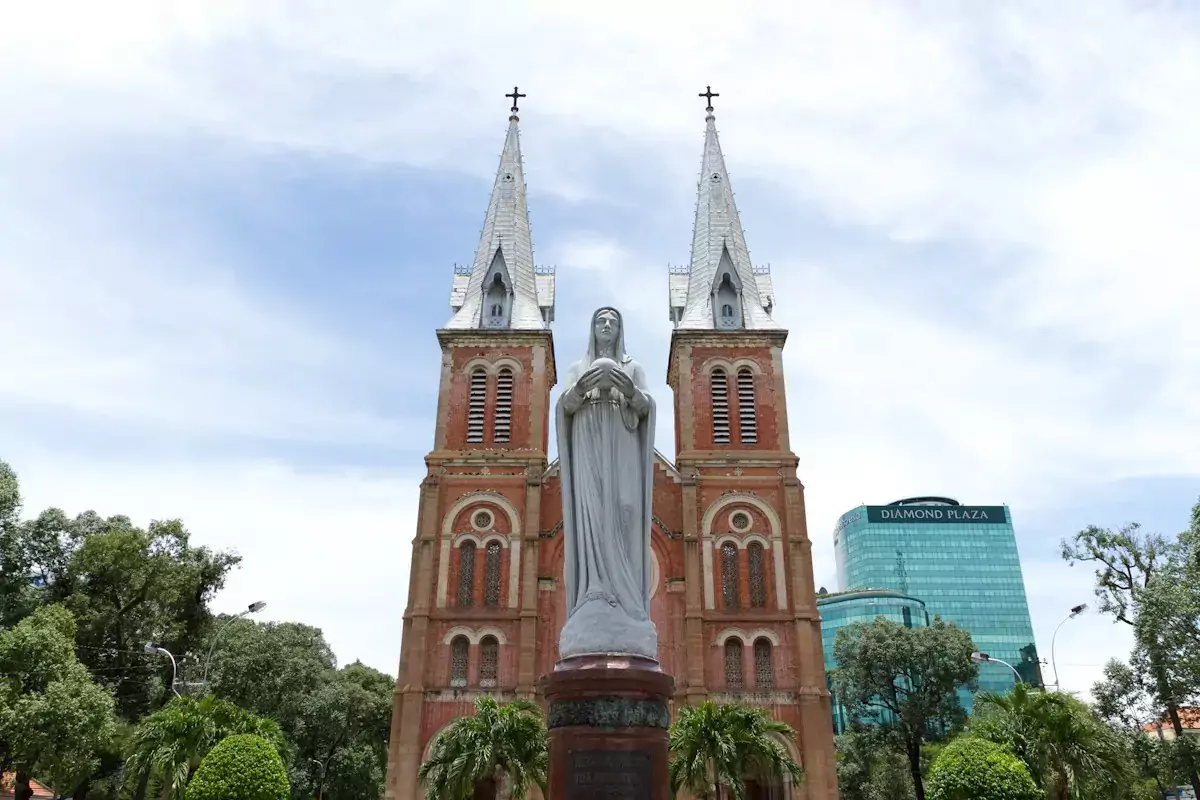
Saigon Notre Dame Cathedral, officially the Cathedral Basilica of Our Lady of The Immaculate Conception, was constructed between 1863 and 1880 with materials imported from France, including red bricks from Marseille. Its twin bell towers rise to 58 meters and house six large bronze bells. The cathedral is built in neo-Romanesque style, inspired by the famous Notre Dame in Paris.
The interior features stained glass windows from France and a monolithic marble altar with intricately carved angels. The surrounding square, known as Paris Commune Square, is a popular meeting place and hosts the Our Lady of Peace statue, a beautiful granite piece symbolizing hope and peace.
The cathedral underwent extensive renovations completed in 2023, during which it was partially closed to the public. Visitors should check current opening times before visiting. Its central location means the area around the cathedral can be busy and noisy and caution is advised for personal belongings due to typical urban pickpocket risks.
Despite these minor issues, the Saigon Notre Dame Cathedral remains a beloved symbol of the city’s colonial history, cultural diversity and architectural elegance, offering a quiet respite amid the lively city streets.
The cathedral is centrally located in District 1 of Ho Chi Minh City, easily reachable by foot, taxi or bus from most city areas. International travelers arrive at Tan Son Nhat International Airport and can take a short taxi ride directly to the cathedral area.
Most visitors stay in the vibrant District 1 or nearby areas, which offer a wide range of accommodations including boutique hotels, guesthouses and luxury options, all within easy walking distance to key city attractions.
Log in to add this place to a travel list and get a summary of all recommended items for your whole trip.
We calculate the average costs when travelling to destinations and compare those with the living costs at your home. With this you can get an estimate of how expensive or cheap the destination is for you.
To customise this, you can set up which location and price level are used for the calculations in your account settings.
The exchange rate price factor shows how expensive or cheap a currency currently is compared to its historical average. It's a quick way to see if a country is currently more or less affordable due to exchange rate changes.
