We use cookies and external services: MapTiler for interactive maps and Google Maps to show route duration/distance. Both may process personal data such as your IP address, including transfers outside the EU/EEA. See our privacy policy for details. By clicking ‘Accept all’, you consent to this.
Toyama, on the Sea of Japan coast at the northern end of the Japanese Alps, has a humid subtropical climate with four distinct seasons. Winters are cold, snowy, and windy, while summers are hot, humid, and wet. The region is known for dramatic seasonal shifts, abundant precipitation, and iconic mountain and coastal scenery.
The best times to travel section shows how the months compare for a visit, so you can find the time of year that fits what you want to do.
Background colours of the months:
The colour shows the typical temperature: yellow (hot), green (mild) and blue (cold). How strong the colour is shows the travel season: full colour means high season, soft colour means shoulder season and soft-striped means off season.
Weather symbols:
Each month has one symbol showing what the weather is typically like, such as hot and sunny, freezing or a rainy or snowy season. Use them to quickly spot months that match the weather you want, or to avoid the ones that don't.
Crowdedness:
The people icon shows how busy the place usually is. The more people, the more crowded it gets.
Additional notes:
The grey info boxes point out special things worth knowing, like recurring weather issues or seasonal events.
The climate of Toyama
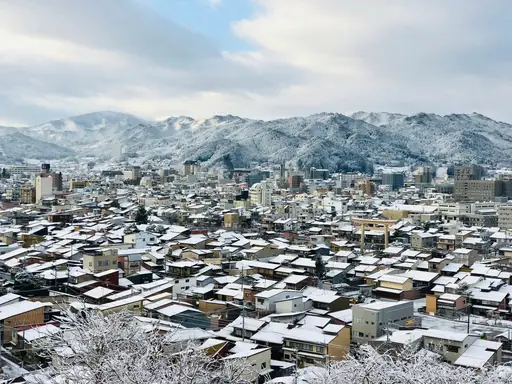
Toyama’s climate is shaped by its coastal location and proximity to the Japanese Alps, resulting in significant seasonal contrasts. Winters (December–March) are cold, windy, and snowy, with average highs of 5–8°C and lows near 1–2°C. January is typically the snowiest month, with up to 120 cm of snow and frequent precipitation. The sky is often cloudy, and sunshine is limited to 2–3 hours per day in winter. Despite the cold, extreme lows below -5°C are rare, as the Sea of Japan moderates temperatures. Winds can be brisk, especially near the coast.
Summers (June–September) are hot, humid, and wet, with average highs of 28–31°C in July and August and lows around 21–24°C. July is the wettest month, with rainfall exceeding 280 mm, and humidity often above 75%. Typhoons can occasionally bring intense rain and wind from August to early October. Spring (April–May) and autumn (September–October) are the most comfortable seasons, with mild temperatures (16–26°C), lower humidity, and more sunshine. Annual precipitation is high, averaging 2,400 mm, and rainy days are frequent year-round. Sunshine peaks in April and August (up to 7 hours per day), while winter is much gloomier. The sea is warm enough for swimming in August and September. Toyama’s climate supports lush summer greenery, vibrant cherry blossoms in spring, and spectacular autumn foliage, while winter transforms the region into a snowy wonderland, especially in the mountains.
| Average climate data for Toyama, Japan | |||||||||||||
|---|---|---|---|---|---|---|---|---|---|---|---|---|---|
| Month | Jan | Feb | Mar | Apr | May | Jun | Jul | Aug | Sep | Oct | Nov | Dec | Year |
| Average water temperature (°C) | 13 | 11 | 11 | 12 | 15 | 20 | 25 | 27 | 26 | 22 | 19 | 15 | 18 |
| Average daily daylight hours (h) | 10 | 10 | 12 | 13 | 14 | 14 | 14 | 13 | 12 | 11 | 10 | 9 | 12 |
Travel info
- Spring (March–May): Cool to mild, with highs from 10°C to 21°C. Cherry blossoms bloom in early to mid-April. Light layers and a jacket are recommended for chilly mornings and evenings.
- Summer (June–August): Hot, humid, and rainy, with highs up to 31°C. July is the wettest month – bring an umbrella and breathable clothing. UV levels are high; sun protection is essential.
- Autumn (September–November): Warm to cool, with highs from 26°C in September to 14°C in November. Lower humidity and beautiful autumn foliage. Ideal for outdoor activities; pack layers for cooler evenings.
- Winter (December–February): Cold, windy, and snowy, with highs of 5–8°C and lows of 1–2°C. Snow is common, especially in January. Bring insulated clothing, boots, and winter accessories.
- Rain is frequent year-round, with the wettest months in July and December; always carry rain gear.
- Typhoon season runs from August to early October – monitor forecasts if travelling during this period.
- Sunshine is most abundant in April and August, with 6–7 hours per day; winter is much cloudier.
- Winds are brisk in winter, especially near the coast – dress accordingly for wind chill.
The best time to visit Toyama
The best times to visit Toyama are late April to June and October. These months offer mild temperatures, moderate humidity, and more sunshine, making them ideal for sightseeing, cherry blossom or autumn foliage viewing, and outdoor activities. Rainfall is lower and weather conditions are generally stable.
The worst time to visit Toyama
The least favourable time to visit Toyama is during winter (December to March), when cold temperatures, frequent snow, strong winds, and limited sunshine can make travel and outdoor activities challenging. July and September can also be very wet and humid, with heavy rain and occasional typhoons.
Frequently asked questions
Toyama’s average annual temperature ranges from 5°C in winter to 30°C in summer. The hottest month is August (average high 30–31°C), while January and February are the coldest (highs 5–6°C, lows 1–2°C).
Yes, Toyama receives about 2,400 mm of precipitation annually, with heavy rain in summer and autumn and significant snowfall in winter. Snow is frequent from December to March, with January being the snowiest month.
Snow is common in Toyama during winter, especially from December to March. The city averages 120 cm of snow in January, and the surrounding mountains receive even more.
Cherry blossoms typically bloom in early to mid-April in Toyama. This is a popular time for visitors, with many parks and riverside areas hosting hanami (blossom viewing) events.
Typhoons can occasionally impact Toyama from August to early October, bringing heavy rain and strong winds. While less frequent than in southern Japan, travellers should monitor weather forecasts during this period.
Pack light layers for spring and autumn, breathable clothing and rain gear for summer, and insulated winter clothing and boots for winter. An umbrella is essential, especially during the rainy and typhoon seasons.
Sunshine is most abundant in April and August, with 6–7 hours per day. Winter months are much cloudier, with only 2–3 hours of sunshine daily.
Water temperature in Toyama
The month with the highest average water temperature is August (27.1 °C). The month with the lowest average water temperature is March (10.7 °C). Overall, the average water temperature over the whole year is 18 °C.
Daylight hours and sunshine hours in Toyama
The month with the longest days, so the most daylight, is June (Average daylight: 14.1 h). The month with the shortest days, so the least daylight, is December (Average daylight: 9.1 h). Over the whole year there are 11.9 h of daylight per day on average.