





Was this page helpful?

| Opening hours: |
|
||
|---|---|---|---|
| Public website: | izushaboten.com |
| Power Grid: |
100 V, 50 Hz Plug: Type A
Type A:
 Read about power adapters |
|---|---|
| Currency: |
Japanese Yen (JPY) £1 ≈ JP¥210 |
| Cashless info: |
Rating 4/5
Cashless payments are becoming more common, especially in cities, with some shops still preferring cash. Be prepared for occasional cash-only situations in rural areas.
Save with a travel credit card |
| eSIM providers: |
Best value: Saily Flexibility: Airalo Read our in-depth comparison |
| Tipping: | Tipping is not customary in Japan and can be considered rude. Excellent service is the norm, and tipping is unnecessary in most places. |
|---|---|
| Public drinking: | Public drinking is legal and commonly accepted, particularly during festivals and events. |
| Public smoking: | Smoking is prohibited in indoor public places but allowed in designated outdoor areas. Some restaurants may have smoking sections. |
| New Year (January) |
One of the most important holidays, expect crowded temples and high prices. Plan ahead. |
|---|---|
| Golden Week (April-May) |
The busiest travel time, expect high demand for accommodation and transport. |
| Obon (August) |
A time to honour ancestors, many businesses close, and transport can be crowded. |
| Emergency contact: | Emergency Number: 110 (Police), 119 (Fire & Ambulance) |
|---|---|
| Taxi apps: | Uber, JapanTaxi, DiDi |
| Other: | Japan is a country of respect, so understanding local customs and etiquette is important. Public transport is efficient, but can be crowded during peak hours. |
The best times to travel section shows how the months compare for a visit, so you can find the time of year that fits what you want to do.
Background colours of the months:
The colour shows the typical temperature: yellow (hot), green (mild) and blue (cold). How strong the colour is shows the travel season: full colour means high season, soft colour means shoulder season and soft-striped means off season.
Weather symbols:
Each month has one symbol showing what the weather is typically like, such as hot and sunny, freezing or a rainy or snowy season. Use them to quickly spot months that match the weather you want, or to avoid the ones that don't.
Crowdedness:
The people icon shows how busy the place usually is. The more people, the more crowded it gets.
Additional notes:
The grey info boxes point out special things worth knowing, like recurring weather issues or seasonal events.
Izu Shaboten Zoo is a hands-on animal park in Ito that takes its name from its cactus collection. About 150 species live here while many of the animals are kept so visitors can get close. Some roam free in places and others can be petted. That makes the park a good fit for families with children, who can feed and touch animals instead of only watching them.
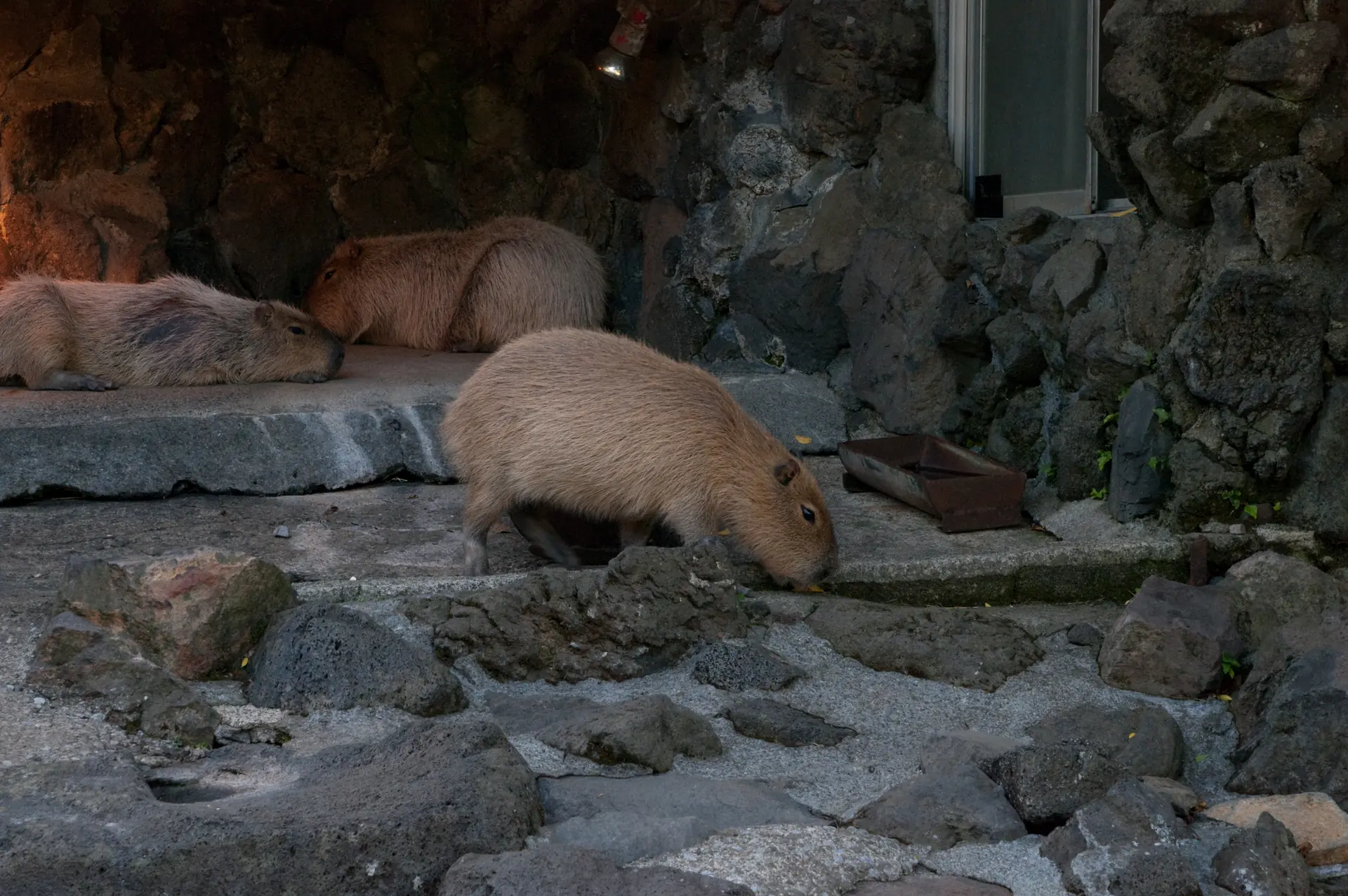
The capybara outdoor bath is the feature the zoo is best known for. Capybaras soak in warm water in an open pool while the zoo offers many chances to interact with them. Bath events usually belong to the cooler months, so check the official site for dates before planning a trip around them.
Beyond the capybaras the zoo offers a string of feeding experiences. On the savanna area visitors can feed giraffes, while the llama zipline sends treats along a line to the animals. An animal boat tour takes visitors out on the water while one course lands on Monkey Island. Which experiences run can change by day and season, so ask at the gate when you arrive. The savanna gives a close look at giraffes while the boat ride shows the grounds from a different angle.
The greenhouses hold about 1,500 varieties of cacti and succulents and the zoo also offers a cactus picking experience. Besides the animals you'll find a restaurant and a shop with imported goods and original products. Opening hours are usually 09:30 – 17:00 but they may change by season. Most visitors spend a half day here.
Trains and buses are the usual way to reach the zoo, though a car is just as common. Take the Tokaido Shinkansen or Tokaido Line to Atami, then the Ito Line to Ito Station. From Ito Station a Tokai Bus takes about 35 minutes and a taxi about 25 minutes. Izukogen Station is closer. From there a Tokai Bus takes about 20 minutes and a taxi about 10 minutes. Tokyo to Atami takes roughly an hour on the Shinkansen while the Ito Line adds around half an hour more to Ito. By car, the zoo is about 85 km from Atsugi IC on the Tomei Expressway, via the Odawara-Atsugi Road and Route 135. From Numazu IC it's about 55 km via the Izu Expressway and the Izu Chuo Road. Weekends and holidays can bring heavy traffic along the coast, so allow extra time.
Most visitors base themselves in Ito, a hot spring town on the coast with ryokan, resort hotels and business hotels spread between the station and the sea. Many places have their own hot spring baths, which suits a trip that mixes animals with a soak. Izukogen is a resort area close to the zoo with pensions, villas and larger resort hotels. That's the quieter option and the shorter trip to the park. Atami has the largest choice of hotels in the region and a Shinkansen station, so it works if you want an easy rail link with Tokyo. Rooms fill up on summer weekends, during Golden Week and around New Year, so book early at those times. A car makes the zoo much easier to reach from any of these bases.


Eating at the zoo is simple. The restaurant is known for its Cappy Burger while the shop sells snacks and souvenirs. Choices inside are limited, so many visitors plan a meal in town before or after.
The Izu coast is known for fresh seafood. Ito and Atami have sushi counters, seafood rice bowls and casual diners near their stations. Izukogen has cafes and small restaurants along its main roads.
Convenience stores and supermarkets are scarce on the way to the zoo, so stock up on water and snacks beforehand if you're travelling with children. Vegetarians will find the zoo's options limited.
Log in to add this place to a travel list and get a summary of all recommended items for your whole trip.
We calculate the average costs when travelling to destinations and compare those with the living costs at your home. With this you can get an estimate of how expensive or cheap the destination is for you.
To customise this, you can set up which location and price level are used for the calculations in your account settings.
The exchange rate price factor shows how expensive or cheap a currency currently is compared to its historical average. It's a quick way to see if a country is currently more or less affordable due to exchange rate changes.
