We use cookies and external services: MapTiler for interactive maps and Google Maps to show route duration/distance. Both may process personal data such as your IP address, including transfers outside the EU/EEA. See our privacy policy for details. By clicking ‘Accept all’, you consent to this.
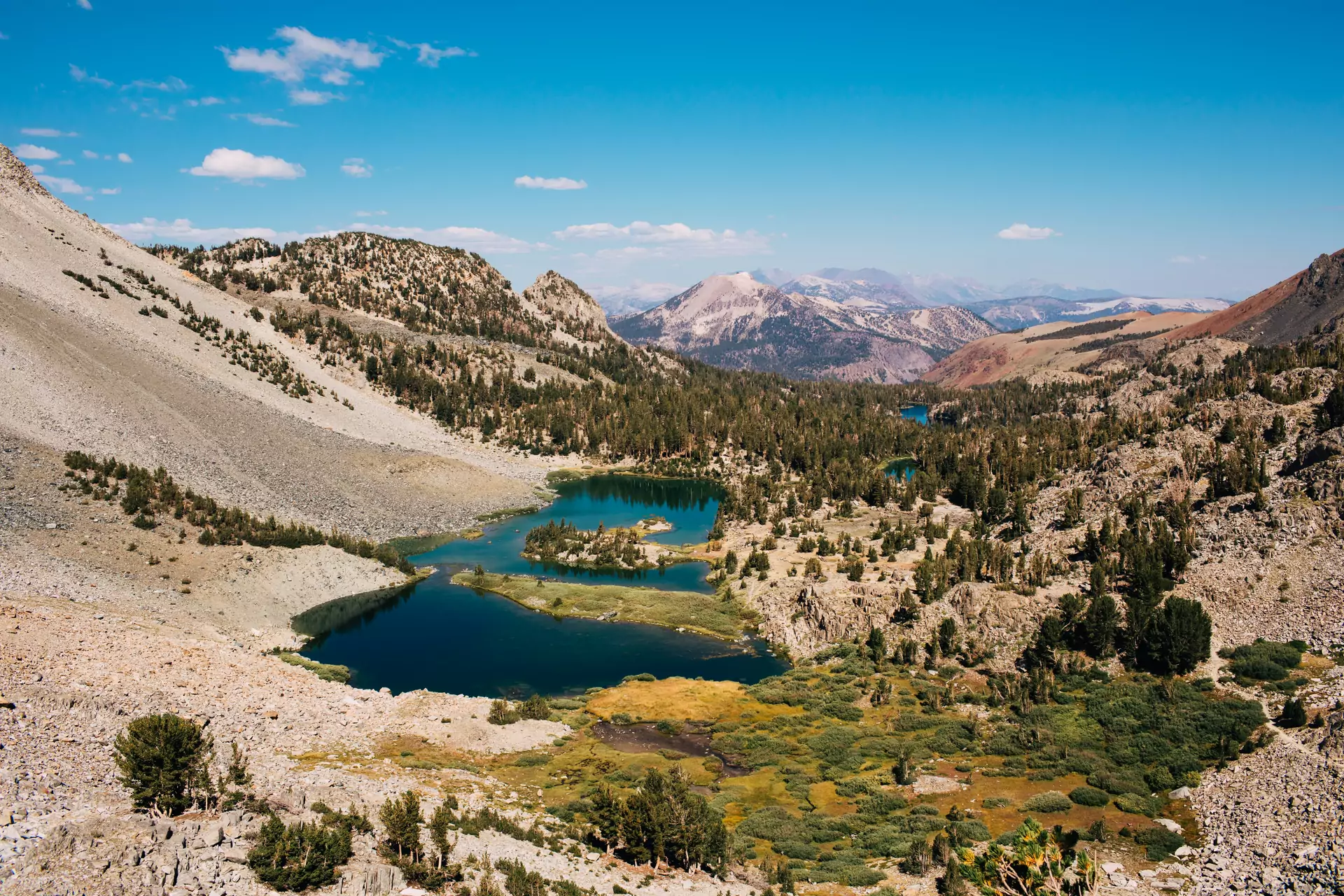
Mammoth Lakes, nestled in California’s Eastern Sierra, features a high-altitude continental climate with dramatic seasonal contrasts. Summers are warm, dry, and sunny with cool nights, while winters are long, cold, and bring heavy snowfall. The area’s stunning scenery, crisp mountain air, and abundance of sunshine make it a year-round destination for outdoor enthusiasts and adventure seekers.
The best times to travel section shows how the months compare for a visit, so you can find the time of year that fits what you want to do.
Background colours of the months:
The colour shows the typical temperature: yellow (hot), green (mild) and blue (cold). How strong the colour is shows the travel season: full colour means high season, soft colour means shoulder season and soft-striped means off season.
Weather symbols:
Each month has one symbol showing what the weather is typically like, such as hot and sunny, freezing or a rainy or snowy season. Use them to quickly spot months that match the weather you want, or to avoid the ones that don't.
Crowdedness:
The people icon shows how busy the place usually is. The more people, the more crowded it gets.
Additional notes:
The grey info boxes point out special things worth knowing, like recurring weather issues or seasonal events.
The climate of Mammoth Lakes
Mammoth Lakes experiences four distinct seasons shaped by its elevation of over 2,400 metres (8,000 feet). Summers (June–August) are warm and arid, with average highs of 23–26°C and nighttime lows of 4–8°C. Days are mostly sunny, with up to 12 hours of sunshine, and humidity remains low. Even in July and August, nights can be chilly, so layers are essential. Occasional afternoon thunderstorms may occur, but rain is rare, and the air is crisp and clear. The summer climate is ideal for hiking, mountain biking, and lake activities, with wildflowers and alpine meadows in full bloom.
Autumn (September–November) brings cooler days (15–21°C in September, dropping to 7°C in November) and cold nights, often near freezing. Autumn foliage is spectacular, and the first snow dustings typically appear in October. Winters (December–March) are long, cold, and snowy, with average highs of –1 to 5°C and lows from –9 to –2°C. Mammoth Lakes receives an impressive 236–400 cm of snow annually, making it a premier destination for skiing, snowboarding, and other winter sports. Spring (April–May) is a transitional season, with highs rising from 8°C to 16°C, lingering snow, and increasing sunshine. The region enjoys about 275–300 sunny days per year, with winds generally light to moderate, though mountain gusts can occur during storms. Annual precipitation averages 585 mm, with most falling as snow in winter and early spring.
| Average climate data for Mammoth Lakes, United States | |||||||||||||
|---|---|---|---|---|---|---|---|---|---|---|---|---|---|
| Month | Jan | Feb | Mar | Apr | May | Jun | Jul | Aug | Sep | Oct | Nov | Dec | Year |
| Average maximum temperature (°C) | 2 | 1 | 3 | 7 | 12 | 19 | 23 | 22 | 19 | 13 | 7 | 1 | 23 |
| Average minimum temperature (°C) | -9 | -10 | -8 | -4 | -0 | 6 | 9 | 8 | 5 | -0 | -5 | -9 | -10 |
| Average precipitation (mm) | 17 | 24 | 19 | 13 | 9 | 5 | 4 | 2 | 3 | 2 | 11 | 16 | 125 |
| Average rainfall days (days) | 4 | 4 | 6 | 6 | 5 | 4 | 4 | 2 | 2 | 2 | 4 | 5 | 48 |
| Average snowfall (mm) | 108 | 142 | 132 | 86 | 38 | 2 | 0 | 0 | 3 | 7 | 83 | 127 | 728 |
| Average snowfall days (days) | 9 | 9 | 11 | 7 | 5 | 1 | 0 | 0 | 1 | 2 | 6 | 10 | 61 |
| Average relative humidity (%) | 71 | 75 | 74 | 68 | 57 | 41 | 36 | 35 | 39 | 45 | 55 | 72 | 56 |
| Average wind speed (km/h) | 9 | 10 | 11 | 11 | 10 | 10 | 8 | 8 | 8 | 9 | 9 | 10 | 9 |
| Average daily daylight hours (h) | 9 | 10 | 12 | 13 | 14 | 14 | 14 | 13 | 12 | 11 | 10 | 9 | 12 |
| Average daily sunshine hours (h) | 6 | 6 | 8 | 10 | 11 | 11 | 12 | 12 | 11 | 8 | 7 | 6 | 9 |
| Average cloud coverage (%) | 29 | 30 | 29 | 24 | 18 | 10 | 10 | 7 | 9 | 11 | 17 | 29 | 19 |
| Average UV index | 2 | 2 | 2 | 2 | 3 | 5 | 5 | 4 | 3 | 2 | 2 | 2 | 3 |
Travel info
- Winter (Dec–Mar): Cold and snowy, with highs of –1 to 5°C and lows often below –7°C. Ideal for skiing, snowboarding, and snowshoeing. Dress in thermal layers and insulated boots; check forecasts for snowstorms.
- Spring (Apr–May): Cool with highs of 8–16°C. Snow lingers into late spring, and trails may be muddy. Great for quieter visits and late-season skiing – pack layers and waterproof shoes.
- Summer (Jun–Aug): Warm and dry, with highs of 23–26°C and cool nights. Perfect for hiking, biking, and lake activities. Bring sun protection, a jacket for evenings, and stay hydrated at altitude.
- Autumn (Sep–Nov): Mild to cool, with highs of 21°C in September to 7°C in November. Stunning autumn foliage and fewer crowds. Nights are cold – pack warm layers and be prepared for early snow.
- Travel tip: Weather can change quickly – always dress in layers and check forecasts. Summer and winter are peak seasons, so book accommodations early. Altitude can affect visitors; drink plenty of water and acclimatise gradually.
The best time to visit Mammoth Lakes
The best time to visit Mammoth Lakes depends on your interests: June to September offers warm, sunny weather for hiking, biking, and lake activities, with wildflowers and clear mountain views. For winter sports, December to March provides deep snow and lively ski resorts. Fall (late September–October) is quieter and renowned for spectacular foliage.
The worst time to visit Mammoth Lakes
The least favourable time to visit is in late spring (April–early May), when snowmelt can make trails muddy and some outdoor activities are limited. Early winter (late October–November) can also be unpredictable, with chilly, wet weather and fewer open attractions between the main seasons.
Frequently asked questions
Mammoth Lakes has a high-altitude continental climate with warm, dry summers (23–26°C) and long, cold, snowy winters (–1 to 5°C). Nights are cool year-round, and the area enjoys 275–300 sunny days annually.
June to September is best for hiking and lake activities, with warm days and cool nights. December to March is ideal for skiing and winter sports, thanks to deep snow and lively resorts.
Mammoth Lakes receives 236–400 cm (93–157 inches) of snow annually, with the heaviest snowfall from December to March. Snow can linger on the ground into late spring.
Winter highs average –1 to 5°C, while nighttime lows often fall below –7°C. Cold snaps can bring even lower temperatures, and snowstorms are common from December to March.
Yes, Mammoth Lakes enjoys about 275–300 sunny days per year, with long daylight hours in summer and crisp, clear skies in winter. Even in summer, nights can be chilly due to the altitude.
Pack layers for large day-night temperature swings, sun protection for high UV, and insulated boots and jackets for winter. In summer, bring a jacket for cool evenings and plenty of water to stay hydrated at altitude.
Spring and autumn are quieter, with fewer crowds and beautiful scenery. Spring can be muddy with lingering snow, while fall offers stunning foliage. Some attractions may have limited hours outside the main seasons.
Minimum and maximum temperatures in Mammoth Lakes
The warmest month, with the highest average maximum temperature, is July (23 °C). The month with the lowest average maximum temperature is December (1.2 °C). Overall, the average maximum temperature over the whole year is 10.7 °C.
The month with the highest average minimum temperature is July (9 °C). The coldest month, with the lowest average minimum temperature, is February (-9.6 °C). Overall, the average minimum temperature over the whole year is -1.4 °C.
Rainfall amount in Mammoth Lakes
The wettest month, with the highest amount of precipitation, is February (23.8 mm). The driest month, with the least amount of precipitation, is October (2 mm). Over the whole year there are 124.5 mm of rainfall on average.
Rainfall days in Mammoth Lakes
The month with the most days of rain is April (6.3 days). The month with the fewest days of rain is August (1.8 days). Over the whole year there are 48 days of rain on average.
Snowfall amount in Mammoth Lakes
The month with the most snowfall is February (141.8 mm). The months with the least snowfall are July and August (0 mm). Over the whole year there are 727.7 mm of snowfall on average.
Snowfall days in Mammoth Lakes
The month with the most days of snowfall is March (11.3 days). The months with the fewest days of snowfall are July and August (0 days). Over the whole year there are 61.1 days of snowfall on average.
Relative humidity in Mammoth Lakes
The month with the highest average relative humidity is February (75.1 %). The month with the lowest average relative humidity is August (35.1 %). The overall average relative humidity over the whole year is 55.7 %.
Wind speed in Mammoth Lakes
The windiest month, with the highest average wind speed, is March (11.1 km/h). The calmest month, with the lowest average wind speed, is July (7.9 km/h). The overall average wind speed over the whole year is 9.4 km/h.
Cloud coverage in Mammoth Lakes
The month with the cloudiest skies, so the highest cloud coverage, is February (29.6 %). The month with the clearest skies, so the lowest cloud coverage, is August (6.7 %). Over the whole year there is an average cloud coverage of 18.5 %.
Daylight hours and sunshine hours in Mammoth Lakes
The month with the longest days, so the most daylight, is June (Average daylight: 14.1 h). The month with the shortest days, so the least daylight, is December (Average daylight: 9.1 h). Over the whole year there are 11.8 h of daylight per day on average.
The month with the most sunshine per day is August (Average sunshine: 12.1 h). The month with the least sunshine per day is January (Average sunshine: 5.9 h). Over the whole year there are 9 h of sunlight per day on average.
UV index in Mammoth Lakes
The months with the highest average UV index are June and July (UV index: 5). The months with the lowest average UV index are January, February, March, April, October, November and December (UV index: 2). Over the whole year the average UV index is 2.8.
- Mammoth Lakes climate overview
- Climate table
- Related travel information for Mammoth Lakes
- The best time to visit Mammoth Lakes
- The worst time to visit Mammoth Lakes
- Frequently asked questions
- Temperature summary
- Rainfall amount summary
- Rainfall days summary
- Snowfall amount summary
- Snowfall days summary
- Relative humidity summary
- Wind speed summary
- Cloud coverage summary
- Daylight hours and sunshine hours summary
- UV index summary
- Other recommended travel destinations