












Was this page helpful?

These place ratings give you a quick overview of how well a destination matches different types of trips.
"Best for" scores:
The specific interest scores show where this place really shines – whether it's ideal for hiking, food & drink experiences, museums or other activities. These highlights help you understand what makes the destination special at a glance.
"Your personal" scores:
This reflects how well a place matches your personal preferences. You can adjust the importances of travel topics or other personal requirements categories in your account settings.
"Suited for" badges:
These give you a quick overview of how well a destination suits specific types of travelers, to help you find the places that match your lifestyle, preferences or travel situation.
| Power Grid: |
230 V, 50 Hz Plug: Type C , Type F
Type C:
  Read about power adapters |
|---|---|
| Currency: |
Euro (EUR) $1 ≈ €0.90 |
| Cashless info: |
Rating 4/5
Cards are widely accepted, especially in urban areas, but small establishments may prefer cash. Be prepared for occasional cash-only situations.
Save with a travel credit card |
| eSIM providers: |
Best value: Saily Flexibility: Airalo Read our in-depth comparison |
| Tipping: | Tipping is common in restaurants, typically 5-10%. For taxis, it is customary to round up to the nearest euro. Tipping in cash is more common than adding it to card payments. |
|---|---|
| Public drinking: | Public drinking is allowed in most parts of Germany, especially in beer gardens and public events, but some local regulations may restrict it in specific areas. |
| Public smoking: | Smoking is prohibited indoors in public places such as restaurants, trains, and buses. Designated smoking areas are available outside many buildings. |
| Oktoberfest (September) |
Huge crowds in Munich. Expect high hotel rates and crowded transportation. |
|---|---|
| Christmas (December) |
Christmas markets are popular, expect crowded cities and higher prices. |
| Labour Day (May) |
Many shops are closed, and there are celebrations throughout the country. |
| Emergency contact: | Police: 110, Emergency Number: 112 (Fire, Ambulance) |
|---|---|
| Taxi apps: | Uber, Free Now, myTaxi |
| Other: | Germany is well-equipped for tourists, with good public transport and high-quality facilities. However, be prepared for language barriers in some rural areas. |
The best times to travel section shows how the months compare for a visit, so you can find the time of year that fits what you want to do.
Background colors of the months:
The color shows the typical temperature: yellow (hot), green (mild) and blue (cold). How strong the color is shows the travel season: full color means high season, soft color means shoulder season and soft-striped means off season.
Weather symbols:
Each month has one symbol showing what the weather is typically like, such as hot and sunny, freezing or a rainy or snowy season. Use them to quickly spot months that match the weather you want, or to avoid the ones that don't.
Crowdedness:
The people icon shows how busy the place usually is. The more people, the more crowded it gets.
Additional notes:
The gray info boxes point out special things worth knowing, like recurring weather issues or seasonal events.
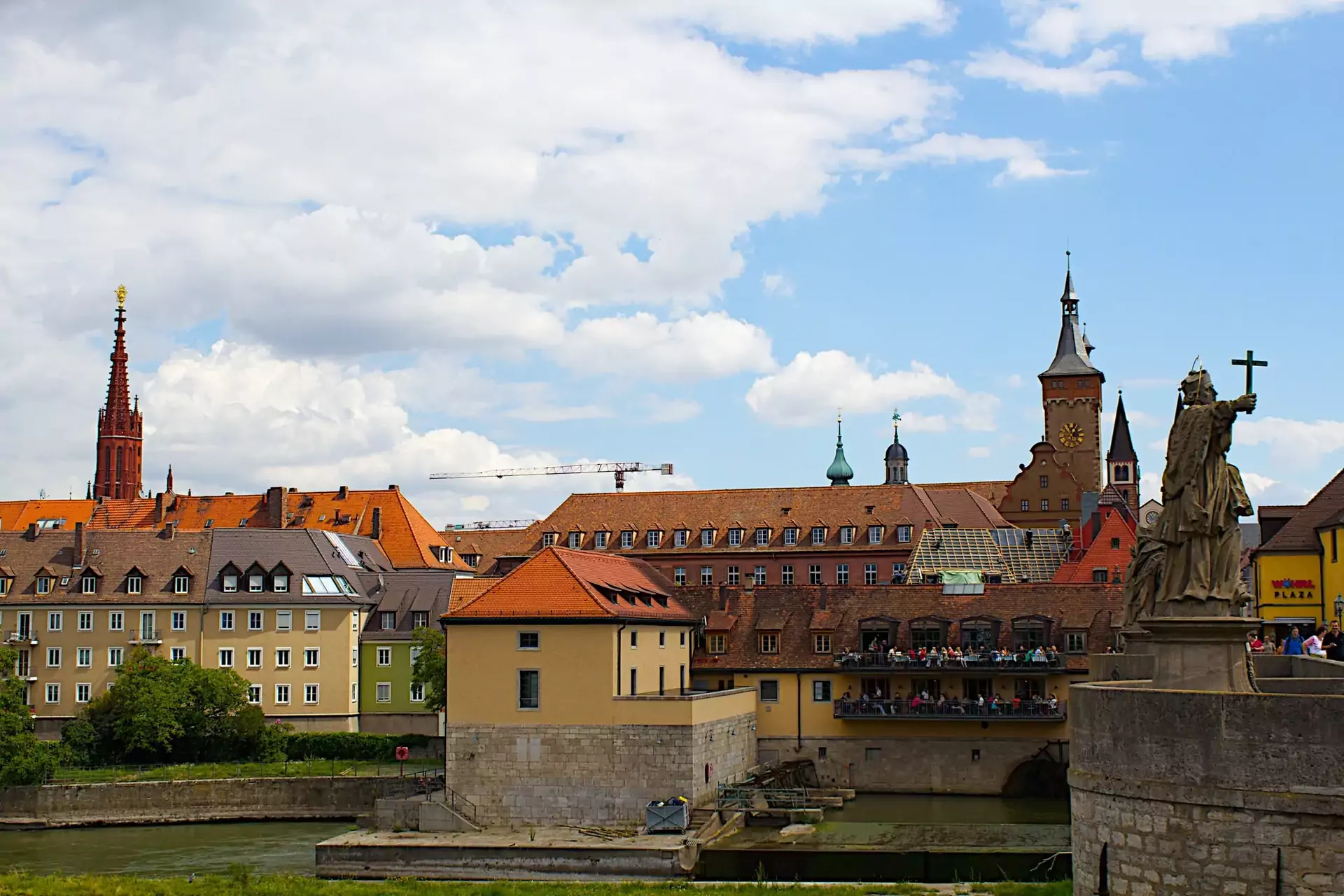
Würzburg packs a lot of history and wine into a small city. The Residence is the main sight. This 18th century baroque palace is a UNESCO World Heritage Site and is famous for its grand staircase and the huge ceiling fresco above it. A formal garden lies behind the palace and is free to enter. The Marienberg Fortress sits on a hill above the river and was long the seat of the local prince bishops. You can walk up through the vineyards for views over the city. The Old Main Bridge is lined with stone statues of saints. In the evening locals get a glass of wine at the bridge kiosks and sit by the water. The Käppele pilgrimage church on the opposite hill is another viewpoint. Wine is part of daily life. The city sits in the Franconian wine region, where the Silvaner grape is served in the flat bottle called Bocksbeutel. Wine estates, cellars and festivals fill the calendar. One day covers the palace, the bridge and the old town. Two days leave time for the fortress, the vineyards and a tasting. Spring to autumn is the best season.
Würzburg is easy to reach by train. ICE trains on the main line between Frankfurt and Nuremberg stop at the central station. Each leg takes about an hour and Munich, Berlin and Hamburg connect directly or with one change. By car the A3 runs between Frankfurt and Nuremberg and the A7 runs north to south. Both cross close to the city. Traffic builds up on Friday afternoons and during the wine festival. Frankfurt Airport is the nearest large airport and trains reach the city in around an hour and a half. Nuremberg Airport is also an option with an easy link by train and S-Bahn. Long distance buses also stop in the city and are usually cheaper than the train.
The old town and the area around the station have the most hotels, guesthouses and apartments and are the practical base. You can walk to the palace, the market square and the bridge and you don't need a car. The districts on the west bank near the Old Main Bridge are quieter and have views of the fortress. Wine villages around the city offer guesthouses on wine estates and a calm base if you have a car or a bike. Campsites are found along the river. Würzburg hosts trade fairs, university events and wine festivals, so rooms can be scarce on those dates. Book ahead for summer weekends and autumn while winter is quieter and cheaper.
The old town is compact and sits inside a ring of green on the east bank of the Main. The station is at the northern edge and the palace is a short walk east of the market square, while the fortress is across the river on the hill.
Walking:
The cathedral, the market square, the palace and the Old Main Bridge are all close together. A steep path leads from the bridge to the fortress, so allow about half an hour for the climb.
Trams and buses:
Several tram lines and many buses link the station, the center and the outer districts. Tickets are sold at machines and on board buses and a guest card is also available.
Cycling:
The Main cycle path leads through the city and the terrain along the river is flat. Rental bikes are available in the center.
Car:
Parking garages sit close to the old town and a car isn't needed in the center, though it helps for visits to the wine villages.
Food in Würzburg is hearty Franconian cooking built on pork, sausages and wine. Wine taverns in the old town serve plain dishes in large portions and the bridge kiosks sell wine by the glass. The center has restaurants, cafes and bakeries and supermarkets make self-catering easy. Many small places close one day a week.
Franconian wine:
The region is known for dry white Silvaner served in the flat Bocksbeutel bottle. Estates offer tastings and cellar tours and many pour their own wine in the old town.
Bratwurst:
Franconian bratwurst are small grilled sausages served in threes or sixes with sauerkraut or on a roll. They're the standard quick meal in town.
Meefischli:
These small fried river fish come with potato salad and are a local specialty on menus in taverns near the Main.
We calculate the average costs when traveling to destinations and compare those with the living costs at your home. With this you can get an estimate of how expensive or cheap the destination is for you.
To customize this, you can set up which location and price level are used for the calculations in your account settings.
The exchange rate price factor shows how expensive or cheap a currency currently is compared to its historical average. It's a quick way to see if a country is currently more or less affordable due to exchange rate changes.
To help you plan your trip, we provide estimated daily costs per person (when traveling as a pair) for different travel styles. These numbers give you an idea of what you might spend each day at this destination, including accommodation, food, transport and activities.
Additionally, we also provide average hotel costs for different travel styles to give you an estimate for the accommodation only.
Please note that these are only estimates. The real costs depend on booking times, season and other factors.
Travel style categories explained:
Backpacker:
Staying in hostels or budget hotels, cooking your own meals or eating cheap and choosing low-cost activities.
Mid-range:
Staying in mid-range hotels, eating at a mix of restaurants and casual spots and enjoying a variety of activities.
Luxury:
Staying in luxury hotels, dining out at high-end restaurants and enjoying premium experiences without worrying about the price.
| Backpacker | Mid-range | Luxury | |
|---|---|---|---|
| 💵 Total costs per day, including accommodation | |||
| 🏨 Accommodation per night, per person | |||
| 🍝 Food per day | |||
| 🚕 Transportation per day |
| 🍽️ Restaurant Dinner, per person | |
|---|---|
| 🍛 Lunch Set, per person | |
| 🍟 Fast food combo | |
| 🍝 Preparing your own food, per day | |
| ☕ Cappuccino | |
| 🍺 Beer in a restaurant, 0.5 l / 16 oz |
| 🚌 Public transport ticket | |
|---|---|
| 🚕 Taxi Ride, 10 km / 6 mi | |
| ⛽ Gas, 1 l / ¼ gal |
| 🎞️ Movie ticket | |
|---|---|
| 👩⚕️ Doctor's consult | |
| 🤧 Cold medication | |
| 💇 Basic haircut |
Log in to add this place to a travel list and get a summary of all recommended items for your whole trip.
