














Was this page helpful?

These place ratings give you a quick overview of how well a destination matches different types of trips.
"Best for" scores:
The specific interest scores show where this place really shines – whether it's ideal for hiking, food & drink experiences, museums or other activities. These highlights help you understand what makes the destination special at a glance.
"Your personal" scores:
This reflects how well a place matches your personal preferences. You can adjust the importances of travel topics or other personal requirements categories in your account settings.
"Suited for" badges:
These give you a quick overview of how well a destination suits specific types of travelers, to help you find the places that match your lifestyle, preferences or travel situation.
| Power Grid: |
100 V, 50 Hz Plug: Type A
Type A:
 Read about power adapters |
|---|---|
| Currency: |
Japanese Yen (JPY) $1 ≈ ¥158 |
| Cashless info: |
Rating 4/5
Cashless payments are becoming more common, especially in cities, with some shops still preferring cash. Be prepared for occasional cash-only situations in rural areas.
Save with a travel credit card |
| eSIM providers: |
Best value: Saily Flexibility: Airalo Read our in-depth comparison |
| Tipping: | Tipping is not customary in Japan and can be considered rude. Excellent service is the norm, and tipping is unnecessary in most places. |
|---|---|
| Public drinking: | Public drinking is legal and commonly accepted, particularly during festivals and events. |
| Public smoking: | Smoking is prohibited in indoor public places but allowed in designated outdoor areas. Some restaurants may have smoking sections. |
| New Year (January) |
One of the most important holidays, expect crowded temples and high prices. Plan ahead. |
|---|---|
| Golden Week (April-May) |
The busiest travel time, expect high demand for accommodation and transportation. |
| Obon (August) |
A time to honor ancestors, many businesses close, and transportation can be crowded. |
| Emergency contact: | Emergency Number: 110 (Police), 119 (Fire & Ambulance) |
|---|---|
| Taxi apps: | Uber, JapanTaxi, DiDi |
| Other: | Japan is a country of respect, so understanding local customs and etiquette is important. Public transportation is efficient, but can be crowded during peak hours. |
The best times to travel section shows how the months compare for a visit, so you can find the time of year that fits what you want to do.
Background colors of the months:
The color shows the typical temperature: yellow (hot), green (mild) and blue (cold). How strong the color is shows the travel season: full color means high season, soft color means shoulder season and soft-striped means off season.
Weather symbols:
Each month has one symbol showing what the weather is typically like, such as hot and sunny, freezing or a rainy or snowy season. Use them to quickly spot months that match the weather you want, or to avoid the ones that don't.
Crowdedness:
The people icon shows how busy the place usually is. The more people, the more crowded it gets.
Additional notes:
The gray info boxes point out special things worth knowing, like recurring weather issues or seasonal events.
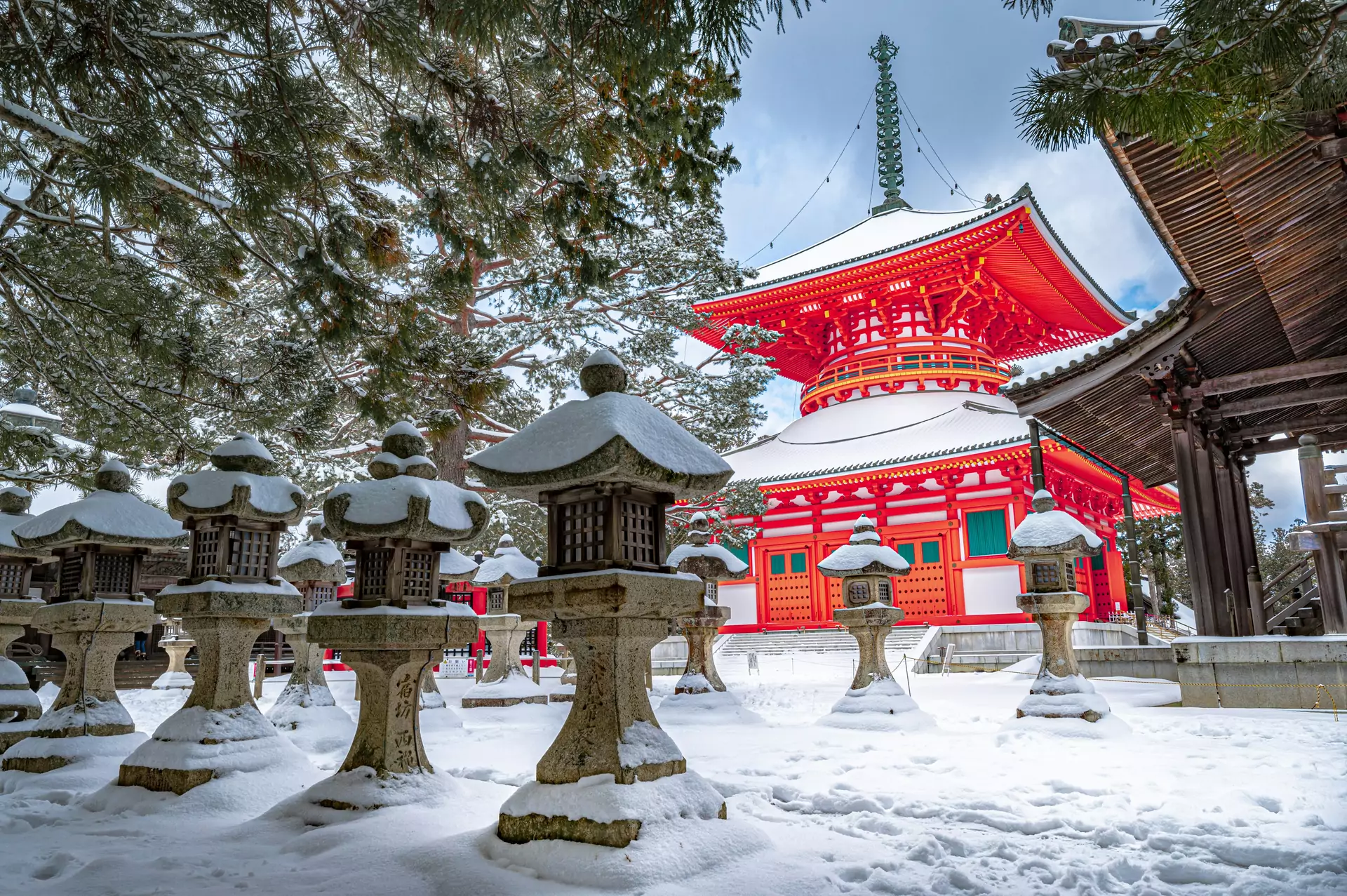
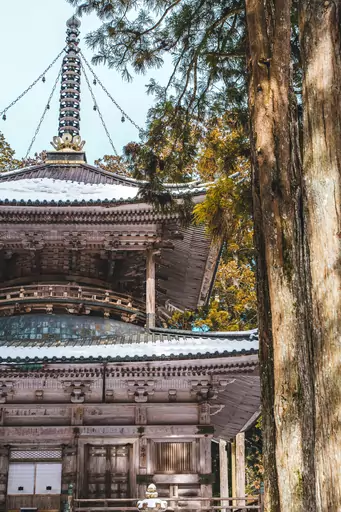
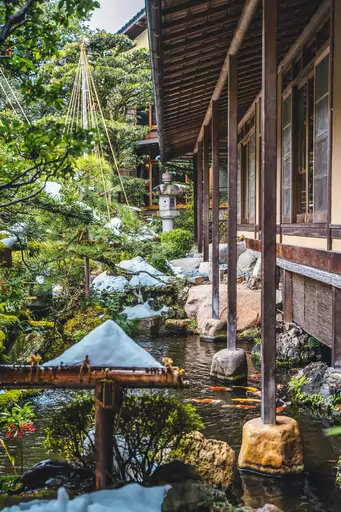
Okunoin, the cemetery path to Kobo Daishi's mausoleum, goes about 1 mi through old cedar forest past tens of thousands of tombs and memorials. Followers believe he remains in eternal meditation there and monks bring him meals every day. The path is atmospheric in daytime and even more so after dark when the lanterns are lit. The town itself is a working monastery community. Danjo Garan is the oldest temple complex and has the vermilion Konpon Daito pagoda at its center. Kongobuji is the head temple of the Koyasan Shingon sect and has painted sliding doors and a large rock garden. The Reihokan museum holds temple treasures like Buddhist statues and paintings that don't fit in the temples themselves. Staying overnight in a temple lodging (shukubo) is what sets Mount Koya apart from a standard day trip. You get a vegetarian monastery dinner and can join the monks' early morning prayers. One night is the best fit for most trips since a day visit leaves little time for both Okunoin and the town. Some travelers combine Mount Koya with the Kumano Kodo pilgrim routes further south.
The easiest way is the Nankai Koya Line from Osaka. Trains run from Namba Station to Gokurakubashi in about 80 to 100 minutes depending on the service. Limited express trains are the fastest while express and rapid express trains are cheaper and usually need a change at Hashimoto. Gran Tenku is a reserved-seat sightseeing train on the same line that takes about 90 minutes to 2 hours. At Gokurakubashi you transfer to a cable car that climbs to Koyasan Station in about 5 minutes. From there a bus takes about 10 minutes to the town center. The cable car costs ¥500 ($3.16). The Koyasan World Heritage Ticket from ¥3,980 ($25.16) covers the round trip from Osaka and town buses for two days. From Kansai International Airport (KIX) you can reach Namba on the Nankai Airport Line and change there. From Kyoto the trip goes through Osaka and takes roughly 3 hours. By car, the drive from Osaka is around 1.5 to 2 hours depending on traffic.
Most visitors stay in a shukubo, which is a room in a working Shingon temple. Around 50 temples take guests and the rooms are simple tatami rooms with futons and shared bathrooms. Stays usually include vegetarian dinner and breakfast. Check-in is generally in the afternoon and the early morning prayer is a main reason people stay. Temples are scattered across the town, so pick one near the area you want to see. Those around the Okunoin approach are good for evening and early morning visits to the cemetery. Others are close to the Garan and Kongobuji. A few ryokan-style inns and small guesthouses are also available but the choice is much smaller than in Osaka or Kyoto. Booking is wise well ahead for autumn foliage season and on weekends. If everything is full, Hashimoto or Osaka can serve as a base for a day trip, although you'll lose the evening and morning hours that make the town special.
Mount Koya is a small town with one main street, so the central temples are close enough to walk between. Local buses cover the longer stretches, such as Okunoin at the eastern end of town.
Walking:
The path through Okunoin takes about 30 to 40 minutes each way at an easy pace from the Ichinohashi entrance to the mausoleum.
Buses:
Nankai Rinkan buses connect Koyasan Station with the town center and go on to Okunoin. You can get on and off along the route, so buses help most when you want to avoid backtracking along the same road. A one-day or two-day bus ticket pays off if you plan more than a couple of rides.
Car:
You don't need a car here. Parking is limited and the area is compact, so a car is only worth it if you're driving through to other places on the mountain.
Food on Mount Koya is shojin ryori, the vegetarian cooking of Buddhist temples. There's little meat or fish in the town. Dishes are built around tofu and seasonal vegetables and mountain plants. Goma-dofu is a sesame tofu and koya-dofu is a freeze-dried tofu that comes from this mountain.
Temple lodging dinners are served early in the evening and breakfast follows the morning prayer. Both are normally included in the room rate. Outside the temples, restaurants and cafes in the town center serve lunch and some noodle dishes. Many close by late afternoon or early evening, so don't plan on a late dinner out.
Vegetarians and vegans will find it easy here although strict vegans should ask about dashi, because some dishes may use fish-based stock. Convenience stores are few, so bring snacks if you're staying overnight.
We calculate the average costs when traveling to destinations and compare those with the living costs at your home. With this you can get an estimate of how expensive or cheap the destination is for you.
To customize this, you can set up which location and price level are used for the calculations in your account settings.
The exchange rate price factor shows how expensive or cheap a currency currently is compared to its historical average. It's a quick way to see if a country is currently more or less affordable due to exchange rate changes.
To help you plan your trip, we provide estimated daily costs per person (when traveling as a pair) for different travel styles. These numbers give you an idea of what you might spend each day at this destination, including accommodation, food, transport and activities.
Additionally, we also provide average hotel costs for different travel styles to give you an estimate for the accommodation only.
Please note that these are only estimates. The real costs depend on booking times, season and other factors.
Travel style categories explained:
Backpacker:
Staying in hostels or budget hotels, cooking your own meals or eating cheap and choosing low-cost activities.
Mid-range:
Staying in mid-range hotels, eating at a mix of restaurants and casual spots and enjoying a variety of activities.
Luxury:
Staying in luxury hotels, dining out at high-end restaurants and enjoying premium experiences without worrying about the price.
| Backpacker | Mid-range | Luxury | |
|---|---|---|---|
| 💵 Total costs per day, including accommodation | |||
| 🏨 Accommodation per night, per person | |||
| 🍝 Food per day | |||
| 🚕 Transportation per day |
| 🍽️ Restaurant Dinner, per person | |
|---|---|
| 🍛 Lunch Set, per person | |
| 🍟 Fast food combo | |
| 🍝 Preparing your own food, per day | |
| ☕ Cappuccino | |
| 🍺 Beer in a restaurant, 0.5 l / 16 oz |
| 🚌 Public transport ticket | |
|---|---|
| 🚕 Taxi Ride, 10 km / 6 mi | |
| ⛽ Gas, 1 l / ¼ gal |
| 🎞️ Movie ticket | |
|---|---|
| 👩⚕️ Doctor's consult | |
| 🤧 Cold medication | |
| 💇 Basic haircut |
Log in to add this place to a travel list and get a summary of all recommended items for your whole trip.
