





Was this page helpful?

| Public website: | asuke.info |
|---|
| Power Grid: |
100 V, 50 Hz Plug: Type A
Type A:
 Read about power adapters |
|---|---|
| Currency: |
Japanese Yen (JPY) $1 ≈ ¥158 |
| Cashless info: |
Rating 4/5
Cashless payments are becoming more common, especially in cities, with some shops still preferring cash. Be prepared for occasional cash-only situations in rural areas.
Save with a travel credit card |
| eSIM providers: |
Best value: Saily Flexibility: Airalo Read our in-depth comparison |
| Tipping: | Tipping is not customary in Japan and can be considered rude. Excellent service is the norm, and tipping is unnecessary in most places. |
|---|---|
| Public drinking: | Public drinking is legal and commonly accepted, particularly during festivals and events. |
| Public smoking: | Smoking is prohibited in indoor public places but allowed in designated outdoor areas. Some restaurants may have smoking sections. |
| New Year (January) |
One of the most important holidays, expect crowded temples and high prices. Plan ahead. |
|---|---|
| Golden Week (April-May) |
The busiest travel time, expect high demand for accommodation and transportation. |
| Obon (August) |
A time to honor ancestors, many businesses close, and transportation can be crowded. |
| Emergency contact: | Emergency Number: 110 (Police), 119 (Fire & Ambulance) |
|---|---|
| Taxi apps: | Uber, JapanTaxi, DiDi |
| Other: | Japan is a country of respect, so understanding local customs and etiquette is important. Public transportation is efficient, but can be crowded during peak hours. |
The best times to travel section shows how the months compare for a visit, so you can find the time of year that fits what you want to do.
Background colors of the months:
The color shows the typical temperature: yellow (hot), green (mild) and blue (cold). How strong the color is shows the travel season: full color means high season, soft color means shoulder season and soft-striped means off season.
Weather symbols:
Each month has one symbol showing what the weather is typically like, such as hot and sunny, freezing or a rainy or snowy season. Use them to quickly spot months that match the weather you want, or to avoid the ones that don't.
Crowdedness:
The people icon shows how busy the place usually is. The more people, the more crowded it gets.
Additional notes:
The gray info boxes point out special things worth knowing, like recurring weather issues or seasonal events.
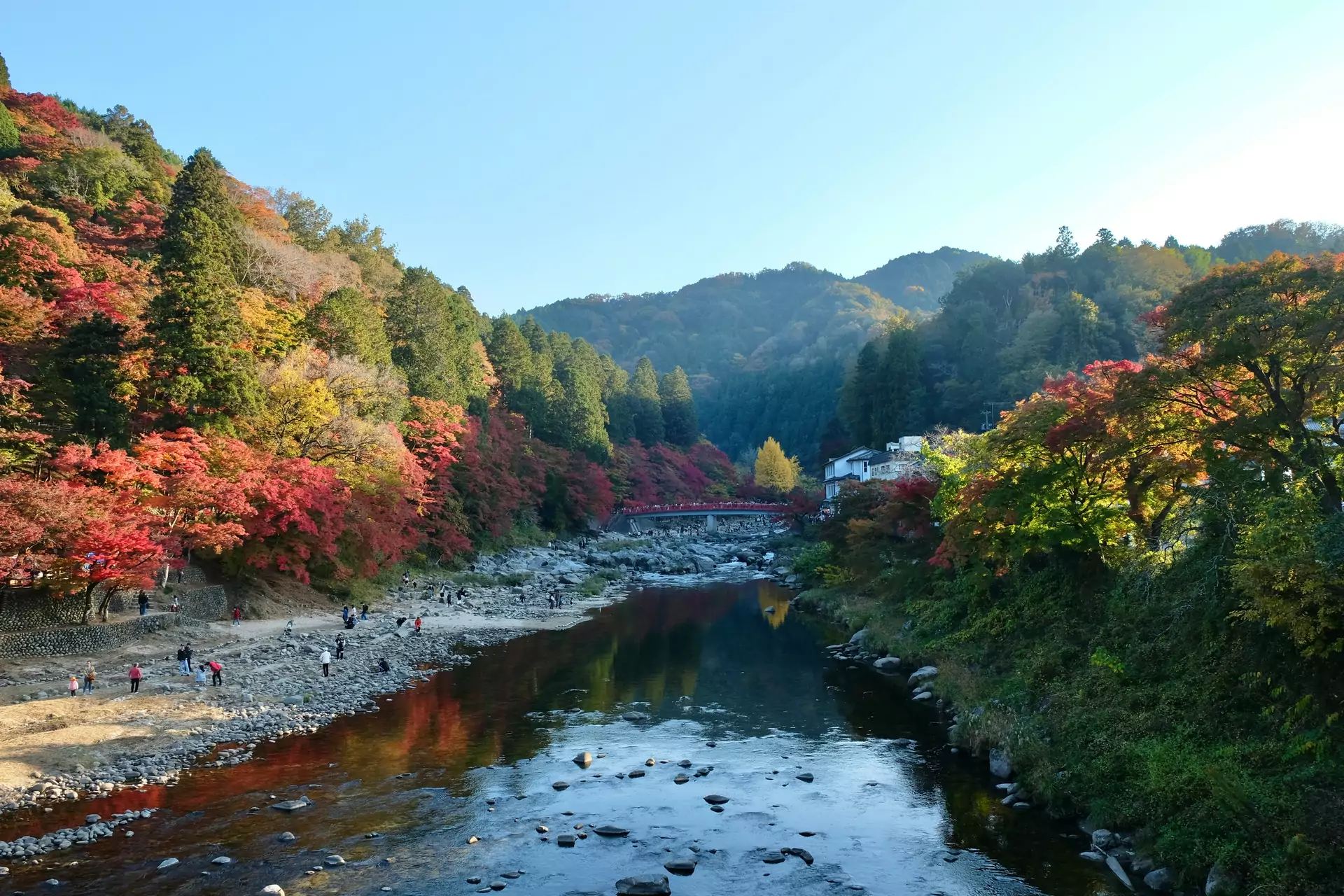
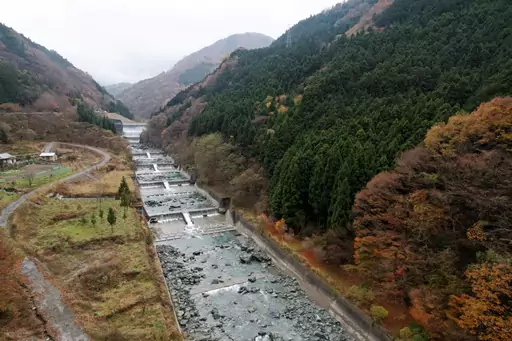
Korankei is a wooded valley in Aichi Prefecture and a well-known place to see autumn leaves. Around 3,000 Japanese maples line the Tomoe River and its paths. Their colors peak in the second half of November during the Maple Festival. At the center of the view is the Taigetsukyo Bridge, a footbridge that links the main entrance with the Kojaku-ji and Korankei Square side. It's a classic spot for photos.
Paths are on both sides of the river and the bridges let you cross between them, so a visit works as a slow walk rather than a trip to one viewpoint. Kojaku-ji Temple is reached by steps through a canopy of maples. Next to Korankei Square, the Sanshu Asuke Yashiki village has farm animals and craft demonstrations and charges a separate admission fee. During the festival the slope of Mount Iimori is lit from sunset until 9:00 PM. The view from across the river is a good spot for evening shots.
Outside autumn the gorge is calm. Spring has fresh green leaves and in March dogtooth violets bloom around Asuke. Entry to the gorge is free and the area is open around the clock, though the lighting runs only during the festival. Plan on one or two hours for the main paths and the temple, with extra time for the museum.
Crowds are the main drawback. Peak weekends have heavy traffic on routes to the gorge and packed bridges and paths. Arriving near sunset on a weekend lets you see the lights as the daytime crowd thins. The best color moves from year to year, so check a leaf forecast before you pick a date.
Trains and a local bus are the usual way to reach Korankei from Nagoya, in roughly two hours. Take a Meitetsu train to Toyotashi Station on the Toyota Line, then a Meitetsu bus bound for Asuke to the Korankei bus stop. The bus ride takes about 40 minutes. Another route starts at Higashi-Okazaki Station on the Meitetsu Nagoya Line, where a bus to Asuke also stops at Korankei. It takes longer, around an hour or more. Extra services may run during the Maple Festival, so check with the tourist association before you go. The nearest major airport is Chubu Centrair (NGO), which connects to Nagoya by train in about 30 minutes. Nagoya is the main hub for Shinkansen and long-distance trains. By car, Korankei is about 15 minutes from Chikaraishi Interchange on the Sanage Green Road or about 20 minutes from Toyota-Kanpachi Interchange. Parking is paid and fills early on peak weekends. Roads into the valley back up as well so the bus is easier in November.
Most visitors stay in Nagoya or in Toyota City rather than at the gorge itself. Nagoya has the widest choice of hotels and puts Korankei about two hours away by train and bus. Toyota City has business hotels near its stations, which shortens the trip and suits an early start. A small number of inns and ryokan are in the Asuke area close to the gorge. They put you in the valley for the evening lighting and for quiet early mornings before day visitors arrive. Rooms are few so book well ahead for November weekends. If everything nearby is full during the festival, Nagoya works as a base for a day trip. Check the last bus back before you stay for the lighting.
Food at Korankei is simple and aimed at day visitors. During the Maple Festival, food stalls around the riverside and square sell snacks to eat while you walk. Goheimochi, a skewered rice cake brushed with miso sauce, is a typical snack in the hills of Aichi.
Small restaurants and cafes in the Asuke area serve lunch and light meals. Outside the festival, choices are limited and some places close early or on weekdays, so check hours before you plan a meal. Bring water and snacks if you plan to walk for a while.
Vegetarians may struggle at stalls and small restaurants, where dashi and meat are common.
Log in to add this place to a travel list and get a summary of all recommended items for your whole trip.
We calculate the average costs when traveling to destinations and compare those with the living costs at your home. With this you can get an estimate of how expensive or cheap the destination is for you.
To customize this, you can set up which location and price level are used for the calculations in your account settings.
The exchange rate price factor shows how expensive or cheap a currency currently is compared to its historical average. It's a quick way to see if a country is currently more or less affordable due to exchange rate changes.
