







Was this page helpful?

| Public website: | www.meijijingu.or.jp |
|---|
| Power Grid: |
100 V, 50 Hz Plug: Type A
Type A:
 Read about power adapters |
|---|---|
| Currency: |
Japanese Yen (JPY) $1 ≈ ¥158 |
| Cashless info: |
Rating 4/5
Cashless payments are becoming more common, especially in cities, with some shops still preferring cash. Be prepared for occasional cash-only situations in rural areas.
Save with a travel credit card |
| eSIM providers: |
Best value: Saily Flexibility: Airalo Read our in-depth comparison |
| Tipping: | Tipping is not customary in Japan and can be considered rude. Excellent service is the norm, and tipping is unnecessary in most places. |
|---|---|
| Public drinking: | Public drinking is legal and commonly accepted, particularly during festivals and events. |
| Public smoking: | Smoking is prohibited in indoor public places but allowed in designated outdoor areas. Some restaurants may have smoking sections. |
| New Year (January) |
One of the most important holidays, expect crowded temples and high prices. Plan ahead. |
|---|---|
| Golden Week (April-May) |
The busiest travel time, expect high demand for accommodation and transportation. |
| Obon (August) |
A time to honor ancestors, many businesses close, and transportation can be crowded. |
| Emergency contact: | Emergency Number: 110 (Police), 119 (Fire & Ambulance) |
|---|---|
| Taxi apps: | Uber, JapanTaxi, DiDi |
| Other: | Japan is a country of respect, so understanding local customs and etiquette is important. Public transportation is efficient, but can be crowded during peak hours. |
The best times to travel section shows how the months compare for a visit, so you can find the time of year that fits what you want to do.
Background colors of the months:
The color shows the typical temperature: yellow (hot), green (mild) and blue (cold). How strong the color is shows the travel season: full color means high season, soft color means shoulder season and soft-striped means off season.
Weather symbols:
Each month has one symbol showing what the weather is typically like, such as hot and sunny, freezing or a rainy or snowy season. Use them to quickly spot months that match the weather you want, or to avoid the ones that don't.
Crowdedness:
The people icon shows how busy the place usually is. The more people, the more crowded it gets.
Additional notes:
The gray info boxes point out special things worth knowing, like recurring weather issues or seasonal events.
Meiji Jingu is the shrine of Emperor Meiji and Empress Shoken, founded in 1920 to honor the emperor who opened Japan to the modern world. Its most striking feature is the setting. A forest of about 100,000 trees covers around 0.3 sq mi, donated by people from across Japan. It shuts out the noise of Harajuku and Shinjuku almost completely.
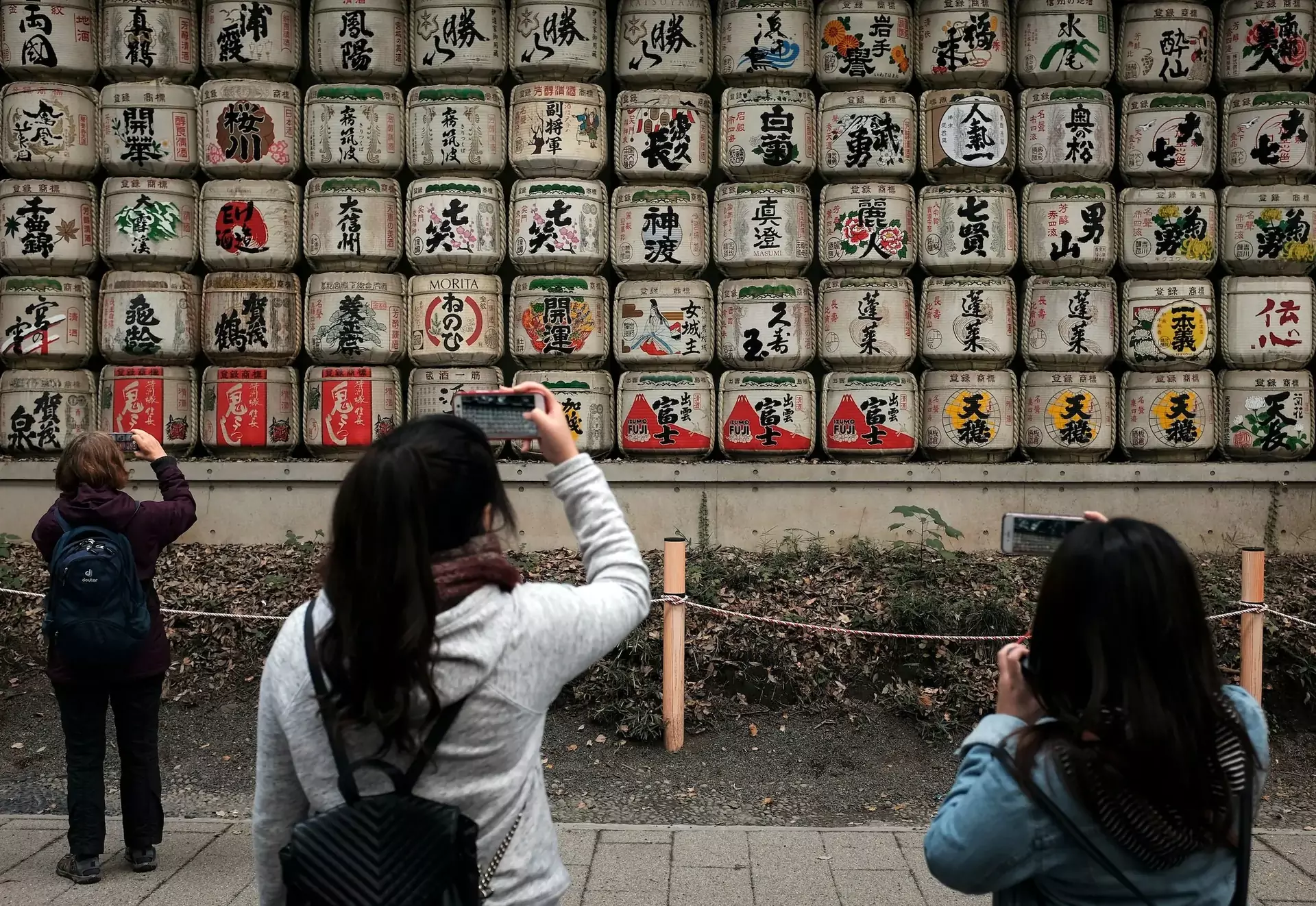
The visit starts at a large wooden torii gate, one of the biggest of its kind in Japan. From there a wide gravel path goes through the trees to the main hall, with more torii gates along the way. About halfway up, two displays face each other. One holds straw-wrapped sake barrels donated by breweries and the other holds Burgundy wine barrels with French labels. Visitors who arrive at the main hall can make a short prayer with a coin, two bows, two claps and a final bow.
The shrine also has quieter parts. The Inner Garden has a pond and a marsh where irises bloom in June. Entry costs ¥500 ($3.15). A museum on the grounds displays items linked to the emperor and empress. Weddings are held at the shrine, so visitors sometimes see traditional wedding processions crossing the courtyard.
Plan on about one hour for the shrine alone, around two with the garden and museum. Entry to the shrine itself is free and the grounds open from sunrise to sunset. The busiest time is the first days of January, when millions of visitors come for the New Year prayers. Weekday mornings are much calmer than weekends.
Trains are the easiest way to reach the shrine, which has several entrances. The south gate is about a minute on foot from JR Harajuku Station on the Yamanote Line. Meijijingumae Station, on the Chiyoda and Fukutoshin subway lines, is beside the same gate. The north entrance is a short walk from Yoyogi Station and Shinjuku Station is also within walking distance. From Shinjuku Station the Yamanote Line reaches Harajuku in about 5 minutes. Tokyo Station takes around 25 minutes by train. Haneda Airport (HND) is roughly 40 minutes away by train and Narita Airport (NRT) around an hour and a half. Driving isn't practical since the shrine has no visitor parking, but taxis can drop you at the main gate.
Most visitors stay in nearby Shibuya, Shinjuku or Harajuku itself, since the shrine is between them. Shibuya has a wide range from budget hostels to larger business hotels. Shinjuku has even more, with direct rail access to both airports. Harajuku and Omotesando have a smaller number of boutique hotels. A stay in this part of Tokyo lets you visit the shrine early before the crowds arrive. It also puts you close to the Yamanote Line and several subway lines for the rest of the city. Rooms fill up around the New Year holiday, when millions of visitors come to pray and during cherry blossom season in late March and early April. Book early at those times.
Food near the shrine is easy to find and varied. Harajuku's Takeshita Street sells crepes and other snacks while Omotesando has cafes and bakeries. Shibuya and Shinjuku have restaurants of every kind within a short train ride.
Food and drink are limited to designated areas inside the grounds, so eat before you go in or afterward. Around New Year, stalls on the approach sell street food such as yakisoba, takoyaki and amazake.
Vegetarians will find many options in this area, though fish stock is common in Japanese dishes. Convenience stores near the stations sell onigiri and sandwiches if you want something quick before the walk.
Log in to add this place to a travel list and get a summary of all recommended items for your whole trip.
We calculate the average costs when traveling to destinations and compare those with the living costs at your home. With this you can get an estimate of how expensive or cheap the destination is for you.
To customize this, you can set up which location and price level are used for the calculations in your account settings.
The exchange rate price factor shows how expensive or cheap a currency currently is compared to its historical average. It's a quick way to see if a country is currently more or less affordable due to exchange rate changes.
