











Was this page helpful?

These place ratings give you a quick overview of how well a destination matches different types of trips.
"Best for" scores:
The specific interest scores show where this place really shines – whether it's ideal for hiking, food & drink experiences, museums or other activities. These highlights help you understand what makes the destination special at a glance.
"Your personal" scores:
This reflects how well a place matches your personal preferences. You can adjust the importances of travel topics or other personal requirements categories in your account settings.
"Suited for" badges:
These give you a quick overview of how well a destination suits specific types of travelers, to help you find the places that match your lifestyle, preferences or travel situation.
| Power Grid: |
100 V, 50 Hz Plug: Type A
Type A:
 Read about power adapters |
|---|---|
| Currency: |
Japanese Yen (JPY) $1 ≈ ¥158 |
| Cashless info: |
Rating 4/5
Cashless payments are becoming more common, especially in cities, with some shops still preferring cash. Be prepared for occasional cash-only situations in rural areas.
Save with a travel credit card |
| eSIM providers: |
Best value: Saily Flexibility: Airalo Read our in-depth comparison |
| Tipping: | Tipping is not customary in Japan and can be considered rude. Excellent service is the norm, and tipping is unnecessary in most places. |
|---|---|
| Public drinking: | Public drinking is legal and commonly accepted, particularly during festivals and events. |
| Public smoking: | Smoking is prohibited in indoor public places but allowed in designated outdoor areas. Some restaurants may have smoking sections. |
| New Year (January) |
One of the most important holidays, expect crowded temples and high prices. Plan ahead. |
|---|---|
| Golden Week (April-May) |
The busiest travel time, expect high demand for accommodation and transportation. |
| Obon (August) |
A time to honor ancestors, many businesses close, and transportation can be crowded. |
| Emergency contact: | Emergency Number: 110 (Police), 119 (Fire & Ambulance) |
|---|---|
| Taxi apps: | Uber, JapanTaxi, DiDi |
| Other: | Japan is a country of respect, so understanding local customs and etiquette is important. Public transportation is efficient, but can be crowded during peak hours. |
The best times to travel section shows how the months compare for a visit, so you can find the time of year that fits what you want to do.
Background colors of the months:
The color shows the typical temperature: yellow (hot), green (mild) and blue (cold). How strong the color is shows the travel season: full color means high season, soft color means shoulder season and soft-striped means off season.
Weather symbols:
Each month has one symbol showing what the weather is typically like, such as hot and sunny, freezing or a rainy or snowy season. Use them to quickly spot months that match the weather you want, or to avoid the ones that don't.
Crowdedness:
The people icon shows how busy the place usually is. The more people, the more crowded it gets.
Additional notes:
The gray info boxes point out special things worth knowing, like recurring weather issues or seasonal events.
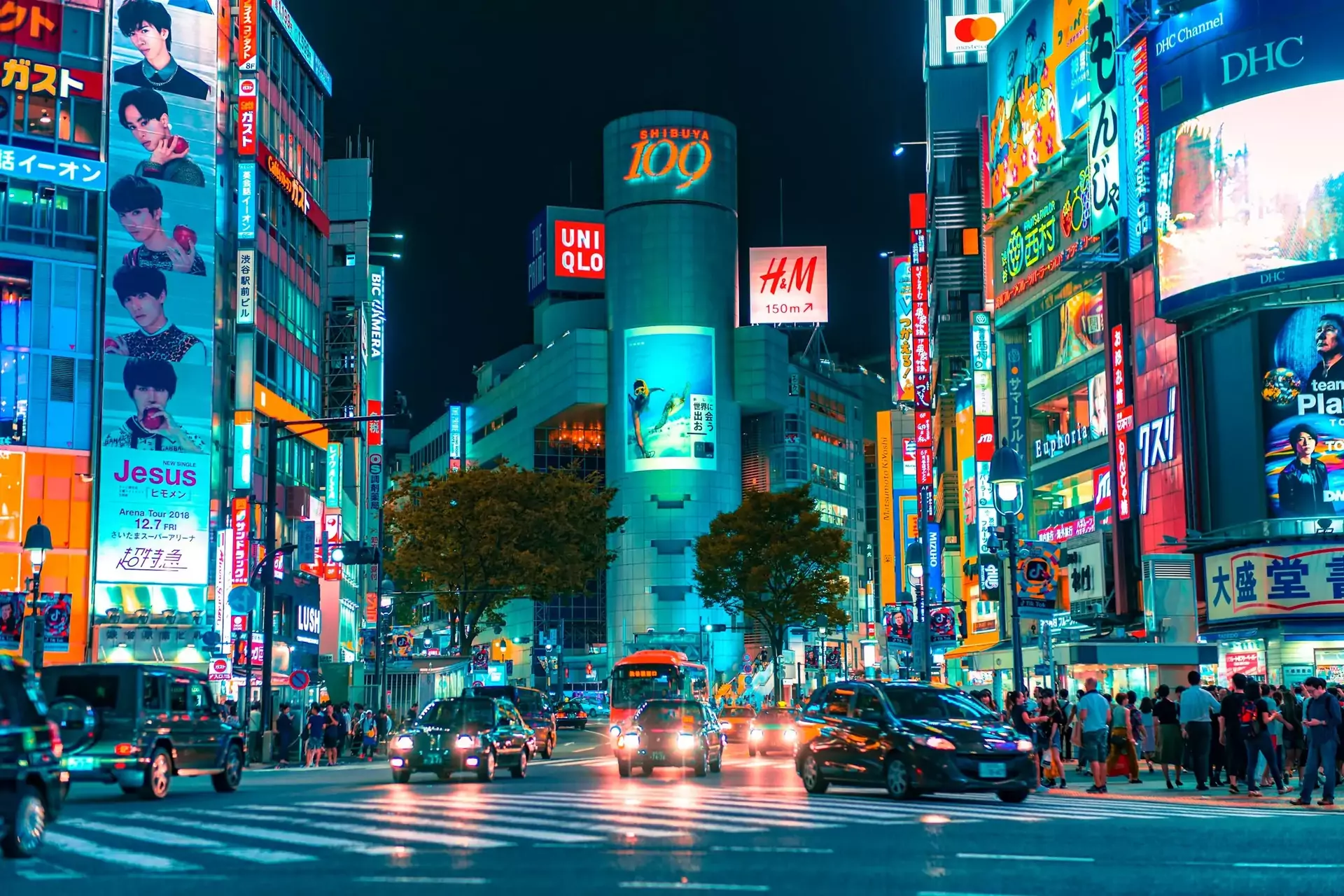
Shibuya is home to the Shibuya Scramble Crossing, where traffic lights stop cars in every direction at once and crowds of people cross from all sides. The crossing is outside the Hachiko exit of the station, surrounded by large LED screens and it's the best known sight of the district.
Beyond the crossing the district is full of contrasts. Large billboards face Shibuya 109, a fashion building, while the back alleys have small bars, street art and ramen shops. The district has fashion, youth culture, nightlife and cafes. There are a few quiet corners between the crowds too. It's a trend-focused area but you don't have to follow trends to enjoy it.
Shibuya is active at any hour. By day it's a good place for shopping and people-watching. At night the area fills with bars, live music venues and clubs that suit different crowds, from cocktail bars with skyline views to basement DJ bars.
Shibuya can be very crowded, especially on weekends. It's also easy to get lost in the maze of streets and prices for food and shopping tend to be higher in trendy spots. If you like a loud and energetic city, it's a good place to see it.
The district is worth the trip for the scramble crossing and for how much is within a few minutes of it on foot. Traffic lights stop cars in every direction at once and pedestrians cross from all sides, which turns the crossing into a spectacle you can watch from street level or from above. Shibuya Hikarie has an indoor viewing area on its 11th floor. SHIBUYA SKY on Shibuya Scramble Square is a rooftop deck about 750 ft up that's in demand at sunset. Beyond the crossing there's plenty to see on foot. Center Gai is a pedestrian street of arcades, karaoke rooms, game centers and ramen shops that has long been a youth hangout. Shibuya 109 and Parco are the main fashion stops while the side streets have record shops and small galleries. Miyashita Park is a rooftop park with a bouldering wall on top of a row of shops and restaurants. Nonbei Yokocho, a lane of tiny bars near the tracks, fills up after dark. A half day is enough for the crossing, one viewpoint and Center Gai. An evening adds dinner and drinks. Meiji Shrine is free to enter and one Yamanote Line stop away at Harajuku, so it fits easily into the same day. It's loud, crowded and commercial. If you'd rather have quiet cafes and side streets, Daikanyama and Nakameguro are a short ride on the Toyoko Line.
Most visitors reach Shibuya by train. The station is on the JR Yamanote Line, so it connects directly to Tokyo Station (about 30 minutes), Shinjuku (about 7 minutes) and Shinagawa (about 12 minutes). From Yokohama the Tokyu Toyoko Line runs straight into Shibuya in about 30 minutes. Shinkansen passengers usually change at Tokyo or Shinagawa. Haneda Airport (HND) has no direct train to Shibuya. The usual route is the Keikyu Line to Shinagawa and then the Yamanote Line, which takes roughly 40 to 50 minutes in total. Limousine buses also run to the Shibuya Station area about once an hour and take 45 minutes to over an hour depending on traffic. From Narita Airport (NRT) the JR Narita Express runs to Shibuya Station in about 1 hour 20 minutes, though not every N'EX train stops there so check the timetable. The Keisei Skyliner to Nippori followed by the Yamanote Line takes a similar time. Driving is possible via the Shibuya ramp on the Metropolitan Expressway. Parking is limited and costly and the streets near the station are congested, so a car adds little for most trips.
Shibuya has one of the widest ranges of places to sleep in Tokyo, mostly business hotels and mid-range chains plus hostels, capsule hotels and a few luxury towers. Rooms are small by international standards. Prices tend to rise the closer you get to the station. The area around the Hachiko exit and Scramble Square has everything at your door and stays lively into the early hours. Streets near Dogenzaka and Center Gai are busy at night, so light sleepers should ask for a higher floor or a quieter side. The streets toward Jingumae and Yoyogi Park are calmer and still within about 10 to 15 minutes on foot of the station. Ebisu is one stop south on the Yamanote Line and is quieter at night. Rooms fill up and prices climb around Halloween weekend and New Year's Eve, so book early for those dates.
Central Shibuya is compact enough to cover on foot. The crossing, Center Gai, Scramble Square and the Hachiko statue are within a few minutes of each other and Miyashita Park is about 5 minutes away. Some streets are steep, with Dogenzaka and Miyamasuzaka the main hills.
Trains and subways:
For the rest of Tokyo the station does the work. The JR Yamanote Line loops to Harajuku, Shinjuku, Tokyo Station and Shinagawa. The Ginza Line goes to Ginza and Asakusa, the Hanzomon Line to Otemachi and the Fukutoshin Line to Shinjuku and Ikebukuro. The Tokyu Toyoko Line runs toward Daikanyama, Nakameguro and Yokohama.
Cards and tickets:
An IC card such as Suica or Pasmo works on all of them. Visitors from abroad can also buy a Tokyo Subway Ticket that gives 24 hours on Tokyo Metro and Toei lines, though not on JR trains like the Yamanote Line.
Taxis:
You don't need a car. Taxis are easy to find but traffic around the crossing is slow, so a short ride can take longer than the train.
Food in Shibuya is casual and quick, with ramen shops, izakaya (Japanese pubs serving small plates), conveyor-belt sushi and yakitori places around the station. Many stay open into the early morning. Center Gai and the lanes near the tracks are packed with small counters where you can eat quickly before a night out.
Department store basements near the station sell prepared food, bento boxes and sweets. They work well for a quick lunch or a picnic in Yoyogi Park. Convenience stores are on almost every block and sell sandwiches, rice balls and hot meals. Some ramen shops use a ticket machine at the entrance and a few small places take only cash.
Vegetarians and vegans will find options, but fish stock turns up in many dishes so it helps to ask. Halal choices are limited.
We calculate the average costs when traveling to destinations and compare those with the living costs at your home. With this you can get an estimate of how expensive or cheap the destination is for you.
To customize this, you can set up which location and price level are used for the calculations in your account settings.
The exchange rate price factor shows how expensive or cheap a currency currently is compared to its historical average. It's a quick way to see if a country is currently more or less affordable due to exchange rate changes.
To help you plan your trip, we provide estimated daily costs per person (when traveling as a pair) for different travel styles. These numbers give you an idea of what you might spend each day at this destination, including accommodation, food, transport and activities.
Additionally, we also provide average hotel costs for different travel styles to give you an estimate for the accommodation only.
Please note that these are only estimates. The real costs depend on booking times, season and other factors.
Travel style categories explained:
Backpacker:
Staying in hostels or budget hotels, cooking your own meals or eating cheap and choosing low-cost activities.
Mid-range:
Staying in mid-range hotels, eating at a mix of restaurants and casual spots and enjoying a variety of activities.
Luxury:
Staying in luxury hotels, dining out at high-end restaurants and enjoying premium experiences without worrying about the price.
| Backpacker | Mid-range | Luxury | |
|---|---|---|---|
| 💵 Total costs per day, including accommodation | |||
| 🏨 Accommodation per night, per person | |||
| 🍝 Food per day | |||
| 🚕 Transportation per day |
| 🍽️ Restaurant Dinner, per person | |
|---|---|
| 🍛 Lunch Set, per person | |
| 🍟 Fast food combo | |
| 🍝 Preparing your own food, per day | |
| ☕ Cappuccino | |
| 🍺 Beer in a restaurant, 0.5 l / 16 oz |
| 🚌 Public transport ticket | |
|---|---|
| 🚕 Taxi Ride, 10 km / 6 mi | |
| ⛽ Gas, 1 l / ¼ gal |
| 🎞️ Movie ticket | |
|---|---|
| 👩⚕️ Doctor's consult | |
| 🤧 Cold medication | |
| 💇 Basic haircut |
Log in to add this place to a travel list and get a summary of all recommended items for your whole trip.
