









Was this page helpful?

| Public website: | play-shibuya.com |
|---|
| Power Grid: |
100 V, 50 Hz Plug: Type A
Type A:
 Read about power adapters |
|---|---|
| Currency: |
Japanese Yen (JPY) $1 ≈ ¥158 |
| Cashless info: |
Rating 4/5
Cashless payments are becoming more common, especially in cities, with some shops still preferring cash. Be prepared for occasional cash-only situations in rural areas.
Save with a travel credit card |
| eSIM providers: |
Best value: Saily Flexibility: Airalo Read our in-depth comparison |
| Tipping: | Tipping is not customary in Japan and can be considered rude. Excellent service is the norm, and tipping is unnecessary in most places. |
|---|---|
| Public drinking: | Public drinking is legal and commonly accepted, particularly during festivals and events. |
| Public smoking: | Smoking is prohibited in indoor public places but allowed in designated outdoor areas. Some restaurants may have smoking sections. |
| New Year (January) |
One of the most important holidays, expect crowded temples and high prices. Plan ahead. |
|---|---|
| Golden Week (April-May) |
The busiest travel time, expect high demand for accommodation and transportation. |
| Obon (August) |
A time to honor ancestors, many businesses close, and transportation can be crowded. |
| Emergency contact: | Emergency Number: 110 (Police), 119 (Fire & Ambulance) |
|---|---|
| Taxi apps: | Uber, JapanTaxi, DiDi |
| Other: | Japan is a country of respect, so understanding local customs and etiquette is important. Public transportation is efficient, but can be crowded during peak hours. |
The best times to travel section shows how the months compare for a visit, so you can find the time of year that fits what you want to do.
Background colors of the months:
The color shows the typical temperature: yellow (hot), green (mild) and blue (cold). How strong the color is shows the travel season: full color means high season, soft color means shoulder season and soft-striped means off season.
Weather symbols:
Each month has one symbol showing what the weather is typically like, such as hot and sunny, freezing or a rainy or snowy season. Use them to quickly spot months that match the weather you want, or to avoid the ones that don't.
Crowdedness:
The people icon shows how busy the place usually is. The more people, the more crowded it gets.
Additional notes:
The gray info boxes point out special things worth knowing, like recurring weather issues or seasonal events.
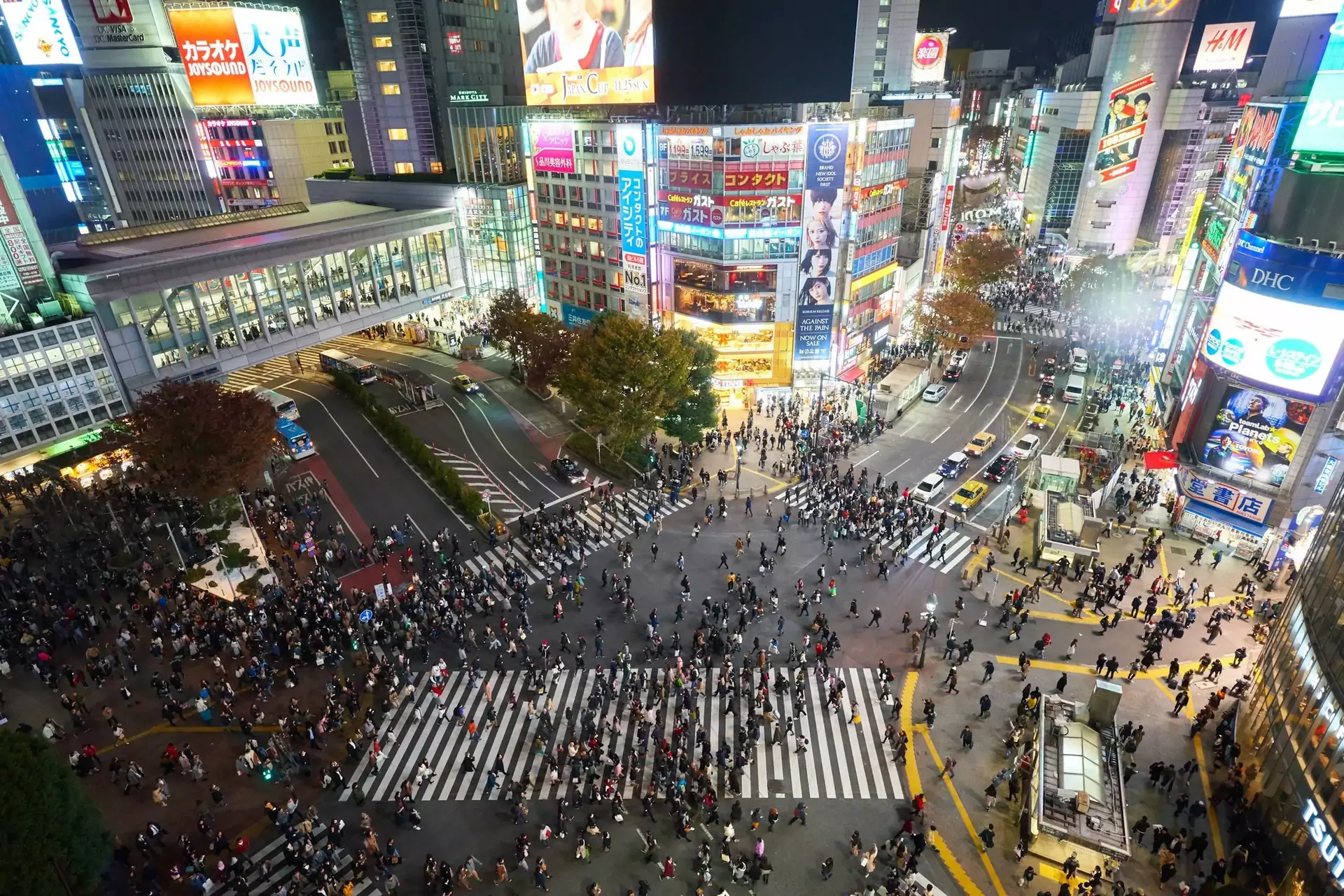
Shibuya Crossing is the wide intersection right in front of the Hachiko Exit. When the signals change, traffic stops in every direction and pedestrians cross at once, including diagonally between corners. The Tokyo tourism board says upwards of 1,000 people can be crossing together. It costs nothing and has no opening hours since it's a public street. The video screens that light up the surrounding buildings give the corner its distinctive look after dark.
Most people experience it first from the street. Walk across from the station side toward Shibuya Center Gai, a pedestrian street with shops, bars and restaurants. Crossing back the other way gives you a different angle on the crowd. The statue of Hachiko the dog is by the station exit next to the crossing and is a well-known meeting spot.
For a view from above, Shibuya Sky is the main option. It's the rooftop observation space of the Shibuya Scramble Square tower, 750 ft above the ground. The building connects directly to Shibuya Station. Doors open at 10:00 AM and the last admission is around 9:00 PM, while adult tickets booked online cost ¥2,700 ($17.07) before 3:00 PM and ¥3,400 ($21.49) from 3:00 PM. Most visits take about 90 minutes. Sunset is the busiest slot with a queue to match, so plan to be early. The rooftop can close in bad weather or strong wind.
Cafes and shops on the upper floors around the intersection also look down on it. If you only want to cross and take photos, the crossing works as a short stop of around half an hour. Shibuya Station is right beside it, so it combines easily with shopping in Shibuya or a visit to the Sky deck later in the day.
Shibuya Station is the stop for the crossing and the Hachiko Exit opens right onto it. The station is served by the JR Yamanote Line, three Tokyo Metro lines (Ginza, Hanzomon and Fukutoshin), the Tokyu Toyoko Line and the Keio Inokashira Line. From Shinjuku the Yamanote Line takes about 7 minutes and from Tokyo Station you should allow around 30 minutes. From Asakusa the Ginza Line runs straight through in roughly 35 minutes. From Haneda Airport (HND) the Keikyu Line to Shinagawa and then the Yamanote Line reaches Shibuya in about 40 minutes. From Narita Airport (NRT) the Narita Express goes to Shibuya in around 80 to 90 minutes. Driving isn't practical since the area is built around the station and its streets are busy. Shibuya Scramble Square has no parking of its own, so trains are the sensible choice.
Shibuya is a practical base since the station has direct trains across Tokyo and the crossing is a few steps from the Hachiko Exit. Hotels around the station range from business hotels to larger upscale ones. Prices tend to be higher than in quieter neighborhoods. The streets near Center Gai and the station stay lively late, so a higher floor or a room facing away from the main streets helps if you sleep lightly. Harajuku and Ebisu are one stop away on the JR Yamanote Line and feel calmer. Shinjuku is about 7 minutes away on the same line and has far more hotels at every price level. Weekends and big event nights bring large crowds to the crossing, so it helps to book early for those dates.
Eating options around Shibuya Crossing are plentiful and mostly casual, from ramen and sushi counters to izakaya (Japanese pubs) and cafes. Shibuya Center Gai and the lanes behind it have the most choice for sit-down meals and many places stay open late.
The buildings around the station hold restaurant floors and food halls. Shibuya Scramble Square has restaurants above its shopping floors. Some cafes above the crossing double as viewpoints. There's no food at the crossing itself so you'd pick a place nearby.
Convenience stores are on almost every block for cheap snacks and drinks. In the evening the bar streets get crowded, so groups may want to book ahead.
Log in to add this place to a travel list and get a summary of all recommended items for your whole trip.
We calculate the average costs when traveling to destinations and compare those with the living costs at your home. With this you can get an estimate of how expensive or cheap the destination is for you.
To customize this, you can set up which location and price level are used for the calculations in your account settings.
The exchange rate price factor shows how expensive or cheap a currency currently is compared to its historical average. It's a quick way to see if a country is currently more or less affordable due to exchange rate changes.
