







Was this page helpful?

| Opening hours: |
|
||
|---|---|---|---|
| Public website: | www.senso-ji.jp |
| Power Grid: |
100 V, 50 Hz Plug: Type A
Type A:
 Read about power adapters |
|---|---|
| Currency: |
Japanese Yen (JPY) $1 ≈ ¥158 |
| Cashless info: |
Rating 4/5
Cashless payments are becoming more common, especially in cities, with some shops still preferring cash. Be prepared for occasional cash-only situations in rural areas.
Save with a travel credit card |
| eSIM providers: |
Best value: Saily Flexibility: Airalo Read our in-depth comparison |
| Tipping: | Tipping is not customary in Japan and can be considered rude. Excellent service is the norm, and tipping is unnecessary in most places. |
|---|---|
| Public drinking: | Public drinking is legal and commonly accepted, particularly during festivals and events. |
| Public smoking: | Smoking is prohibited in indoor public places but allowed in designated outdoor areas. Some restaurants may have smoking sections. |
| New Year (January) |
One of the most important holidays, expect crowded temples and high prices. Plan ahead. |
|---|---|
| Golden Week (April-May) |
The busiest travel time, expect high demand for accommodation and transportation. |
| Obon (August) |
A time to honor ancestors, many businesses close, and transportation can be crowded. |
| Emergency contact: | Emergency Number: 110 (Police), 119 (Fire & Ambulance) |
|---|---|
| Taxi apps: | Uber, JapanTaxi, DiDi |
| Other: | Japan is a country of respect, so understanding local customs and etiquette is important. Public transportation is efficient, but can be crowded during peak hours. |
The best times to travel section shows how the months compare for a visit, so you can find the time of year that fits what you want to do.
Background colors of the months:
The color shows the typical temperature: yellow (hot), green (mild) and blue (cold). How strong the color is shows the travel season: full color means high season, soft color means shoulder season and soft-striped means off season.
Weather symbols:
Each month has one symbol showing what the weather is typically like, such as hot and sunny, freezing or a rainy or snowy season. Use them to quickly spot months that match the weather you want, or to avoid the ones that don't.
Crowdedness:
The people icon shows how busy the place usually is. The more people, the more crowded it gets.
Additional notes:
The gray info boxes point out special things worth knowing, like recurring weather issues or seasonal events.
The Buddhist temple of Senso-ji is in Asakusa and is regarded as Tokyo's oldest temple. Its story begins in 628 when fishermen found a statue of Kannon, the bodhisattva of compassion, in their net on the Sumida River. A local headman turned his house into a temple for it and in 645 a priest built a hall for the statue. The statue was hidden from view and the temple says it has never been shown since. The grounds are free to enter and the site is still a working temple with daily worship.
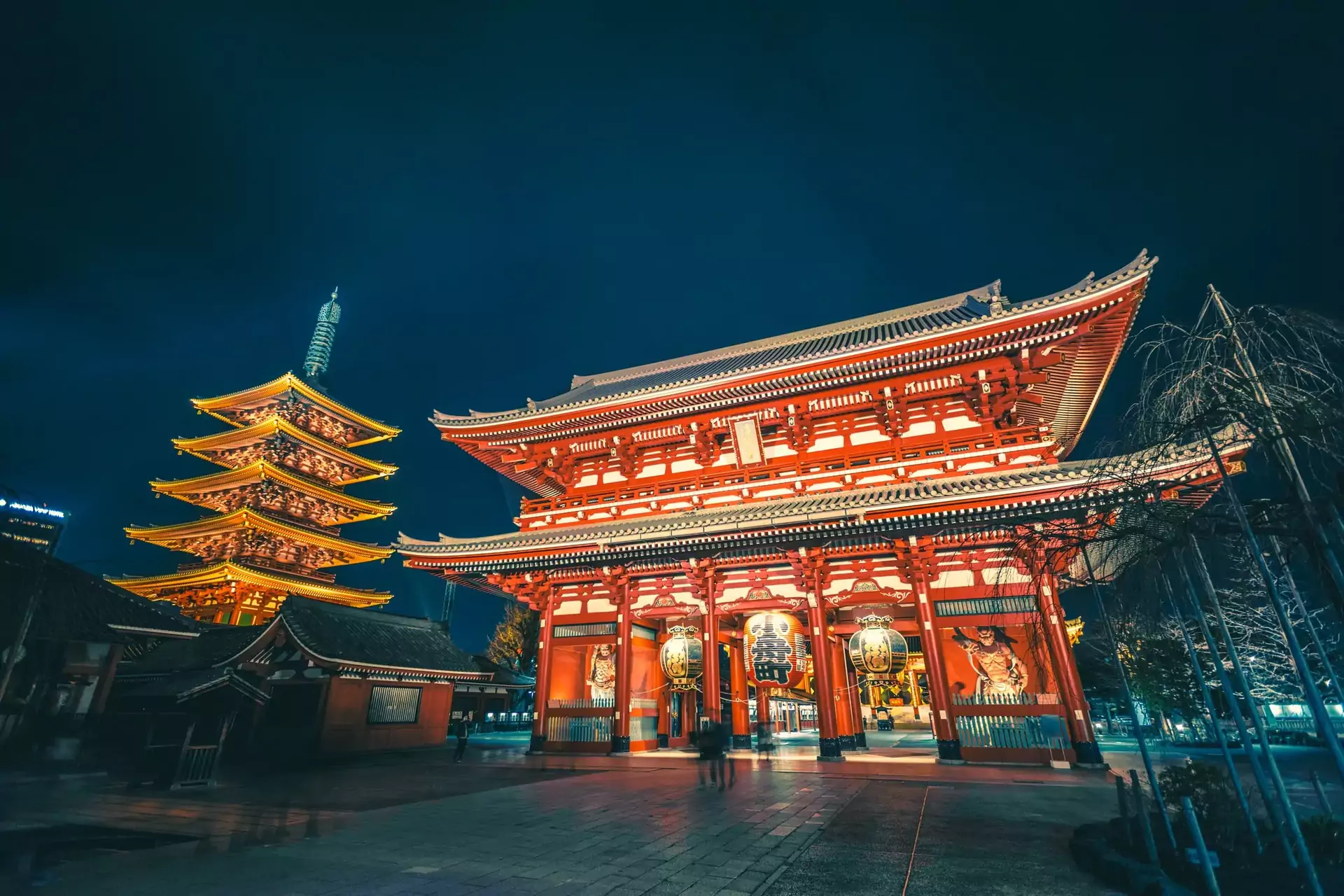
Most visits start at the Kaminarimon, the outer gate with a giant red lantern and statues of the wind god Fujin and the thunder god Raijin. The gate burned down in 1865 and the current one dates from 1960. Beyond it the Nakamise shopping street leads toward the temple, lined with stalls selling traditional snacks, toys and souvenirs. At the far end the Hozomon gate marks the entrance to the inner grounds and was rebuilt in 1964.
The Main Hall is where visitors place their hands together in prayer and stand before the offering box. Nearby the five-story pagoda was destroyed in an air raid in March 1945 and rebuilt in 1973. It holds Buddha's ashes, a gift from a temple in Sri Lanka. Yogodo Hall is where the temple's goshuin seals are given out and the temple also holds festivals through the year, including Hatsumode in the first week of January and a hagoita market in mid-December.
The grounds can be entered at any hour and the paths are wide, so getting around is easy. The Main Hall itself has stairs at the front and an elevator on its west side. Allow about half an hour for the gate, Nakamise and the main buildings. Add more time if you want to browse the stalls or visit the surrounding streets of Asakusa.
Trains are the easiest way to reach Senso-ji and Asakusa Station is the closest stop. It's served by the Tokyo Metro Ginza Line, the Toei Asakusa Line and the Tobu Skytree Line. The Kaminarimon gate is a short walk from the station exits. From Ueno the Ginza Line takes about 5 minutes. From Tokyo Station you can change at Kanda for the Ginza Line, about 20 minutes in total. From Shinjuku the JR Chuo Line to Kanda and then the Ginza Line takes around 35 minutes. Some Keikyu trains from Haneda Airport (HND) continue onto the Toei Asakusa Line and reach Asakusa in around 40 minutes. From Narita Airport (NRT) the Keisei Access Express runs direct to Asakusa in about 50 minutes. The Tobu Skytree Line connects Asakusa with Tokyo Skytree in about 3 minutes. A waterbus pier on the Sumida River is a few minutes' walk from the temple and the Skytree Shuttle bus links Ueno Station with a stop near the north side of Senso-ji. Senso-ji has no car park of its own.
Asakusa itself is a practical base with a traditional feel and direct train links. It has a mix of business hotels, guesthouses, hostels and a few Japanese-style inns within walking distance of the temple. The streets around the temple quiet down in the evening and the area feels calmer than central Tokyo after dark. Ueno is the main alternative, five minutes away on the Ginza Line, with more large hotels and the Narita and Haneda links nearby. Staying near Tokyo Skytree puts you a few minutes from Asakusa as well. Choosing a hub such as Tokyo Station or Shinjuku gives more choice and a ride of about 20 to 35 minutes. Asakusa fills up around New Year and during major festivals, so it helps to book early for those dates.


Food around Senso-ji is a mix of street snacks and traditional restaurants. Nakamise has stalls selling baked sweets and rice crackers that are made in front of you. The lanes behind the temple have many casual restaurants. Edo-style sushi, tempura and soba are common in Asakusa. Rice crackers and baked sweets from the stalls also travel well as souvenirs.
There's no restaurant inside the temple grounds so you'd eat on the surrounding streets. Rokku Broadway and the nearby blocks have numerous restaurants for sit-down meals. Many food stalls close earlier in the evening than restaurants do. Convenience stores and cafes are easy to find near Asakusa Station if you want something quick.
Log in to add this place to a travel list and get a summary of all recommended items for your whole trip.
We calculate the average costs when traveling to destinations and compare those with the living costs at your home. With this you can get an estimate of how expensive or cheap the destination is for you.
To customize this, you can set up which location and price level are used for the calculations in your account settings.
The exchange rate price factor shows how expensive or cheap a currency currently is compared to its historical average. It's a quick way to see if a country is currently more or less affordable due to exchange rate changes.
