






Was this page helpful?

| Opening hours: |
|
|
|---|---|---|
| Public website: | inari.jp |
| Power Grid: |
100 V, 50 Hz Plug: Type A
Type A:
 Read about power adapters |
|---|---|
| Currency: |
Japanese Yen (JPY) $1 ≈ ¥158 |
| Cashless info: |
Rating 4/5
Cashless payments are becoming more common, especially in cities, with some shops still preferring cash. Be prepared for occasional cash-only situations in rural areas.
Save with a travel credit card |
| eSIM providers: |
Best value: Saily Flexibility: Airalo Read our in-depth comparison |
| Tipping: | Tipping is not customary in Japan and can be considered rude. Excellent service is the norm, and tipping is unnecessary in most places. |
|---|---|
| Public drinking: | Public drinking is legal and commonly accepted, particularly during festivals and events. |
| Public smoking: | Smoking is prohibited in indoor public places but allowed in designated outdoor areas. Some restaurants may have smoking sections. |
| New Year (January) |
One of the most important holidays, expect crowded temples and high prices. Plan ahead. |
|---|---|
| Golden Week (April-May) |
The busiest travel time, expect high demand for accommodation and transportation. |
| Obon (August) |
A time to honor ancestors, many businesses close, and transportation can be crowded. |
| Emergency contact: | Emergency Number: 110 (Police), 119 (Fire & Ambulance) |
|---|---|
| Taxi apps: | Uber, JapanTaxi, DiDi |
| Other: | Japan is a country of respect, so understanding local customs and etiquette is important. Public transportation is efficient, but can be crowded during peak hours. |
The best times to travel section shows how the months compare for a visit, so you can find the time of year that fits what you want to do.
Background colors of the months:
The color shows the typical temperature: yellow (hot), green (mild) and blue (cold). How strong the color is shows the travel season: full color means high season, soft color means shoulder season and soft-striped means off season.
Weather symbols:
Each month has one symbol showing what the weather is typically like, such as hot and sunny, freezing or a rainy or snowy season. Use them to quickly spot months that match the weather you want, or to avoid the ones that don't.
Crowdedness:
The people icon shows how busy the place usually is. The more people, the more crowded it gets.
Additional notes:
The gray info boxes point out special things worth knowing, like recurring weather issues or seasonal events.
Fushimi Inari Taisha is the central shrine for about 40,000 Inari shrines across Japan. Inari is the deity of good harvests and business success. The shrine is said to have been founded in 711, before Kyoto became the capital. Foxes are considered Inari's divine messengers and fox statues are scattered across the grounds, often with a key in the mouth that represents the granary key. The grounds are free to enter and open around the clock.
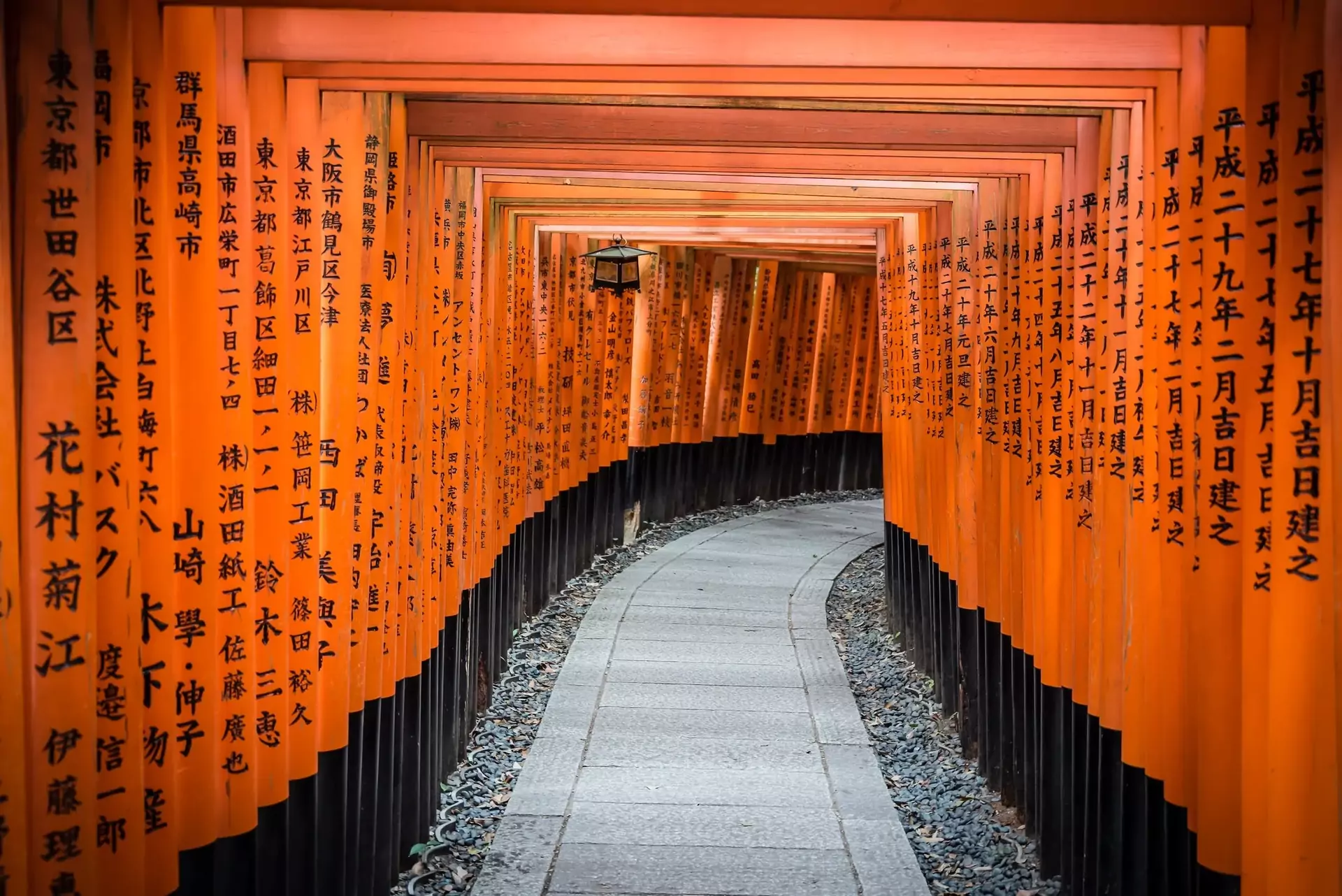
Beyond the main hall the famous torii gates begin. Companies and individuals donate the gates for business prosperity and the mountain holds thousands of them, some dating from the Edo period. The Senbon Torii is the tunnel of closely packed gates on the approach to the Okunoin shrine and is the section most visitors photograph. The paths go up Inariyama, a mountain 750 ft high that counts as part of the shrine, with smaller shrines and worship stones along the way.
Touring the whole mountain takes about 2 to 3 hours and a souvenir shop and tea stall are about halfway up. You can turn back at any point, so many visitors only walk the first section. The paths are busiest in the daytime and early morning or late afternoon visits are quieter. Late in the day the upper paths feel more eerie, with small shrines and graveyards among the trees.
JR Inari Station is right in front of the shrine, so there's no long approach before the torii begin. Wear shoes with good grip since the way up is mostly stone steps. You can plan on about an hour for the lower gates and up to three hours for the summit loop. Bring water and consider a light lunch from the stalls on the way.
Trains are the easiest way to reach the shrine. From Kyoto Station the JR Nara Line runs to Inari Station in about 9 minutes and both rapid and local trains stop there. The large red torii gate and the main approach are visible from the station and the shrine is a short walk east. Starting from Shijo Kawaramachi the Keihan Line runs directly to Fushimi Inari Station in about 22 minutes, although limited express trains don't stop there. Walk east for roughly 5 to 7 minutes through a small temple town with souvenir shops and Kyoto-style restaurants. Then cross the Inari Bridge and the JR line crossing to reach the main approach. City Bus 5 also runs to the area but its travel time can vary by more than 24 minutes, so trains are the better choice. From Kansai Airport (KIX) the Haruka express reaches Kyoto Station in about 75 minutes and you change to the JR Nara Line.
Most visitors stay in central Kyoto and reach the shrine by a short train ride, since the JR Nara Line from Kyoto Station takes only about 9 minutes. The Kyoto Station area has the widest choice of hotels and the easiest connections. Shijo Kawaramachi and Gion have more restaurants and old streets and the Keihan Line runs direct to Fushimi Inari Station from there. Staying close to the shrine suits you if you want to arrive early or walk the mountain in the evening when it's quiet. The area around Inari and Fushimi has a smaller number of guesthouses and small hotels and fewer restaurants than the center. Rooms across Kyoto fill quickly during cherry blossom season and the autumn foliage, so it helps to book early for those weeks.


Food around the shrine is casual and mostly sold from stalls and small shops on the approach streets. Tea stalls serve inari sushi (rice wrapped in sweet fried tofu) and kitsune udon (noodles topped with fried tofu). Sweet shops sell tsujiura senbei, a type of fortune cookie said to date to the 19th century.
Between Fushimi Inari Station and the shrine you'll find Kyoto-style restaurants and souvenir shops. Halfway up the mountain a shop and a tea stall give you a place to rest on the hike. Stalls near the main hall can be busy at midday, so a light lunch before or after the climb helps avoid waits. Convenience stores are close to the stations if you'd like to bring water or snacks.
Log in to add this place to a travel list and get a summary of all recommended items for your whole trip.
We calculate the average costs when traveling to destinations and compare those with the living costs at your home. With this you can get an estimate of how expensive or cheap the destination is for you.
To customize this, you can set up which location and price level are used for the calculations in your account settings.
The exchange rate price factor shows how expensive or cheap a currency currently is compared to its historical average. It's a quick way to see if a country is currently more or less affordable due to exchange rate changes.
