






Was this page helpful?

| Opening hours: |
|
||
|---|---|---|---|
| Public website: | www.kiyomizudera.or.jp |
| Power Grid: |
100 V, 50 Hz Plug: Type A
Type A:
 Read about power adapters |
|---|---|
| Currency: |
Japanese Yen (JPY) $1 ≈ ¥158 |
| Cashless info: |
Rating 4/5
Cashless payments are becoming more common, especially in cities, with some shops still preferring cash. Be prepared for occasional cash-only situations in rural areas.
Save with a travel credit card |
| eSIM providers: |
Best value: Saily Flexibility: Airalo Read our in-depth comparison |
| Tipping: | Tipping is not customary in Japan and can be considered rude. Excellent service is the norm, and tipping is unnecessary in most places. |
|---|---|
| Public drinking: | Public drinking is legal and commonly accepted, particularly during festivals and events. |
| Public smoking: | Smoking is prohibited in indoor public places but allowed in designated outdoor areas. Some restaurants may have smoking sections. |
| New Year (January) |
One of the most important holidays, expect crowded temples and high prices. Plan ahead. |
|---|---|
| Golden Week (April-May) |
The busiest travel time, expect high demand for accommodation and transportation. |
| Obon (August) |
A time to honor ancestors, many businesses close, and transportation can be crowded. |
| Emergency contact: | Emergency Number: 110 (Police), 119 (Fire & Ambulance) |
|---|---|
| Taxi apps: | Uber, JapanTaxi, DiDi |
| Other: | Japan is a country of respect, so understanding local customs and etiquette is important. Public transportation is efficient, but can be crowded during peak hours. |
The best times to travel section shows how the months compare for a visit, so you can find the time of year that fits what you want to do.
Background colors of the months:
The color shows the typical temperature: yellow (hot), green (mild) and blue (cold). How strong the color is shows the travel season: full color means high season, soft color means shoulder season and soft-striped means off season.
Weather symbols:
Each month has one symbol showing what the weather is typically like, such as hot and sunny, freezing or a rainy or snowy season. Use them to quickly spot months that match the weather you want, or to avoid the ones that don't.
Crowdedness:
The people icon shows how busy the place usually is. The more people, the more crowded it gets.
Additional notes:
The gray info boxes point out special things worth knowing, like recurring weather issues or seasonal events.
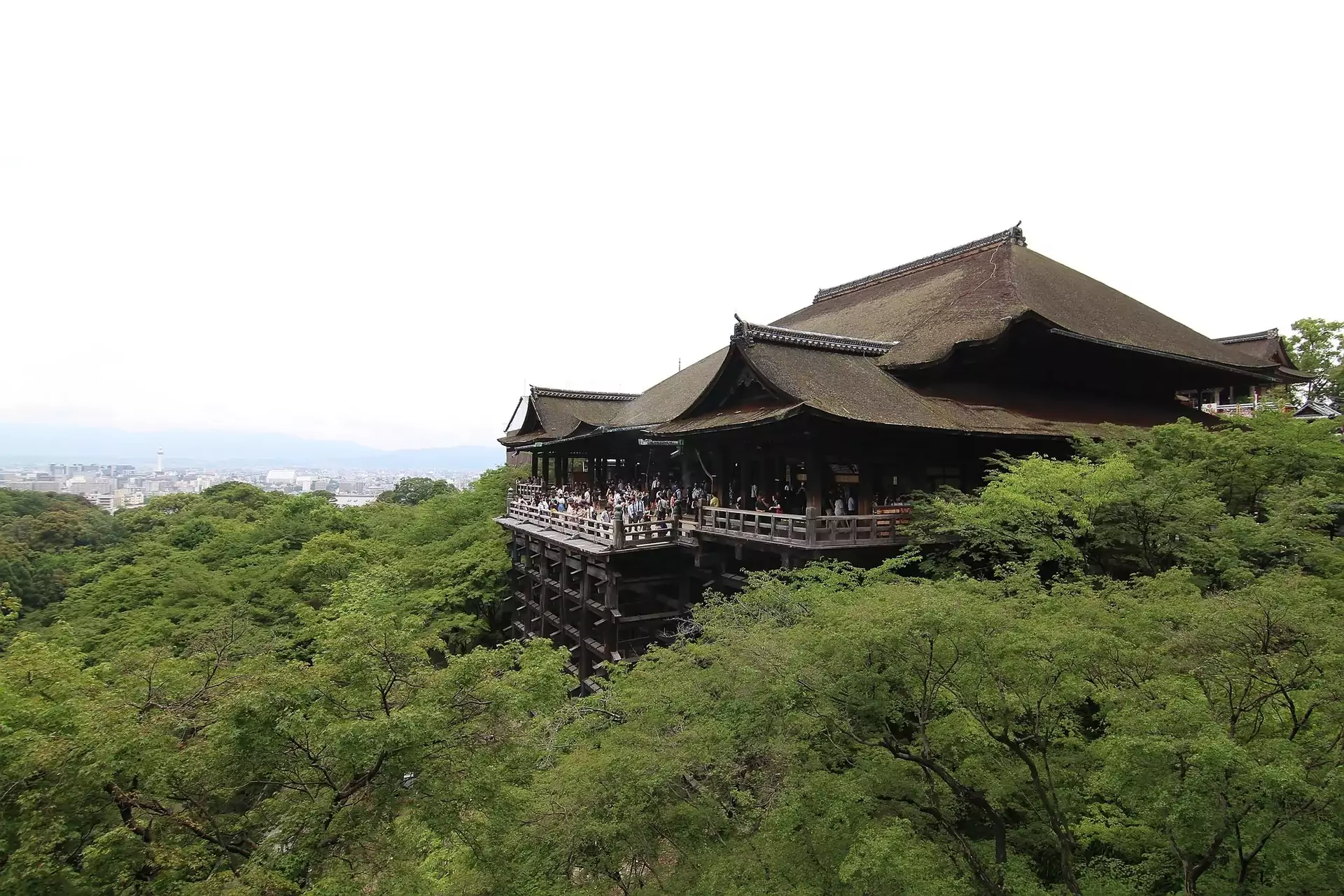
Kiyomizu-dera is a Buddhist temple on a small mountain in the Higashiyama district. It was founded in 778 and is part of the UNESCO World Heritage listing for the historic monuments of ancient Kyoto. The setting gives it wide views over the city. The grounds change with the seasons, with cherry blossoms in spring, green in summer, autumn colors in fall and bare trees in winter.
The main hall is the best-known part. Its wooden stage is about 43 ft above the ground and was built without nails. It's often crowded, so heading to the far corner and waiting a moment gives a better view of the city. At the base of the hall the Otowa Waterfall splits into three streams. Visitors drink from one of them using long-handled ladles and are asked to pour the water into the hand instead of drinking from the ladle.
Behind the main hall Jishu Shrine is known for romance. Two stones are in front of it and walking from one to the other with your eyes closed is said to bring true love. Further uphill the Okunoin hall has a smaller veranda that gives a good view back toward the main hall and the city. The temple holds evening illuminations in spring and fall.
The approach is part of the visit and from the bus stops it's a climb of at least 10 minutes uphill along lanes lined with shops selling Kiyomizu-yaki pottery and yuba, a soy-based food. From Gion the pedestrian streets of Ninenzaka and Sannenzaka lead up to the temple. An admission fee applies for the main grounds. Expect stairs and slopes throughout and plan on one to two hours, longer in cherry blossom and autumn foliage seasons.
Kiyomizu-dera is in Higashiyama and the usual approach is by bus or on foot. From Kyoto Station, bus 100 or 206 runs to the Gojozaka or Kiyomizu-michi stop and from there the temple is about a 10-minute walk uphill. These buses are often crowded and the roads around Higashiyama can jam. A less crowded option is to take the Karasuma Line subway one stop to Kujo Station and then City Bus 202 or 207 to Gojozaka. From Shijo Kawaramachi the recommended route is on foot past Hanamikoji Street and Yasaka Shrine. From Kiyomizu-Gojo Station on the Keihan Line you walk up Gojozaka. Higashiyama Station on the Tozai Line is about 35 minutes away on foot through Nene-no-michi, Ninenzaka and Sannenzaka. From Kansai Airport (KIX) the Haruka express reaches Kyoto Station in about 75 minutes and you continue by bus or subway. Driving isn't recommended since the roads near Higashiyama are often congested.
Staying in Higashiyama puts the temple within walking distance and gives access to the lanes and wooden streets of the district early in the morning before the crowds arrive. The area has Japanese-style inns, small guesthouses in restored townhouses and a few hotels. Prices tend to be higher than in the city center. Gion and Shijo Kawaramachi are a short walk or bus ride away and have more hotels and restaurants. The Kyoto Station area has the widest choice and the easiest train links, with the temple reachable by bus or subway and a short walk. Rooms across Kyoto fill quickly during cherry blossom season and the autumn foliage, so it helps to book early for those weeks. If you want to avoid the hill, choose a base near Kiyomizu-Gojo Station or Gion rather than far up the slope.


Food near the temple is mostly on the approach streets rather than inside the grounds. Shops and tea houses along the lanes sell matcha sweets, Kyoto-style confectionery and other snacks to eat as you walk. Yuba, a soy-based food, is a local specialty and is often served in set meals with tofu dishes.
There aren't many full restaurants right next to the main hall, so a proper meal usually means walking back down toward Gion or Shijo Kawaramachi. Convenience stores are easier to find at the base of the slope than near the top. On weekends and in peak seasons the cafes and tea rooms fill up in the middle of the day, so an early or late visit helps avoid waits.
Log in to add this place to a travel list and get a summary of all recommended items for your whole trip.
We calculate the average costs when traveling to destinations and compare those with the living costs at your home. With this you can get an estimate of how expensive or cheap the destination is for you.
To customize this, you can set up which location and price level are used for the calculations in your account settings.
The exchange rate price factor shows how expensive or cheap a currency currently is compared to its historical average. It's a quick way to see if a country is currently more or less affordable due to exchange rate changes.
