








Was this page helpful?

| Opening hours: |
|
||
|---|---|---|---|
| Public website: | www.ashikaga.co.jp |
| Power Grid: |
100 V, 50 Hz Plug: Type A
Type A:
 Read about power adapters |
|---|---|
| Currency: |
Japanese Yen (JPY) $1 ≈ ¥158 |
| Cashless info: |
Rating 4/5
Cashless payments are becoming more common, especially in cities, with some shops still preferring cash. Be prepared for occasional cash-only situations in rural areas.
Save with a travel credit card |
| eSIM providers: |
Best value: Saily Flexibility: Airalo Read our in-depth comparison |
| Tipping: | Tipping is not customary in Japan and can be considered rude. Excellent service is the norm, and tipping is unnecessary in most places. |
|---|---|
| Public drinking: | Public drinking is legal and commonly accepted, particularly during festivals and events. |
| Public smoking: | Smoking is prohibited in indoor public places but allowed in designated outdoor areas. Some restaurants may have smoking sections. |
| New Year (January) |
One of the most important holidays, expect crowded temples and high prices. Plan ahead. |
|---|---|
| Golden Week (April-May) |
The busiest travel time, expect high demand for accommodation and transportation. |
| Obon (August) |
A time to honor ancestors, many businesses close, and transportation can be crowded. |
| Emergency contact: | Emergency Number: 110 (Police), 119 (Fire & Ambulance) |
|---|---|
| Taxi apps: | Uber, JapanTaxi, DiDi |
| Other: | Japan is a country of respect, so understanding local customs and etiquette is important. Public transportation is efficient, but can be crowded during peak hours. |
The best times to travel section shows how the months compare for a visit, so you can find the time of year that fits what you want to do.
Background colors of the months:
The color shows the typical temperature: yellow (hot), green (mild) and blue (cold). How strong the color is shows the travel season: full color means high season, soft color means shoulder season and soft-striped means off season.
Weather symbols:
Each month has one symbol showing what the weather is typically like, such as hot and sunny, freezing or a rainy or snowy season. Use them to quickly spot months that match the weather you want, or to avoid the ones that don't.
Crowdedness:
The people icon shows how busy the place usually is. The more people, the more crowded it gets.
Additional notes:
The gray info boxes point out special things worth knowing, like recurring weather issues or seasonal events.
Ashikaga Flower Park is built around wisteria and the main attraction is the Great Wisteria, a tree more than 160 years old whose branches are trained over a trellis covering about 11,000 sq ft. Tochigi Prefecture has designated the trellis a natural monument. The park grows more than 350 wisteria trees in all and they come into bloom in sequence. Pale pink varieties open first in mid to late April. The Great Wisteria peaks around late April and early May and the white wisteria follows in early May. Laburnum, a European tree with yellow flowers that look like wisteria, finishes the run in early to mid May.
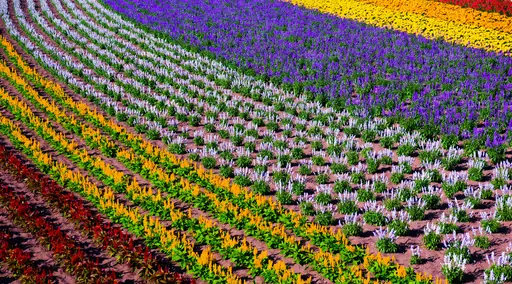
The park changes with the calendar. Its official guide divides the year into eight flower seasons and more than 5,000 azalea bushes bloom from mid-April into early May alongside the wisteria. The rose garden holds about 400 kinds of roses on 2,500 bushes. Rhododendrons, clematis, irises, hydrangeas and water lilies are among the plantings that carry the park through the rest of the year.
From autumn into February the park holds Flower Fantasy, a light show with LED displays across the grounds. These include light tunnels and wisteria shapes made of light. It has run in three stages, with a flower-themed show into mid-November, a Christmas show from late November and a New Year illumination from January 1. The lights come on in the late afternoon. During the day the park is a quieter and more traditional garden visit.
Allow a couple of hours to walk the grounds, longer if you linger at the trellis and the tunnel. Hours shift with the season and generally run from about 9:00 AM or 10:00 AM until 5:00 PM or 6:00 PM, with last entry 30 minutes before closing. In peak wisteria weeks and during the illumination the park opens earlier or stays open until about 9:00 PM. Adult admission runs from about ¥300 ($1.89) in quiet periods to about ¥2,300 ($14.51) at the wisteria peak. Pets aren't allowed.
Trains are the easiest way to reach Ashikaga Flower Park, with the JR Ryomo Line stopping at Ashikaga Flower Park Station right beside the park. From Tokyo the quickest route is the Tohoku Shinkansen to Oyama, which takes about 40 minutes. A Ryomo Line train then covers the rest in roughly half an hour. Regular JR trains on the Utsunomiya or Shonan-Shinjuku lines also reach Oyama and make the whole trip about two hours. From Asakusa the Tobu Railway runs to Ashikagashi Station, from where you walk to JR Ashikaga Station and ride one stop on the Ryomo Line. Limited express trains from the Tokyo area have run on some days in wisteria season. A free shuttle bus has linked Ashikaga Station and the park in spring. The nearest major airports are Haneda (HND) and Narita (NRT), both reached by connecting through central Tokyo. Drivers can leave the Tohoku Expressway at Sano-Fujioka Interchange, about 20 minutes from the park. The free parking lot has space for around 300 cars and weekdays are easier for drivers during wisteria season.
The park has no lodging of its own so most people stay in nearby towns or make a day trip from Tokyo. Ashikaga city is the closest base, with smaller business hotels around JR Ashikaga Station and Tobu Ashikagashi Station. JR Ashikaga Station is one stop from the park by train. Oyama and Sano are other towns on the same rail corridor and both are reasonable alternatives if Ashikaga is full. Tokyo also works as a base if you don't mind about two hours each way. That gets harder in the busiest weeks, when the park stays open into the evening and trains back are crowded. Rooms in Ashikaga and the surrounding towns tend to fill from late April to mid-May and over Golden Week, so booking early helps. At other times of year there's less pressure on availability and prices.
Eating at Ashikaga Flower Park mostly happens inside the park, since the park asks guests not to bring in their own food or drinks. There's a restaurant serving Japanese and Western dishes, plus cafes and a souvenir shop that sells wisteria-themed sweets made for the park. The drinks list includes coffee, tea, draft beer and sake or wine by the glass.
The park's group set menus draw on Tochigi ingredients such as Shimotsuke beef (a prefectural brand) and rainbow trout, alongside simpler tempura and teriyaki sets. A vegetable set with no meat or fish apart from fish stock is offered for groups in the cooler months. If you want more choice, the city of Ashikaga is one stop away by train and has restaurants around its station, which suits a meal before or after the visit.
Log in to add this place to a travel list and get a summary of all recommended items for your whole trip.
We calculate the average costs when traveling to destinations and compare those with the living costs at your home. With this you can get an estimate of how expensive or cheap the destination is for you.
To customize this, you can set up which location and price level are used for the calculations in your account settings.
The exchange rate price factor shows how expensive or cheap a currency currently is compared to its historical average. It's a quick way to see if a country is currently more or less affordable due to exchange rate changes.
