









Was this page helpful?

These place ratings give you a quick overview of how well a destination matches different types of trips.
"Best for" scores:
The specific interest scores show where this place really shines – whether it's ideal for hiking, food & drink experiences, museums or other activities. These highlights help you understand what makes the destination special at a glance.
"Your personal" scores:
This reflects how well a place matches your personal preferences. You can adjust the importances of travel topics or other personal requirements categories in your account settings.
"Suited for" badges:
These give you a quick overview of how well a destination suits specific types of travelers, to help you find the places that match your lifestyle, preferences or travel situation.
| Power Grid: |
230 V, 50 Hz Plug: Type D , Type G
Type D:
  Read about power adapters |
|---|---|
| Currency: |
Bhutanese Ngultrum (BTN) $1 ≈ BTN 95.03 |
| Cashless info: |
Rating 2/5
Cashless payments are not widely accepted in Bhutan, and cash is generally preferred, especially in rural areas. Credit cards are accepted in larger cities.
Save with a travel credit card |
| eSIM providers: |
Flexibility: Airalo Read our in-depth comparison |
| Tipping: | Tipping is not mandatory in Bhutan, but it is appreciated. A 5-10% tip is common in restaurants and for hotel staff. |
|---|---|
| Public drinking: | Public drinking is not common in Bhutan, and alcohol consumption is generally restricted to private spaces or licensed venues. |
| Public smoking: | Smoking is banned in most public areas, and Bhutan has some of the strictest tobacco laws in the world, although the ban on tobacco sales was lifted in 2021. Smoking is allowed in private places. |
| Bhutan National Day (December) |
Expect celebrations with parades and festivals in the capital, Thimphu. |
|---|---|
| Tsechu Festival (October) |
Tsechu is an important religious festival, attracting large crowds for traditional dances and performances. |
| Emergency contact: | Emergency Numbers: 113 (Police), 112 (Ambulance), 110 (Fire) |
|---|---|
| Taxi apps: | Tashi Taxi |
| Other: | Bhutan is known for its stunning monasteries, trekking trails, and commitment to preserving its unique culture and environment. |
The best times to travel section shows how the months compare for a visit, so you can find the time of year that fits what you want to do.
Background colors of the months:
The color shows the typical temperature: yellow (hot), green (mild) and blue (cold). How strong the color is shows the travel season: full color means high season, soft color means shoulder season and soft-striped means off season.
Weather symbols:
Each month has one symbol showing what the weather is typically like, such as hot and sunny, freezing or a rainy or snowy season. Use them to quickly spot months that match the weather you want, or to avoid the ones that don't.
Crowdedness:
The people icon shows how busy the place usually is. The more people, the more crowded it gets.
Additional notes:
The gray info boxes point out special things worth knowing, like recurring weather issues or seasonal events.
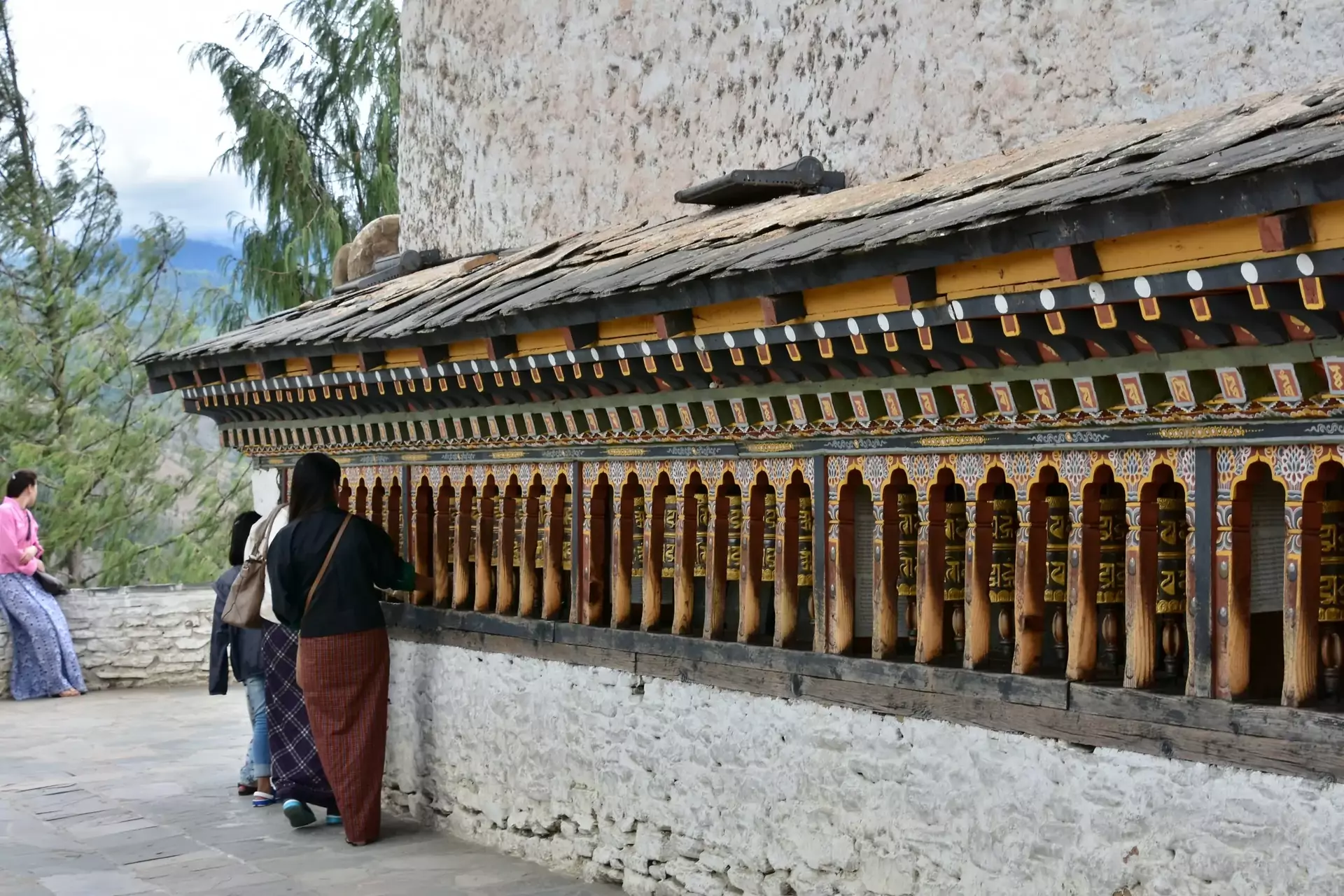
Thimphu is a working capital where office workers and students wear the national dress, the gho for men and the kira for women, so traditional culture is part of ordinary city life. The city has no traffic lights and the center is small enough to walk, which suits a day or two of unhurried sightseeing. Tashichho Dzong is the main sight and the center of Bhutan's government. Visitors are admitted after office hours on working days and all day on weekends and public holidays. The Buddha Dordenma is a large gilded Buddha statue on a hill above the valley and entry is free. The National Memorial Chorten is a white stupa where locals walk clockwise around the base through the day. Changangkha Lhakhang is an old hilltop temple known for blessings for newborns. From Friday to Sunday the Centenary Farmers' Market fills the bank of the Wang Chhu with stalls selling vegetables, chilies, cheese and handicrafts. The Folk Heritage Museum and the Textile Museum take about an hour each. The Motithang Takin Preserve is home to the takin, Bhutan's national animal. The Thimphu Tshechu, a masked dance festival at Tashichho Dzong, is held each autumn on dates that follow the lunar calendar. Punakha is 46 mi away over the Dochula Pass, so Thimphu works as a base for day trips and onward travel. There's little nightlife. The hills and altitude mean an easy first day helps.
Thimphu has no airport. Paro is Bhutan's only international airport and is about 29 mi from Thimphu, a drive of 1 to 1.5 hours. Druk Air and Bhutan Airlines fly into Paro from Delhi, Kolkata and Bagdogra, with other connections through places such as Kathmandu and Bangkok. Phuentsholing on the Indian border is the main land entry. The road from there to Thimphu is long and winding, around 105 mi. It takes several hours. All visitors need a visa before travel. Indian nationals need a permit instead. You can apply through the Department of Immigration's online portal, a tour operator or a hotel. The visa fee is $40 ($40) and the Sustainable Development Fee is $100 ($100) per adult per night, with lower rates for children. Your passport must be valid for at least six months after departure.
Most hotels are in the center around Norzin Lam and Clock Tower Square, where restaurants and shops are within walking distance. The center puts you close to the market, the Memorial Chorten and several museums. Motithang, on the hill above the center, is quieter and has several hotels with views over the valley. Accommodation ranges from simple guesthouses and family-run places to international-standard hotels. Prices tend to be mid-range to high. Paro, near the airport, is another base for a first or last night, about an hour away by road. Rooms fill up in autumn and spring and around the Thimphu Tshechu festival, so book months ahead.
The center, around the main street Norzin Lam and Clock Tower Square, is compact and can be covered on foot. Many sights are on hills or across the valley, so a taxi or a car with a driver is useful for those. Bhutan has no traffic lights. Traffic can build up around the center.
Walking:
The center has shops, cafes and the market area within a short walk. The streets slope and the altitude makes walking tiring on the first day, so go slowly.
Taxis:
Taxis are easy to find in town and are the simplest way to reach sights outside the center such as the Buddha Dordenma. Agree the fare first or ask your hotel what a trip should cost.
Buses:
City buses run through Thimphu and out to nearby towns. They're mostly used by residents and are less convenient for sightseeing than a taxi.
Car with driver:
Tour operators usually arrange a car and driver. The road to Punakha over the Dochula Pass is winding and takes about 2 to 2.5 hours. It's best not to drive it at night.
Bhutanese food is hearty and built around red rice, vegetables, cheese, dried meat and chilies, which are cooked as a vegetable rather than only used as a spice. Thimphu has a wide choice, with Bhutanese restaurants alongside Indian, Tibetan and Chinese places and western-style cafes. Meals are often spicy so ask for less chili if you're not used to it. Vegetarian dishes are easy to find.
Ema datshi:
The national dish, chilies cooked in a cheese sauce and eaten with red rice. Variations use potatoes or mushrooms instead of chilies.
Red rice:
A nutty, slightly sticky rice grown in Bhutan's valleys that comes with most meals and soaks up the sauce of chili and cheese dishes.
Momos:
Steamed dumplings filled with cheese, vegetables, pork or beef and served with a chili dip. They're a common snack or light lunch.
Suja:
Salted butter tea served in homes, offices and monasteries, often with puffed rice. It tastes closer to a soup than a sweet tea.
We calculate the average costs when traveling to destinations and compare those with the living costs at your home. With this you can get an estimate of how expensive or cheap the destination is for you.
To customize this, you can set up which location and price level are used for the calculations in your account settings.
The exchange rate price factor shows how expensive or cheap a currency currently is compared to its historical average. It's a quick way to see if a country is currently more or less affordable due to exchange rate changes.
To help you plan your trip, we provide estimated daily costs per person (when traveling as a pair) for different travel styles. These numbers give you an idea of what you might spend each day at this destination, including accommodation, food, transport and activities.
Additionally, we also provide average hotel costs for different travel styles to give you an estimate for the accommodation only.
Please note that these are only estimates. The real costs depend on booking times, season and other factors.
Travel style categories explained:
Backpacker:
Staying in hostels or budget hotels, cooking your own meals or eating cheap and choosing low-cost activities.
Mid-range:
Staying in mid-range hotels, eating at a mix of restaurants and casual spots and enjoying a variety of activities.
Luxury:
Staying in luxury hotels, dining out at high-end restaurants and enjoying premium experiences without worrying about the price.
| Backpacker | Mid-range | Luxury | |
|---|---|---|---|
| 💵 Total costs per day, including accommodation | |||
| 🏨 Accommodation per night, per person | |||
| 🍝 Food per day | |||
| 🚕 Transportation per day |
| 🍽️ Restaurant Dinner, per person | |
|---|---|
| 🍛 Lunch Set, per person | |
| 🍟 Fast food combo | |
| 🍝 Preparing your own food, per day | |
| ☕ Cappuccino | |
| 🍺 Beer in a restaurant, 0.5 l / 16 oz |
| 🚌 Public transport ticket | |
|---|---|
| 🚕 Taxi Ride, 10 km / 6 mi | |
| ⛽ Gas, 1 l / ¼ gal |
| 🎞️ Movie ticket | |
|---|---|
| 👩⚕️ Doctor's consult | |
| 🤧 Cold medication | |
| 💇 Basic haircut |
Log in to add this place to a travel list and get a summary of all recommended items for your whole trip.
